Scientist of the Day - Carl Hagenbeck
.jpg#/media/File:Hamburg,_Hamburg_-_Zoologischer_Garten;_Carl_Hagenbecks_Tierpark;_Heufressergehege_(Zeno_Ansichtskarten).jpg)
Tierpark Hagenbeck, Hamburg-Stellingen, postcard, ca 1910 (Wikimedia commons)
Carl Hagenbeck, Jr., a German dealer in exotic animals and a pioneer in zoo design, was born in Hamburg on June 10, 1844. His father was a fish merchant, and Carl junior's introduction to wild animals came with the marine animals that his father's fish nets often pulled in. Soon the younger Hagenbeck was taking part in expeditions to Asia and Africa to capture wild animals to bring back to Hamburg for resale. He built markets to display and sell his ostriches, monkeys, and seals, and gradually realized that the general public would pay to see exotic animals, especially if they were trained to perform.


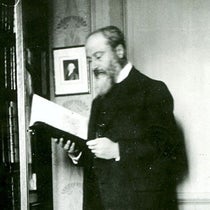
Portrait of Carl Hagenbeck, photogravure frontispiece, Beasts and Men, being Carl Hagenbeck's Experiences for Half a Century among Wild Animals, by Carl Hagenbeck, 1909 (Linda Hall Library)
Hagenbeck built a variety of animal establishments in Hamburg in the late 19th century, but the big step forward came in 1907, when he built Hagenbeck’s Tiergarten, in Stellingen, a suburb of Hamburg. There was already a zoological park in Hamburg, run by the local Zoological Society, but it was very traditional, rather like the zoo attached to the Museum of Natural History in Paris, with the animals kept in isolated buildings.


Title page, Beasts and Men, being Carl Hagenbeck's Experiences for Half a Century among Wild Animals, by Carl Hagenbeck, 1909 (Linda Hall Library)
At his Tiergarten, Hagenbech constructed artificial cliffs and ponds, surrounded by hidden moats, and mixed the animals together, so penguins, seals, and walruses shared the same enclosure, as did lions, tigers, and leopards. Most of the viewing was outdoors, and the surroundings were as natural as possible. Hagenbeck had created, in one giant step, the modern participatory zoo.


Hagenbeck in the lions’ den, Beasts and Men, being Carl Hagenbeck's Experiences for Half a Century among Wild Animals, by Carl Hagenbeck, p. 136, 1909 (Linda Hall Library)
In 1909, Hagenbeck published a biographical adventure book, in which he recounted his life as an animal collector, vendor, and zoo innovator. The English version was called Beasts and Men, being Carl Hagenbeck’s Experiences for Half a century among Wild Animals, and we have a copy in our collections. It is abundantly illustrated, and most of our images here, including the portrait, are from Beasts and Men.


Seals and penguins in Arctic panorama, Beasts and Men, being Carl Hagenbeck's Experiences for Half a Century among Wild Animals, by Carl Hagenbeck, p. 236, 1909 (Linda Hall Library)
As the title suggests, Hagenbeck also put on ethnic displays of human tribes and races, such as Sámi from Lapland, Inuit from Greenland, and Oglala Sioux from South Dakota. Such shows would not be socially acceptable today, but in 1907 they were incredibly popular with the public. In his training of animals, Hagaenbeck was unusually humane for the day, concerned that the animals not be bored by captivity. He also did not take himself too seriously, as indicated by the fleeing animals in the cartoon, “Hagenbeck comes!”, in his book (seventh image).


Ostriches in the snow at Tierpark Hagenbeck, Beasts and Men, being Carl Hagenbeck's Experiences for Half a Century among Wild Animals, by Carl Hagenbeck, p. 204, 1909 (Linda Hall Library)
The Hamburg Zoological Society Zoo closed in 1929, but Hagenbeck’s Tiergarten is still there, not quite as revolutionary as it was six-score years ago, but its legacy lives on in most zoos built since then.


“Hagenbeck comes!”, cartoon in Beasts and Men, being Carl Hagenbeck's Experiences for Half a Century among Wild Animals, by Carl Hagenbeck, p. 64, 1909 (Linda Hall Library)
The two most famous parts of the Tiergarten were the African panorama and the Arctic panorama. A third section that Hagenbeck did not even mention in Beasts and Men was a Dinosaur Park. I learned about this only by accident when I stumbled on a cover story in a 1911 issue of Scientific American, with lots of photographs of reconstructed Triceratops and Iguanodon at Sellingen. We will show you these in a follow-up post in the near future.

Tierpark Hagenbeck, Hamburg-Stellingen, photograph, 2015 (Wikimedia commons)
Hagenbeck died of a snakebite on Apr. 14, 1913, at age 68. He is buried in the Friedhof Hamburg-Ohlsdorf, beneath a sleeping bronze lion in what looks like pastoral plot, a pretty good trick, considering that the Ohlsdorf Cemetery is the largest rural cemetery in the world (last image).


Gravestone of Carl Hagenbeck, Ohlsdorf Cemetery, Hamburg (findagrave.com)
William B. Ashworth, Jr., Consultant for the History of Science, Linda Hall Library and Associate Professor emeritus, Department of History, University of Missouri-Kansas City. Comments or corrections are welcome; please direct to ashworthw@umkc.edu.