Scientist of the Day - Alexander Agassiz

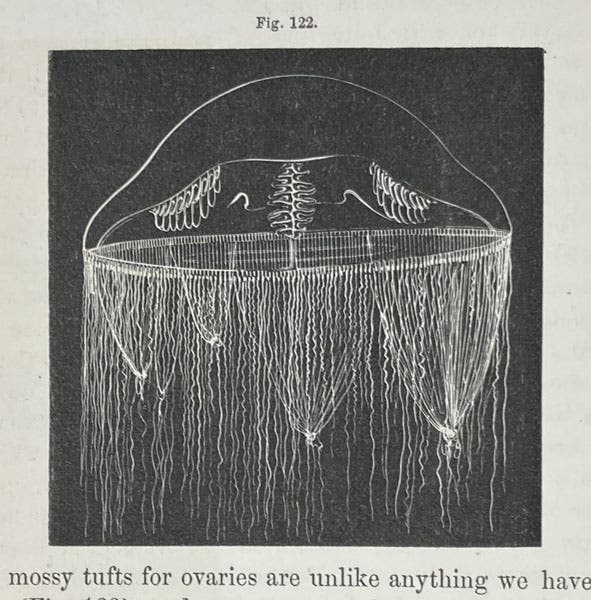
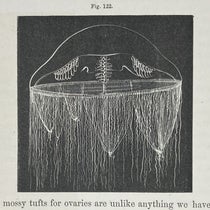
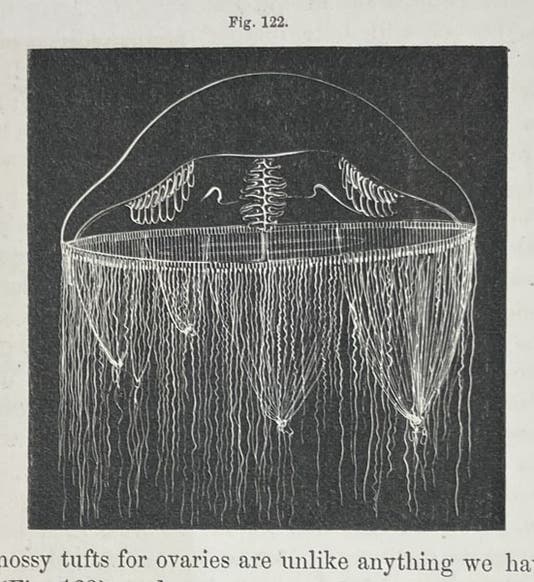
Ptychogena lactea, a jellyfish, drawing by Alexander Agassiz, Seaside Studies in Natural History, by Elizabeth Agassiz and Alexander Agassiz, p. 86, fig. 122, 1865 (Linda Hall Library)
Alexander Agassiz, a Swiss-American zoologist, died Mar. 27, 1910, at age 75. Agassiz was the son of the noted Swiss glaciologist Louis Agassiz, and when Louis moved from Neuchâtel to accept a position at Harvard in 1846, Alexander soon followed, emigrating to the United States at the age of 13. He received several degrees, one in engineering and one in zoology, from the Lawrence Scientific School in Cambridge, Mass., at that time informally affiliated with Harvard, and he would later excel as a marine biologist.

Alexander Agassiz as a younger man, daguerreotype, ca 1865 (Wikimedia commons)
But what made Agassiz different from every other American natural scientist of the period, even his father, is that Alexander got rich. In 1867, he was brought in to straighten out two failing copper mines in Calumet, Michigan, and he proved uncannily good at the job, so that within four years, the mines, now consolidated into the Calumet and Hecla Mining company, were turning out most of the copper produced in the United States, and Alexander was on his way to becoming a multimillionaire. He was president of the company for the rest of his life, and it turned a considerable profit for those 40 years. Some of his income was spent the way rich people often spend money; he bought a forty-acre peninsula in Newport, Rhode Island, on which he built a summer house that still survives and has been transformed into a luxury inn. But most of his income was plowed back into research. He gave a great deal of money to the Museum of Comparative Zoology at Harvard, the institution that had been founded by his father and now carries Louis Agassiz's name. Since his field was invertebrate zoology, Alexander organized oceanographic expeditions with regularity, some of them coastal dredging surveys, others to far-away places like Australia and Peru. He became the world’s leading expert on echinoderms (sea urchins and such), and when the Challenger expedition returned in 1876 with its undersea booty, John Murray, one of the principal expedition scientists, turned over all the echinoderms to Agassiz, who authored the appropriate sea-urchin volumes for the expedition Reports.

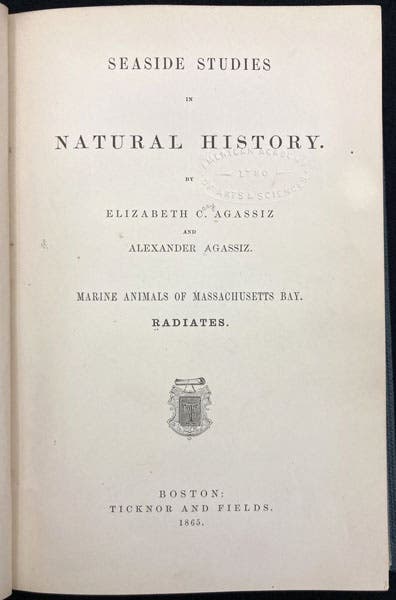
Title page, Seaside Studies in Natural History, by Elizabeth Agassiz and Alexander Agassiz, 1865 (Linda Hall Library)
In 1865, Agassiz published, with Elizabeth Agassiz, a book on marine life, with the general public as intended readera. It was called Seaside Studies in Natural History. Elizabeth was not his wife but his mother, wife of Louis; she wrote the text, and Alexander provided the figures. We have used some of the images to illustrate this post, just because they are so exquisite and charming. You can see several more at our post on Elizabeth.

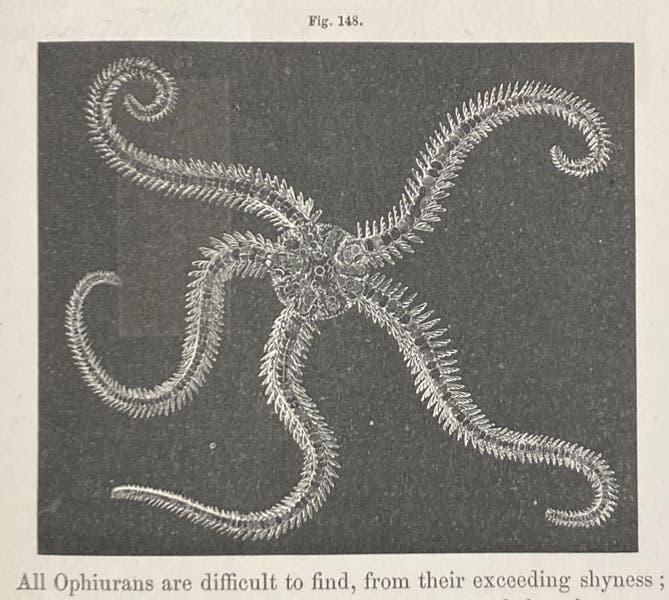
A spotted Ophiopholis, a sea star, drawing by Alexander Agassiz, Seaside Studies in Natural History, by Elizabeth Agassiz and Alexander Agassiz, p. 115, fig. 148, 1865 (Linda Hall Library)
Agassiz is well-remembered at Harvard, where he did more than even his father to establish and enlarge the collections of the Museum of Comparative Zoology. But he is remembered even more fondly in Calumet, Michigan, where a National Historic Site has been established where the mines once stood, and the centerpiece is a fine bronze statue of Alexander (sixth image), designed and executed by Paul Wayland Bartlett, the Rodin student who also did the equestrian monument of Lafayette in Hartford, Connecticut, and a statue of Ben Franklin in Waterbury. The National Park Service website has one of the best accounts of Agassiz's accomplishments with the Calumet and Hecla Mining Company, and a very nice photograph as well:

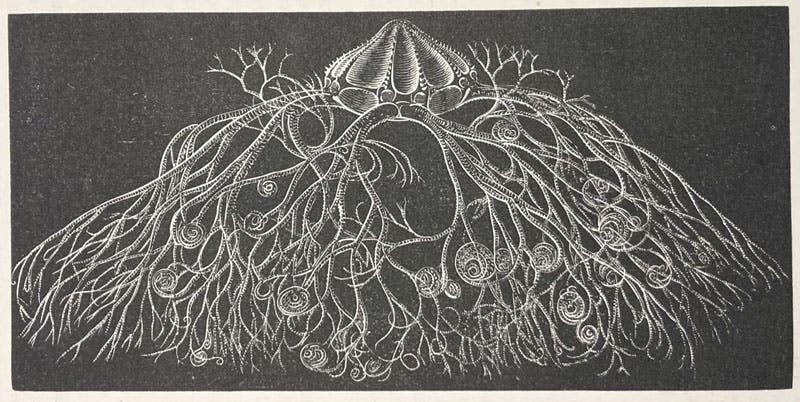
Astophyton, a basket-fish, drawing by Alexander Agassiz, Seaside Studies in Natural History, by Elizabeth Agassiz and Alexander Agassiz, p. 118, fig. 151, 1865 (Linda Hall Library)
Agassiz died peacefully at sea on this day in 1910, on his way back to New York from Europe, and the next year, John Murray, the Challenger zoologist, gave funds to establish the Alexander Agassiz Medal, which is awarded every three years for excellence in oceanography by the National Academy of Sciences, for which Agassiz had served a six-year term as President. The medal was first awarded in 1913 to Johan Hjort, a Norwegian marine biologist. Hjort was a colleague and best friend of Murray, and they wrote an acclaimed book together, The Depths of the Ocean (1912), which we have featured several times, in a post on Hjort, and another on Murray. We are sure that it was just a coincidence that the first Alexander Agassiz medal was given to a good friend of the man who funded the award.

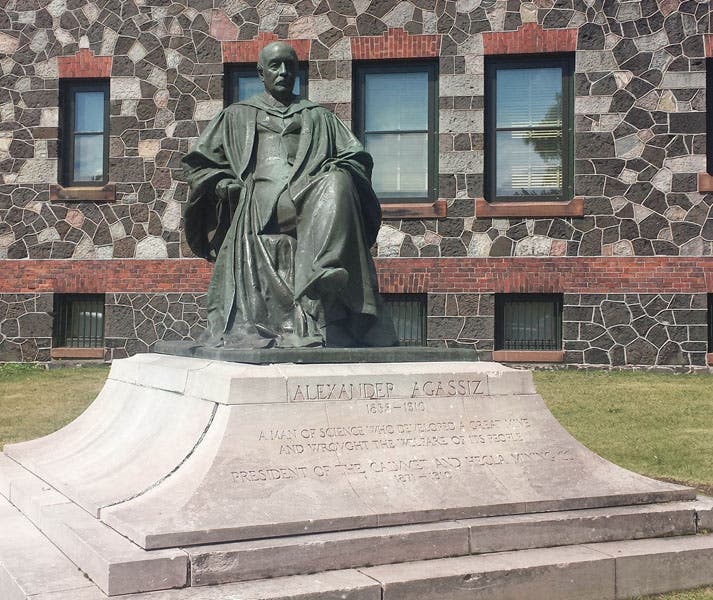
Statue of Alexander Agassiz, bronze sculpture by Paul Wayland Bartlett, Keweenaw National Historical Park, Calumet, Michigan (library.mcz.harvard.edu)
Agassiz was cremated and his ashes were buried at his wife's grave in Forest Hills Cemetery; there is not much to see there, except his incised death date. So we thought we would show you a different kind of memorial. One of the more unusual granfalloons is the set of people who were born when Comet Halley was in the sky, and then died when the comet returned, about 75 years later. It is actually a sizable group, but only a few were celebrities. One was Mark Twain, born in 1835 and dying in 1910. Another was Agassiz. We show you a lovely watercolor in the National Maritime Museum in Greenwich, painted in 1835, when both the comet and Agassiz made their appearances, Agassiz for the first time (last image). There are lots of photos of the 1910 manifestation, but none really appropriate for this occasion.

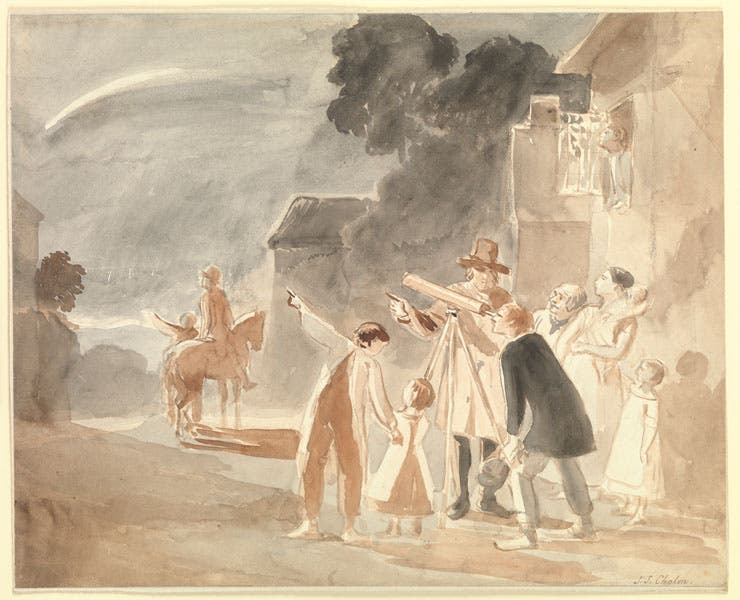
Comet Halley as it appeared in 1835, the year of Alexander Agassiz’s birth, watercolor, National Maritime Museum, Greenwich; Agassiz died in 1910, when Comet Halley next returned (collections.rmg.co.uk)
William B. Ashworth, Jr., Consultant for the History of Science, Linda Hall Library and Associate Professor emeritus, Department of History, University of Missouri-Kansas City. Comments or corrections are welcome; please direct to ashworthw@umkc.edu.