Scientist of the Day - Alexander Mitchell

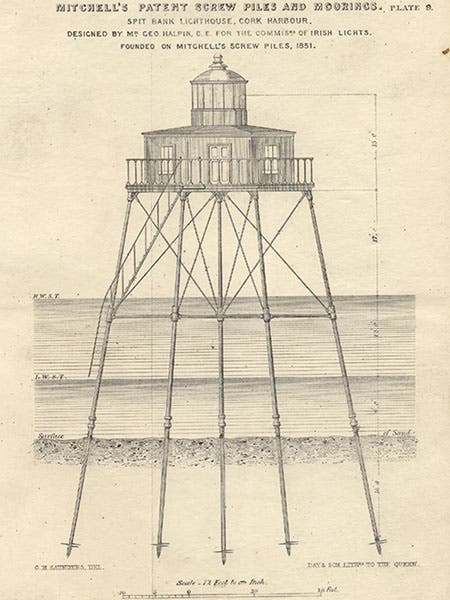
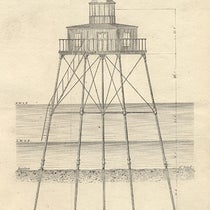
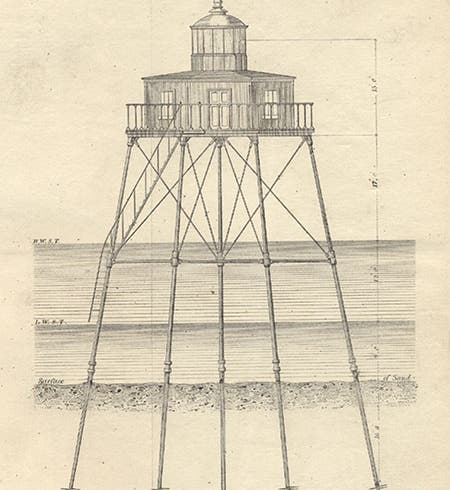
Spit Bank screw-pile lighthouse, erected on Alexander Mitchell’s screw-piles,1851, Cork Harbour, Ireland, elevation diagram (buildingsofireland.ie)
Alexander Mitchell, an Irish engineer, was born in Dublin on Apr. 13, 1780. He was brought up in Belfast, where he attended the Academy and demonstrated natural aptitude in math. Unfortunately, his eyesight began to fail in his youth, and by the time he reached adulthood, Mitchell was totally blind. Nevertheless, he started up a company to manufacture bricks, which was successful, and he married and raised a family.

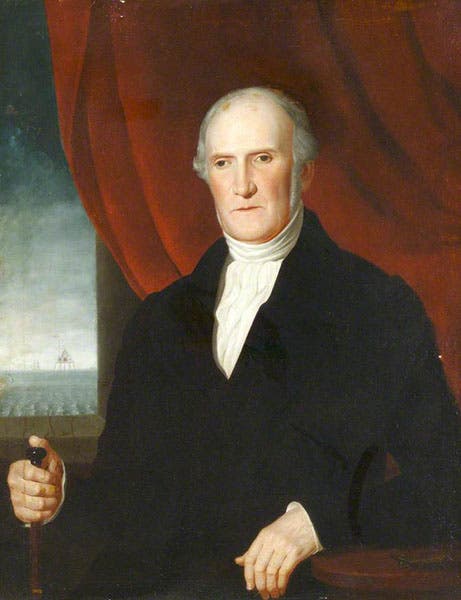
Portrait of Alexander Mitchell, oil on canvas, by Richard Hooke, Belfast Harbour Commissioners (artuk.og)
It was in 1833, when he was 53 years old, that Mitchell had his Great Idea. Until that time, all lighthouses were built of stone and anchored to solid rock. There was no way to build a stone lighthouse in mud or sand, so there was no way to warn ships of mudflats or sandbars. Mitchell wondered whether one might screw piles down into a soft bottom, which could then support a much lighter wooden structure, with a light. He received a patent for his invention in 1833. The Science Museum, London, has Mitchell’s patent models (actually full-size), but they do not show them on their website.

Wyre Light, Fleetwood, Lancashire, screw-pile lighthouse designed and built by Alexander Mitchell, begun in 1839, first light in June 1840, elevation drawing with coloring added later (Wikimedia commons)
In 1838, Mitchell received a contract to construct a screw-pile lighthouse at Maplin Sands at the mouth of the Thames estuary, and soon another, the Wyre Light, was being built off the west coast of Lancashire. Construction was fairly simple. A barge or raft was anchored over the desired location, a long iron rod with a wide screw-flange at the bottom was inserted through a hole in the barge, and 4 to 8 men turned a capstan and screwed the pile into the mud or sand until it was solidly held. Usually 6 to 8 six such rods, placed at the points of a hexagon or octagon, were screwed in, and then a final pile was inserted vertically right in the center. On these piles, a light wooden "cottage" was built, well above high tide, with a cupola for the light on top. Surprisingly, these flimsy-looking structures rode out storms better than heavy lighthouses, because the supporting rods were no impediment to the waves.

Spit Bank screw-pile lighthouse, Cork Harbour, Ireland, one of three surviving Alexander Mitchell screw-pile cottages, recent photograph (Wikimedia commons)
Soon, screw-pile lighthouses were everywhere, especially in the United States, where areas like Chesapeake Bay needed lighthouses but had no rocky islands to support conventional stone towers. The screw-pile lighthouse was just the thing, and hundreds were built.
It is said that three original Mitchell screw-pile structures survive, of which one is the Spit Bank Light in Cork Harbour, Ireland. We show both a contemporary diagram (first image) and a more recent photograph (fourth image)
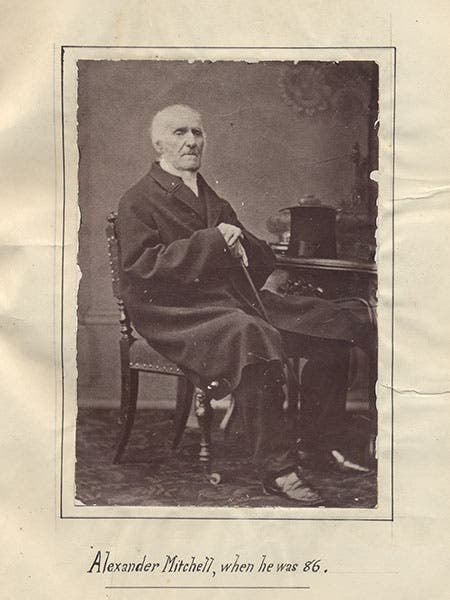
Portrait of Alexander Mitchell, photograph as age 86, las yea of his life (buildingsofireland.ie)
In spite of his infirmity, or perhaps because of it, Mitchell lived to the considerable age of 88, passing away on June 25, 1868. A photograph survives of Mitchell in his last year of life (fifth image)
William B. Ashworth, Jr., Consultant for the History of Science, Linda Hall Library and Associate Professor emeritus, Department of History, University of Missouri-Kansas City. Comments or corrections are welcome; please direct to ashworthw@umkc.edu.