Scientist of the Day - Basil Brown

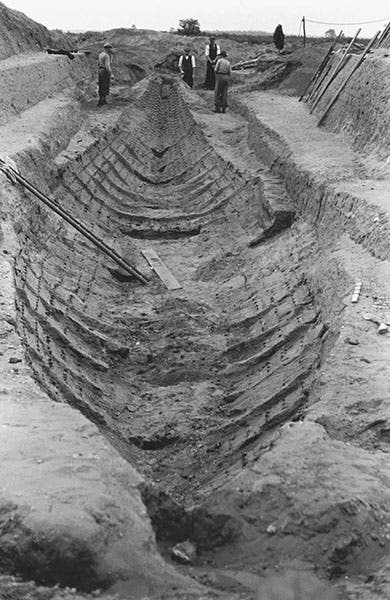
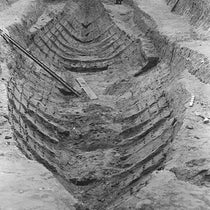
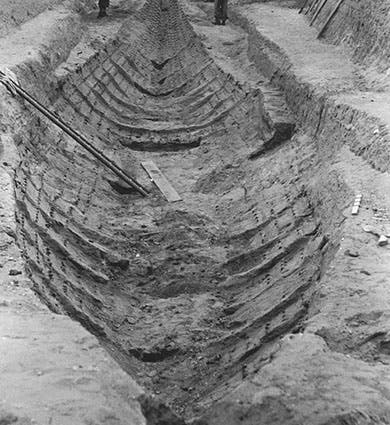
Impression of the excavated ship at Sutton Hoo, Suffolk, photograph, 1939, British Museum (britishmuseum.org)
Basil J.W. Brown, an English amateur archaeologist, was born on Jan. 22, 1888, in Bucklesham, Suffolk, a few miles east of Ipswich. He grew up on the family farm in Rickinghall, also in Suffolk. He attended school until he was twelve, then left to work on the farm.
Brown had a remarkable capacity for self-education. He took all sorts of correspondence courses and taught himself a variety of subjects, such as astronomy, aided by a small library he inherited from his grandfather. He even learned Latin and French.

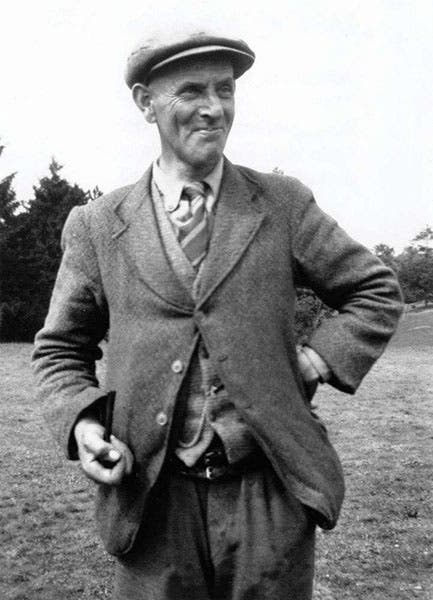
Portrait of Basil Brown, photograph, undated (minervamagazine.com)
Brown began digging things up when he was quite young, a natural thing for a curious boy to do who lived in an area rich with barrows and graves that went back to Viking and Saxon times. He worked frequently as an excavator for the Ipswich Museum and got to know the director there, and as the farm grew less and less profitable, he spent more time on digs. So when a local landowner, Edith Pretty, came to the Ipswich Museum in 1938, wanting to hire someone to investigate some of the 18 burial mounds on her estate at Sutton Hoo in Woodbridge, Brown was recommended. He started work in June of 1838, and the first mound he trenched was revealed to be a burial site, although looted long ago. He investigated 2 other mounds; both proved to be looted burial mounds, one a half-ship burial. No graves or artifacts were found, except for one battle-axe.

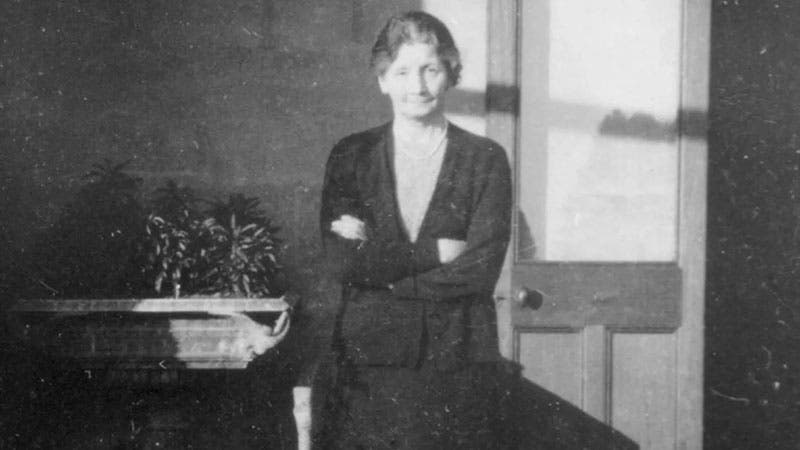
Edith Pretty, owner of the Sutton Hoo estate, undated photograph (bbc.com)
After two months at Sutton Hoo, Brown returned to his Ipswich archaeological work, but he returned to Sutton Hoo in June of 1939 and began work on the big mound. He found rivets in outlying trenches, evidence of a ship burial, and soon he and his helpers had uncovered the impression of an 87-foot ship in the soil. At this point, other institutions, such as the British Museum and the Cambridge Museum of Archaeology became interested, and before long they took over the investigation, although Brown was allowed to assist. It was Brown who discovered the burial chamber, which had escaped the attention of looters, and which contained the well-known Sutton-Hoo helmet. Later that summer, a hearing determined that everything unearthed at Sutton Hoo belonged to Edith Pretty. She subsequently gave it all to the British Museum, where many of the artifacts are on display.

Helmet from the Sutton Hoo ship burial, dating to ca 625 CE, British Museum (Wikimedia commons)
Basil Brown's discovery at Sutton Hoo is one of the most important archaeological finds ever made on English soil. It is now known to be the burial of a Saxon king, dating to about 625 CE, which is well before Viking times. Brown continued to work as an assistant for the Ipswich Museum and made many other significant finds before he retired in 1965. He died on Mar. 12, 1977, and was cremated in Ipswich. There is a small memorial plaque in the Rickinghall Chuch. In 2023, a blue plaque was placed on the house in Rickinghall where he lived for 42 years (sixth image).
.JPG#/media/File:Sutton_hoo_(1).JPG)
Purse lid from the Sutton Hoo ship-burial, British Museum (Wikimedia commons)
In 2021, Brown, Mrs. Pretty, and Sutton Hoo were the subject of a film, The Dig. Brown was played by Ralph Fiennes, who, not surprisingly, did a masterful job of portraying the diffident yet competent self-trained digger. Edith Pretty was played by Carey Mulligan, and while the film has a bit of an "us against the establishment" air about it, it is still excellent by any measure, especially with its recreation of the excavated ship. The movie was based on a book of the same title by John Preston (2007); I have seen the film several times, but I have not read the book. The movie at the time of this writing is being featured on Netflix.

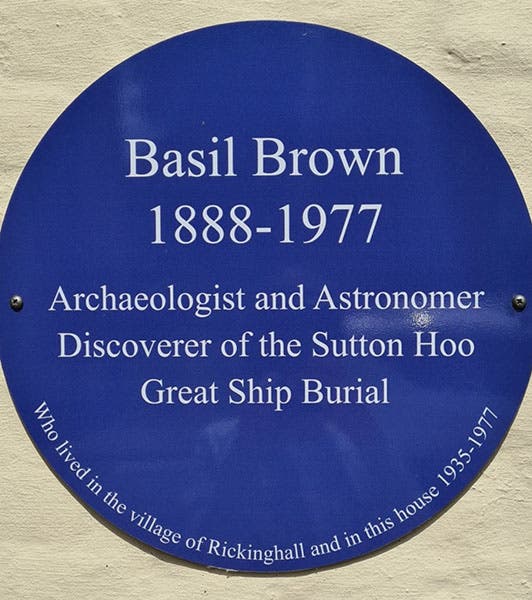
Blue plaque honoring Basil Brown on the house in Rickinghall where he lived for 42 years (mainlymuseums.com)
In 1978, when I began to consult for the Library, my first task was to evaluate the Honeyman Collection, coming up for auction that fall. Honeyman owned a number of star atlases, and since the Library already had a few of those, we decided to try to acquire some more. I looked for reference works and found only one: Astronomical Atlases, Maps & Charts: An Historical & General Guide, by Basil Brown (1932; seventh image). It was the most God-awful reference book I had ever encountered, filled with information, but with no organization, no index, next-to-no bibliographical data, and no identification of copies used. I never connected that Basil Brown with the Sutton Hoo Basil Brown until this year, but they were one and the same, and now it all makes sense. In 1932, 6 years before Sutton Hoo, Brown was an avid astronomer with a small library, probably including some star atlases, but he was untrained in and unfamiliar with bibliography and the techniques of describing books as objects. He noticed a void in the literature, and tried to fill it, as best he could. I am amazed that he, given his background, managed to write (and get published) such a book at all.

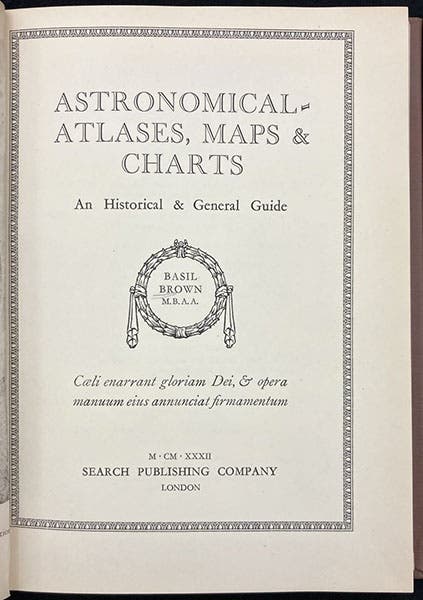
Title page, Astronomical Atlases, Maps & Charts: An Historical & General Guide, by Basil Brown, 1932 (Linda Hall Library)
Fortunately, the very next year, Deborah Warner published The Sky Explored: Celestial Cartography, 1500-1800 (1979), and we now had the reference book we needed for the remaining Honeyman sales. I notice that Ms. Warner did not mention Brown's book at all, not once, even though it was the only precedent to her own. I assume she preferred silence to criticism, which was, I think, the right choice.
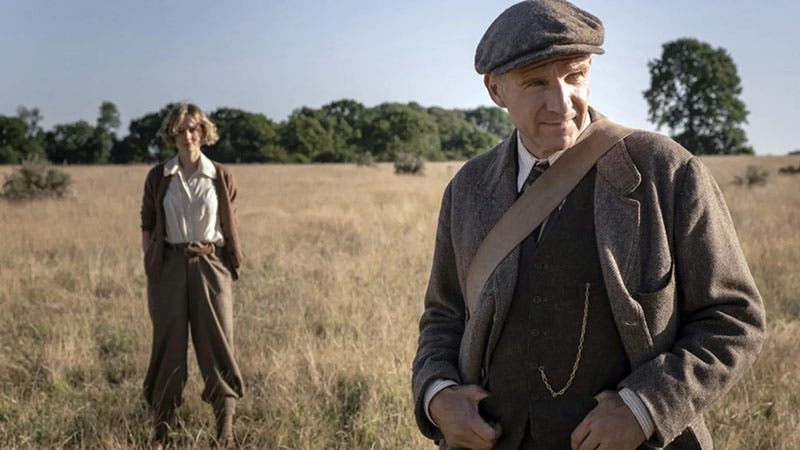
Ralph Fiennes as Basil Brown and Carey Mulligan as Edith Pretty, still from the film The Dig (2021) (bbc.com)
Basil Brown is one of the great folk heroes of Suffolk, as is Edith Pretty, who stood by her digger when the academics wanted to replace him. He is now held in high esteem by archaeologists as well, especially those around Ipswich, as the recent blue plaque indicates. I am so glad that Ralph Fiennes was chosen to play him in The Dig. He brought a humble dignity to the role that seems to characterize Basil Brown in just the right way. And Carey Mulligan helped a great deal in making that work. Please see the film. And do visit the British Museum to see what Basil Brown gave us.
William B. Ashworth, Jr., Consultant for the History of Science, Linda Hall Library and Associate Professor emeritus, Department of History, University of Missouri-Kansas City. Comments or corrections are welcome; please direct to ashworthw@umkc.edu.