

Scientist of the Day - Clifton Suspension Bridge

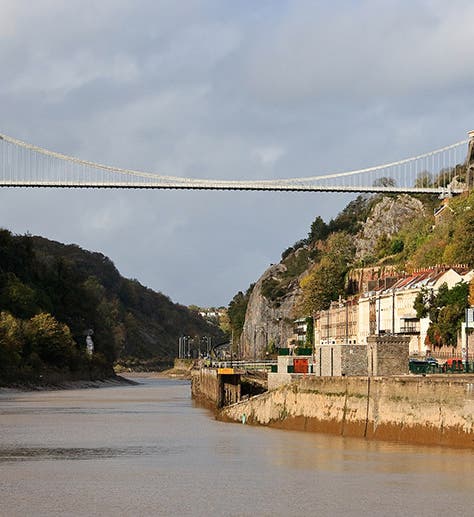
View of the Clifton Suspension Bridge over the River Avon, Bristol, based on a design by Isambard Kingdom Brunel, opened for traffic on Dec. 8, 1864, modem photograph (Wikimedia commons)
The Clifton Suspension Bridge, one of England's most scenic spans, opened for traffic on Dec. 8, 1864. It crosses the River Avon at Avon Gorge in Bristol, connecting Clinton on the east bank to Leigh Woods in North Somerset on the west bank.

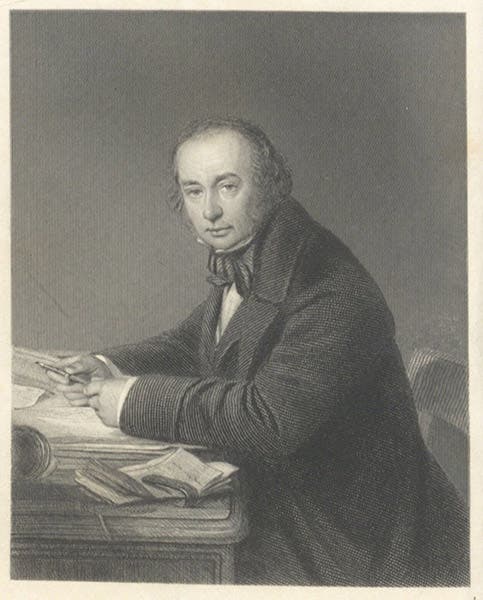
Portrait of Isambard Kingdom Brunel, engraving by Thomas Oldham Barlow after painting by John Callcott Horsley, frontispiece to The Life of Isambard Kingdom Brunel, Civil Engineer, by Isambard Brunel, Jr., 1870 (Linda Hall Library)
The bridge was a long time coming. A wealthy Bristol native left £1000 to the city in the 1750s, requesting that it be invested, and that when it had grown enough to pay for a bridge, that they build one. That time came in 1829, when the fund had grown eightfold, and a call went out for bids. Young Isambard Kingdom Brunel, recently recovered from a serious accident while building the Thames Tunnel for his father, submitted four bids for a single span suspension bridge at four different locations along the gorge.

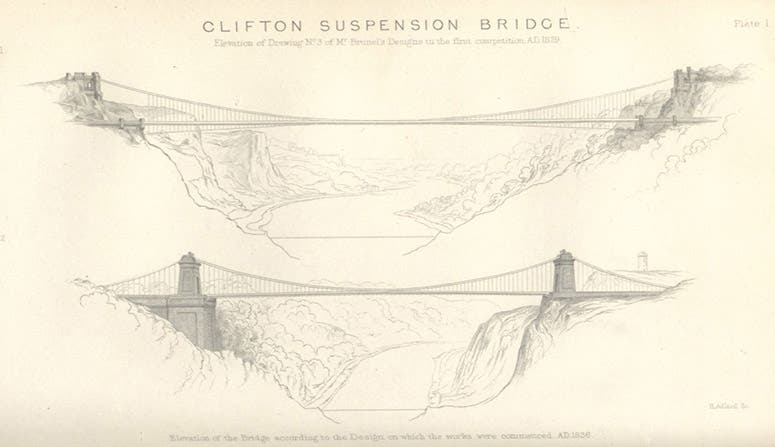
One of Isambard Kingdom Brunel’s initial designs for a suspension bridge over the Avon Gorge (top), and his final design of 1836 (bottom), engraving in The Life of Isambard Kingdom Brunel, Civil Engineer, by Isambard Brunel, Jr., plate 1, p. 49, 1870 (Linda Hall Library)
His favorite was one that had no towers, with the suspension chains coming right out of the bluffs (top figure in third image). His proposals passed the initial cuts, but then the committee brought in Thomas Telford as referee, and Telford didn't like any of the proposals, declaring that a single span in excess of 600 feet was unsound. He in turn proposed a bridge with two stone piers along the riverbanks. So the selection committee sent out another request for bids, with new referees. Telford's bid was deemed too expensive, and they came back to a revised design by Brunel. More funds were raised, and construction of towers began in 1836. Iron bars for chains were ordered and forged. But the project ran out of money, the work slowed, and finally the time limit in Parliament’s authorizing Act ran out. The unused ironwork was sold and used on the Royal Albert Bridge (also designed and erected by Brunel; you can see it in our first post on Brunel), and then Brunel died in 1859, only 53 years old, worn out by incessant work.

The towers and abutments of the unfinished Clifton Suspension Bridge over Avon Gorge, Bristol, lithographed print, ca 1840, Yale Center for British Art (Wikimedia commons)
After his death, Brunel's colleagues at the Institution for Civil Engineering decided that Brunel needed a memorial, and that completing the Clifton Bridge would be just the thing. This time subscriptions were more easily forthcoming, and the new engineers were able to save a considerable amount by reusing the suspension chains from the Hungerford pedestrian suspension bridge over the Thames, which was being demolished to make way for a new railroad bridge (and which had also been designed and built by Brunel). The Clifton Suspension Bridge was formally opened on Dec. 8, 1864, with great celebration. A plaque was placed on one of the towers honoring Brunel (sixth image).

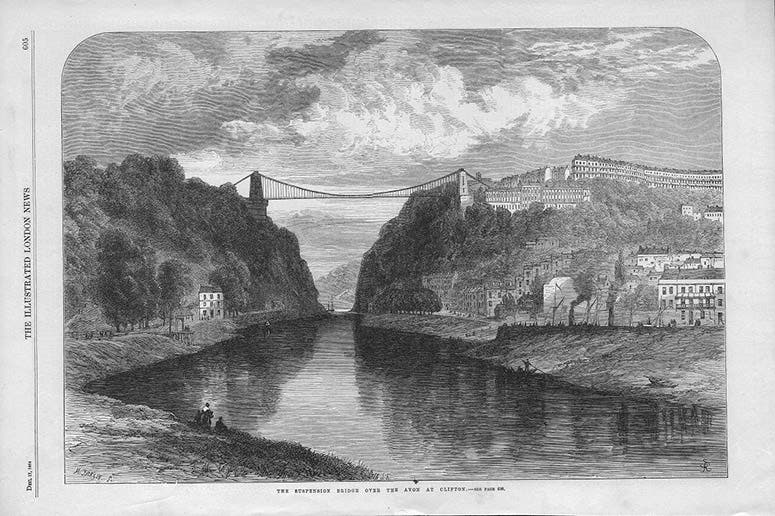
View of the Clifton Suspension Bridge over the River Avon, Bristol, wood engraving, Illustrated London News, Dec. 17, 1864, print for sale at Frontispiece Ltd (mapsandantiqueprints.com)
The Clifton Suspension Bridge has a deck that soars 245 feet above the river, making it a scenic wonder when viewed from either direction. Brunel had intended, back in 1830, that the towers and abutments be decorated in the new Egyptian style, mimicking the pylons at Philae and Karnak, but with scenes of the building of the bridge carved on its sides. That would have been interesting, but that part of Brunei's design was discarded, and much else was changed. One innovation the new engineers kept was Brunel's idea of placing moveable "saddles" for the suspension chains atop each tower that could roll a few inches east or west, which, if the load were unbalanced, would prevent lateral pull on the towers and keep the load vertical. This has worked well in the 160 years since the bridge was opened. I think the original saddles are still in place.

Plaque on the Clifton Suspension Bridge, Bristol, honoring Isambard Kingdom Brunel (Wikimedia commons)
The bridge today is the pride of Bristol and its number one tourist attraction. On its last flight on Nov. 26, 2003, Concorde made a planned detour to pay homage to the bridge, an engineering marvel from another century. A photograph is posted on the website of the Clifton Bridge Trust (last image).
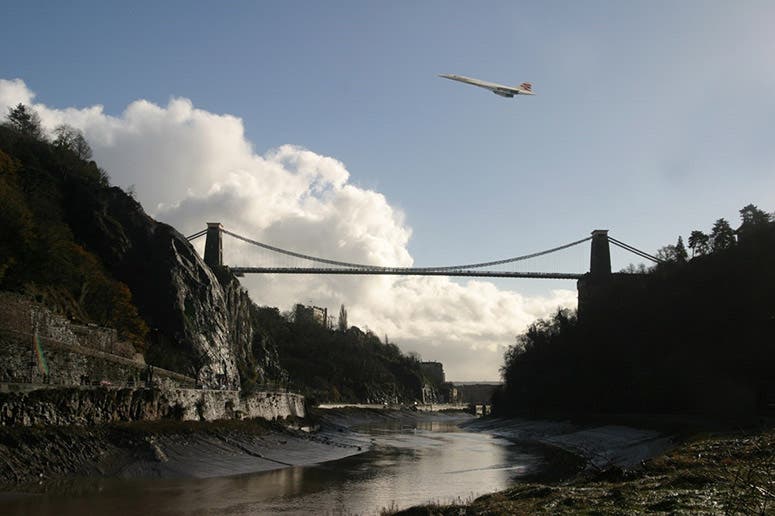
Concorde in a fly-by salute to the Clifton Suspension Bridge on its final flight, Nov. 26, 2003 (cliftonbridge.org.uk)
Brunel's son, Isambard Jr., published a biography of his father, The Life of Isambard Kingdom Brunel, Civil Engineer (1870) that we have in our library, which has a chapter on the long gestation of the Clifton Bridge, and which provided two of our illustrations.
William B. Ashworth, Jr., Consultant for the History of Science, Linda Hall Library and Associate Professor emeritus, Department of History, University of Missouri-Kansas City. Comments or corrections are welcome; please direct to ashworthw@umkc.edu.


