Scientist of the Day - Georgy Flyorov

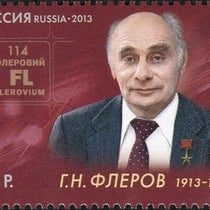
Portrait of Georgy Flyorov on a postage stamp issued in Russia on the centennial of his birth, 2013 (Wikimedia commons)
Georgy Flyorov, a Soviet physicist, was born Mar. 2, 1913, in Rostov-on-Don, just north of the Black Sea. His first name is sometimes written as Georgii, and his last as Flerov. I prefer Georgy Flyorov. He attended the Leningrad Technical Institute and was working at the Ioffe Institute in Leningrad when Otto Hahn announced the discovery of the fission of uranium in 1939, which more or less determined the course of Flyorov's career.

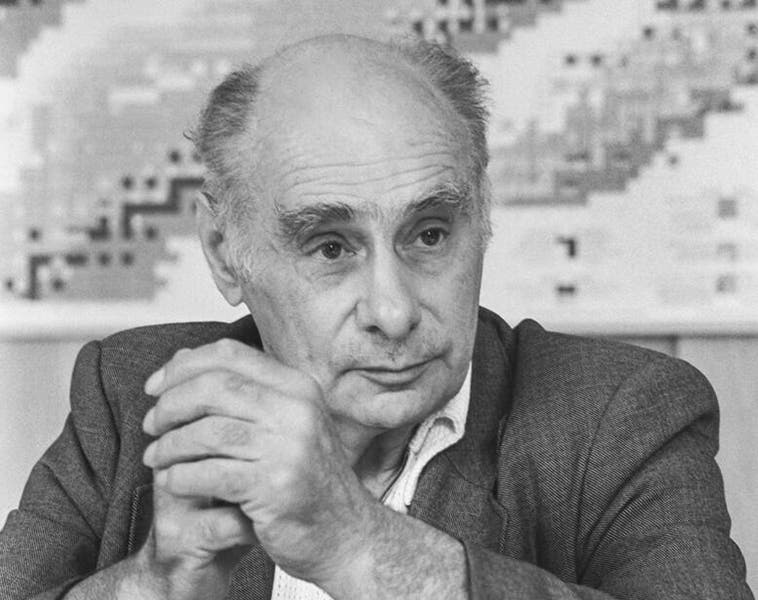
Georgy Flyorov, photograph, undated, Joint Institute of Nuclear Research (jinr.ru)
A uranium atom fissions when it is struck by a slow neutron. In 1940, Flyorov discovered that sometimes a heavy atom just splits spontaneously, without absorbing a neutron. Spontaneous fission is impossible to predict for a specific atom, but it is easy to make probabilistic predictions for groups of atoms. Flyorov was the first in East or West to observe spontaneous fission.
In 1942, Flyorov came to another conclusion, this one exceedingly clever, almost Holmesian. As the Soviet Union's newest expert on nuclear fission, he wanted to keep abreast of current scholarship, and he scoured the relevant journals, such as Physical Review Letters, for articles on fission. He found that no one in England, the United States, or Germany had published anything on the subject in two years! That seemed very suspicious – the silence was indeed deafening – so in 1942, Flyorov wrote a letter directly to Josef Stalin, arguing that both the Germans and the Anglo-Americans must be working on a fission bomb, and suggesting to Stalin that the Soviet Union needed to set up a bomb program of their own. Which Stalin promptly did.

The entrance to the Joint Institute of Nuclear Research, in Dubna, where Georgy Flyorov founded his Laboratory for Nuclear Reactions (Wikimedia commons).
After the war, Flyorov continued to work in nuclear science, and he founded a laboratory in Dubna, north of Moscow, that became part of the Joint Institute for Nuclear Research (JINR); his lab was named the Flyorov Laboratory for Nuclear Reactions, and he was its director until 1989. The office he had there has been preserved just as it was on the day he died in 1990, with a copy of his letter to Stalin on his desk. There ought to be a photo of that floating around on the internet; perhaps one of you can find it.

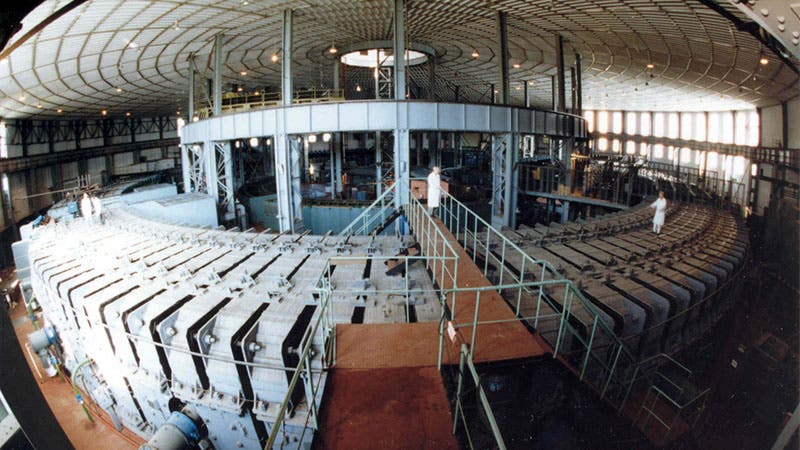
Synchrotron accelerator at JINR, Dubna, where they continue to search for transuranic elements like flerovium and dubnium (interactions.org)
Flyorov spent much of his later career in his laboratory in Dubna, trying to produce what are called transuranic elements – those more massive than uranium, or with an atomic number higher than 92 – and claimed to have done so twice, with elements 106 and 107. However, his claims were after the fact, and these elements had already been named seaborgium and bohrium, respectively, after western physicists. When controversy arose over element 102, which the Swedes had named nobelium, without really having the right to do so, there was some inclination to rename it flerovium, after the lab where element 102 was first detected, but that never came to pass. Finally, in 2012, the transuranic element 114, discovered in Dubna in 1999, was officially named flerovium. Technically, it is named after the lab, not the man, but still, it would seem Flyorov finally has an element to his name. And he is probably pleased, beyond the grave, that the last five transuranic elements, 114-118, have all been discovered at the lab that he founded in 1956.
William B. Ashworth, Jr., Consultant for the History of Science, Linda Hall Library and Associate Professor emeritus, Department of History, University of Missouri-Kansas City. Comments or corrections are welcome; please direct to ashworthw@umkc.edu.