

Scientist of the Day - Harry Govier Seeley

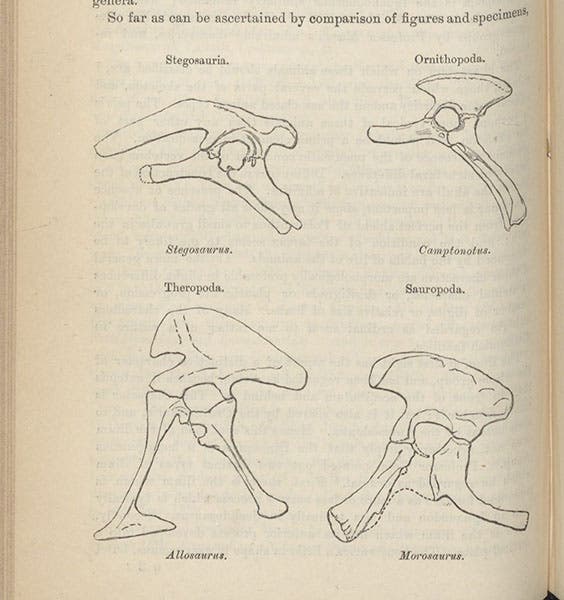
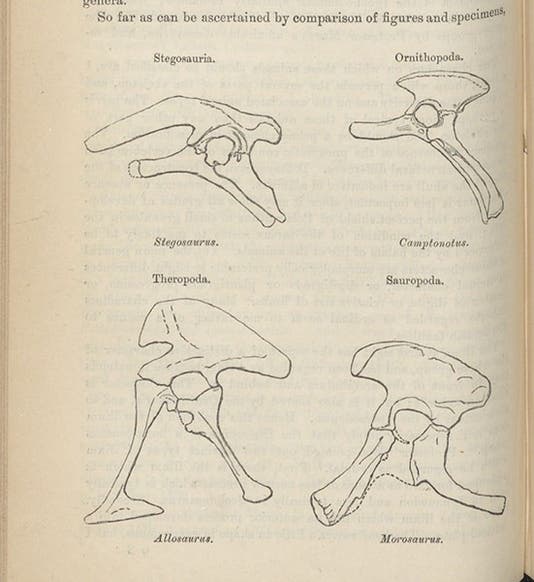
Diagram showing the pelvic structure of two new proposed orders of dinosaurs: Ornithischia (top) and Saurischia (bottom), "On the Classification of the Fossil Animals commonly named Dinosauria,” by Harry Govier Seeley, Proceedings of the Royal Society of London, vol. 43, p. 168, 1888 (Linda Hall Library)
Harry Govier Seeley, an English geologist and paleontologist, died Jan. 8, 1909, at the age of 69. He was born in 1839, 15 years after William Buckland announced the discovery of Megalosaurus, the first recognized dinosaur. When Seeley himself was 15, Benjamin Waterhouse Hawkins unveiled the first life-sized reconstructions of Megalosaurus and the other two known dinosaurs at the Crystal Palace grounds in Sydenham. We frame his birth this way, because Seeley would become a recognized authority on dinosaurs.

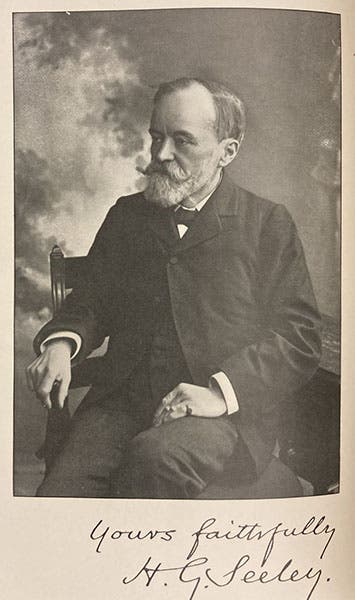
Portrait of Harry Govier Seeley, photograph, undated, in Geological Magazine, dec. 5, vol. 4, plate 12, p. 241, 1907 (Linda Hall Library)
Seeley studied geology and paleontology with Thomas Henry Huxley and was offered several academic positions, but he turned them all down. He didn’t need to earn a living, and he apparently preferred to be master of his own research program. Later in life, he did accept a professorship at King’s College, London.
By the 1880s, many new kinds of dinosaurs had been discovered, mostly in the American west, including Stegosaurus, Brontosaurus, and Triceratops, which meant that paleontologists were now trying to sort them into orders, suborders, and families. Huxley had done so, as had the American Edward D. Cope, and his bitter enemy, Othniel C. Marsh. Their schemes were all different, and all were wrong.

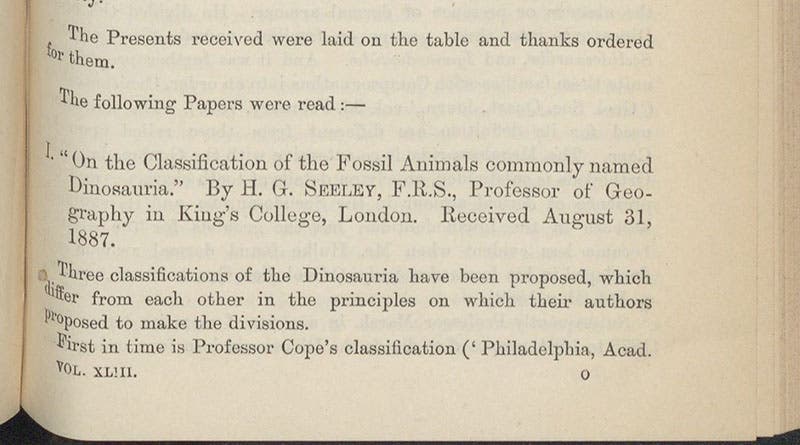
Title and first sentence of a classic paper in dinosaur taxonomy, "On the Classification of the Fossil Animals commonly named Dinosauria,” by Harry Govier Seeley, Proceedings of the Royal Society of London, vol. 43, p. 165, 1888 (Linda Hall Library)
The man who got it right was Seeley. Rather than focusing on foot structure or teeth, which worked well for mammals, he looked at the pelvic structure of all known dinosaurs, and he saw two fundamentally different types. The theropods and sauropods, different though they were in other aspects, both had a simple pubic bone that jutted forward. The ornithopods (Iguanodon) and the horned, plated, and armored dinosaurs all had a two-part pubis, which exended both forward and back, like modern birds. Seeley called the dinosaurs with a bird-like pelvis, Ornithischia, and the other group, the lizard-hipped ones, he called Saurischia. In the figure he published with his paper of 1888 (first image), the Ornithschia are at the top and the Saurischia at the bottom. He considered them both to be orders.

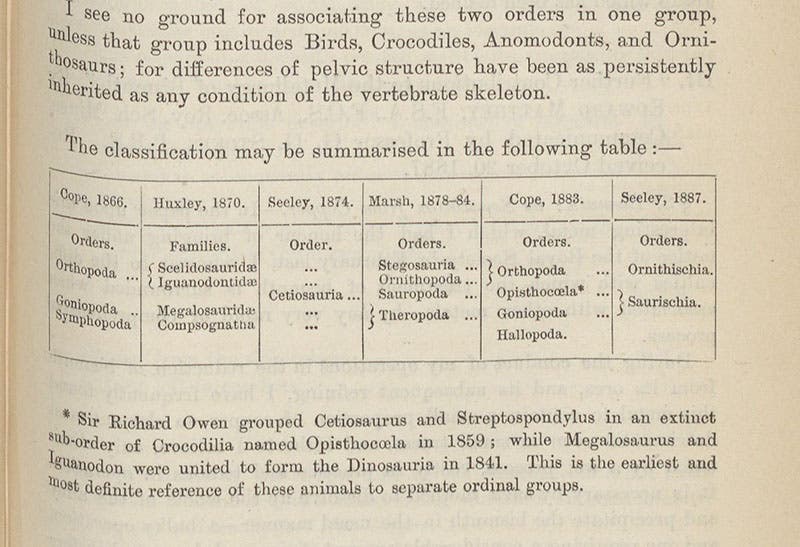
Table comparing suggested dinosaur orders by T.H. Huxley, O.C. Mash, E.D. Cope, and H.C. Seeley, "On the Classification of the Fossil Animals commonly named Dinosauria,” by Harry Govier Seeley, Proceedings of the Royal Society of London, vol. 43, p. 171, 1888 (Linda Hall Library)
This meant that the term dinosaur was a false grouping, lumping together two rather different types of prehistoric reptiles. If you were going to include them both in one group, you should really also throw in crocodilians, pterosaurs, and birds, since they all likely shared a common early Triassic ancestor. Our view of dinosaur taxonomy hasn’t changed much since Seeley.
We displayed Seeley’s 1888 paper as item 20 in our 1996 exhibition, Paper Dinosaurs, which was accompanied by a printed catalog. The online version was recently revamped by Rebeca Escamilla, adding links to sources, so that if you look at the page on Seeley, and click on “View Source” below the image, you will be taken to an online scan of the paper, which you can read in its entirety, if you like.

Detail of the headstone of Harry Govier Seeley, Brookwood Cemetery, Surrey (Wikimedia commons)
Seeley later wrote a widely-read book on pterosaurs, called Dragons of the Air, an Account of Extinct Flying Reptiles (1901), which we have in our collections, and which might be the subject of a future post. He was buried in the well-populated Brookwood Cemetery in Surrey. There is a photo of his monument from a distance on findagave.com, but I thought a detail of the inscription might be more interesting (last image).
It is hard to find a good photograph of a younger Seeley. There is a nice one on Wikipedia, but it is unattributed. We use instead a photograph of an older Seeley, published in Geological Magazine in 1907 (second image).
William B. Ashworth, Jr., Consultant for the History of Science, Linda Hall Library and Associate Professor emeritus, Department of History, University of Missouri-Kansas City. Comments or corrections are welcome; please direct to ashworthw@umkc.edu.


