Scientist of the Day - Henri Frankfort

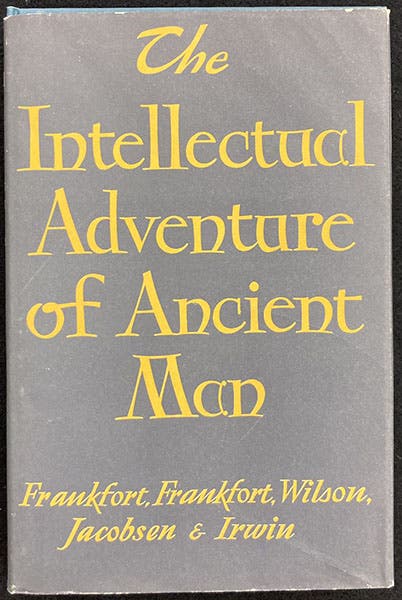
Dust jacket, The Intellectual Adventure of Ancient Man: An Essay on Speculative Thought in the Ancient Near East, by Henri Frankfort, H.A. Goenewegen Frankfort, et al., Univ. of Chicago Press, 1946 (author’s copy)
Henri Frankfort, a Dutch archaeologist and orientalist, was born Feb. 24, 1897, in Amsterdam. He met his future wife, Henriette Groenewegen, while studying archaeology in Amsterdam, and the two married and moved to London, where Henri pursued his PhD under Flinders Petrie at the University of London. The couple, who worked together professionally, was known as Hans and Jettie.
They did field work for the next two decades in Egypt and the Near East, working for the Egypt Exploration Society of London and the Oriental Institute of Chicago. But we are going to leap ahead to a book that the Frankforts published just after World War II, in 1946, called The Intellectual Adventure of Ancient Man: An Essay on Speculative Thought in the Ancient Near East, for which they were the lead authors. It played a formidable role in my own graduate education in the history of science.

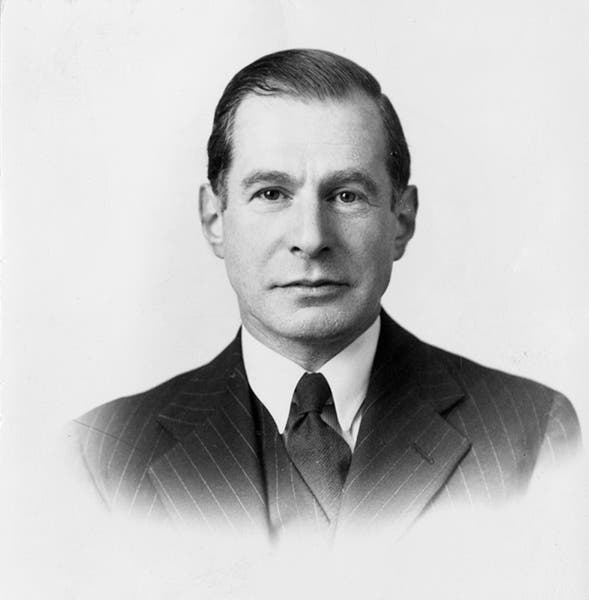
Portrait of Henri Frankfort, photograph, undated, Univ. of Chicago Photo Archive (photoarchive.lib.uchicago.edu)
The big question in considering the origin of western science has always been: why the Greeks? Civilizations in Egypt and Mesopotamia developed sophisticated mathematical tools a thousand years before the Greeks, and were asking questions about the origins of things just as early. Why were their inquiries unfruitful?
Frankfort argued that the difference lay in worldviews. Most primitive cultures have a worldview that Frankfort called mythopoeic (I believe he coined the term), whereby everything in Nature is personified. So a storm is not an abstract thing, but a personalized entity, which acts for irrational reasons, if that term makes sense, and can be angry and vengeful, or even sleepy and sarcastic. With such a worldview, when you ask questions about the origin of things, you ask: who were the creator gods, what did they represent, why did they do what they did. The Babylonians believed that the world arose from water, personified by a saltwater god, a freshwater god, and a god of the mist, and these primordial gods had children, gods of magic and the storm, and their answers to questions about origins produced a elaborate mythology, described in the Enuma Elish. There was nothing rational about it, because personalities are seldom rational.
The Greeks, argued Frankfort, had the advantage of following an intervening culture, the Hebrews, who were not only monotheistic, but who took God right out of Nature and set him above the world. There was no talk of personified natural forces in the Torah.
Whether they followed the example of the Hebrews or not, when Ionian Greeks like Thales and Anaximander started asking questions about the origin of things around 600 BCE, they had already rejected a mythopoeic world view and were asking different kinds of questions: what is the fundamental stuff out of which everything is made; how did that one kind of matter become earth, water, air, and fire; what are the forces that moves things around? “What” and “how” questions produce a completely different set of answers, and a different worldview, than the “who” and “why” questions of the Babylonians. Thales too believed that the world arose from a watery chaos. But that water was just a form of matter, not a squabbling trio of deities.
I learned from the Frankforts that the questions you ask often determine the kinds of answers you will get. In order to discover inertia, as Galileo did, you have to ask, what keeps an object going when a force is removed, a question no one else was asking at the time, because no one thought an object could keep going without a force. Galileo asked a new kind of question, and constructed a new worldview in consequence.
I do not know what present-day scholars of mythology think of the Frankforts’ book. Probably not much – it is a little simplistic to think that cultures are either mythopoeic or rational, and nothing in between. I, a rational being (I like to think), have cursed enough inanimate objects to know how easily a thing can be personified, especially when it is misbehaving. But the Presocratic Greeks did look at Nature differently, and asked new questions, and created theories of matter that would have been unfathomable to the Babylonians. Perhaps it was indeed their rejection of a personified Nature that led them in this new direction, and forever changed the world.
William B. Ashworth, Jr., Consultant for the History of Science, Linda Hall Library and Associate Professor emeritus, Department of History, University of Missouri-Kansas City. Comments or corrections are welcome; please direct to ashworthw@umkc.edu.