Scientist of the Day - Isaac Newton

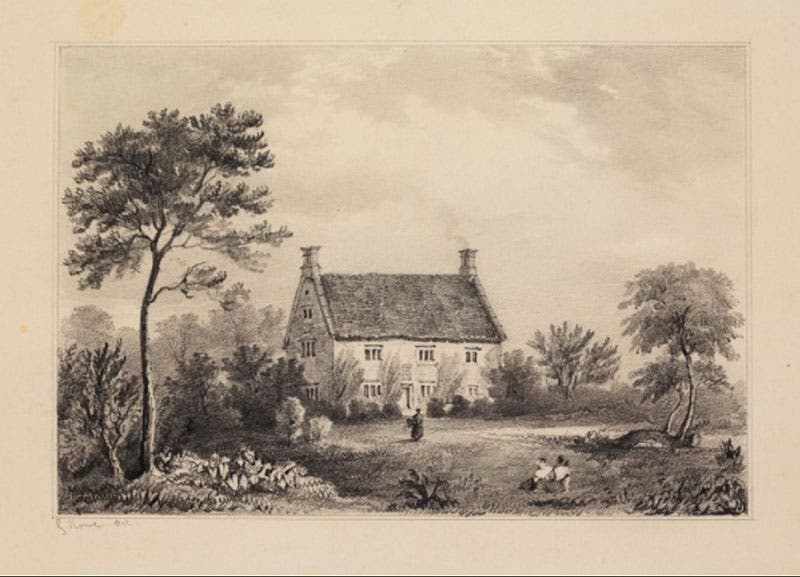
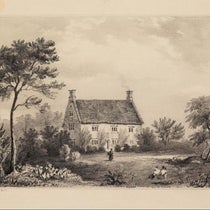
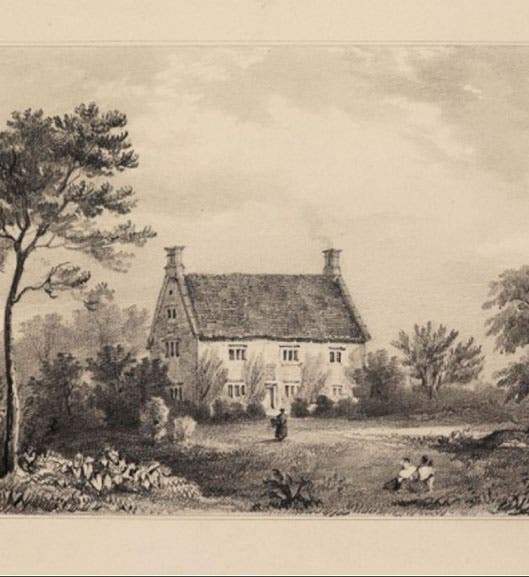
The manor-house of Isaac Newton at Woolsthorpe, with the apple tree fallen and regrowing at right, drawing by Geoge Rowe, 19th-century, Royal Society of London archives (royalsociety.org)
Isaac Newton, England's best- known mathematician and physicist (and alchemist), died on Mar. 31, 1727, in London, at the age of 84. We have written one general introductory post on Newton, one on his "crucial experiment " with a prism in 1667, and one on his letter to Robert Hooke, in which he claimed to have stood on the "shoulders of giants." We should really do one on his Principia (1687) and/or universal gravitation, but first, we are going to visit the most often-related story told about any scientist, the tale of young Newton and the apple tree, and ask if any truth lies behind it.

Statue of Isaac Newon at the Oxford University Museum of Natural History; Newton is contemplating a fallen apple as his feet (Wikimedia commons)
The story is told with many variations, but the gist is that Newton went home to Woolsthorpe (Lincolnshire) in 1666, when Cambridge was closed by the plague. While sitting under an apple tree in his garden, he saw an apple fall from the tree, and he wondered whether the force that drew the apple to the ground might be the same as the force that keeps the Moon in its orbit. In some versions the Moon is up in the sky, prompting a visual comparison, in others, the apple falls on Newton's head, a physical prompt. In all versions, Newton comes up with the idea of universal gravitation.

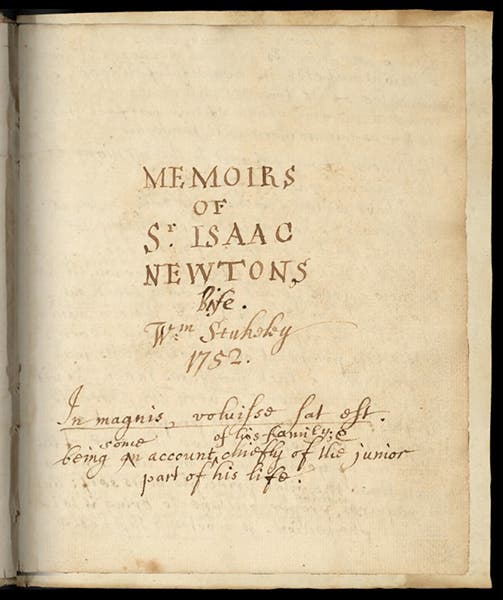
Title page, Memoir of Sir Isaac Newton’s Life, by William Stukeley, manuscript, 1752, Royal Society of London archives (royalsociety.org)
Everyone agrees that the story first came to light in the mid-1720s, 60 years after the event it describes, and that the teller of the tale was Newton himself. He told it in some form to at least four people, including his niece, Catherine Barton, her husband, John Conduit, and a young friend, William Stukekey. Barton told Voltaire, who first published it in two of his books, in 1727 and 1733.
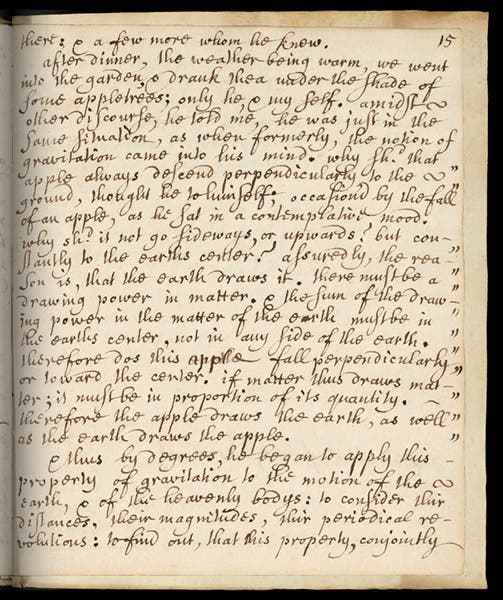
Account of Newton and the apple tree, Memoir of Sir Isaac Newton’s Life, by William Stukeley, manuscript, p. 15, 1752, Royal Society of London archives (royalsociety.org)
But the best source is Stukeley, who was an antiquarian studying Stonehenge and Avebury and living in Grantham, near Newton. He heard the story from Newton’s own lips at dinner on Apr. 15, 1726, and best of all, he wrote it down.
“The weather being warm, we went into the garden and drank tea, under shade of some apple-trees, only he and myself. Amidst other discourses, he told me, he was just in the same situation, as when formerly, the notion of gravitation came into his mind. Why sh[oul]d that apple always descend perpendicularly to the ground, thought he to himself; occasion’d by the fall of an apple, as he sat in contemplative mood? Why sh[oul]d it not go sideways or upwards, but constantly to the earth’s centre?”

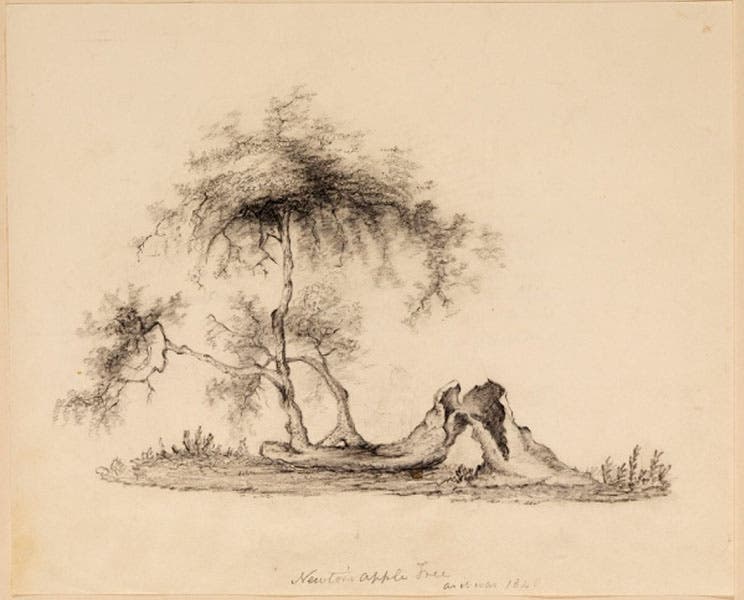
The fallen apple tree outside Isaac Newton’s manor-house at Woolsthorpe, sketch ca 1820, Royal Society of London archives (royalsociety.org)
We can quote like this, because Stukeley’s Memoir of Sir Isaac Newton’s Life, a manuscript put together in 1752, is in the archives of the Royal Society of London, which has made it available online, and you can read the entire account here. If you go to the page numbered “15,” you will see the story of the apple tree (fourth image).
Could it have happened this way? Many have doubted the recollections of an 83-year-old man about an event that happened 60 years earlier. But it has always seemed quite plausible to me. It seems to be exactly the kind of happening that might lead a genius to connect two seemingly disparate events, the fall of an apple and the motion of the Moon in its orbit, by one universal principle.

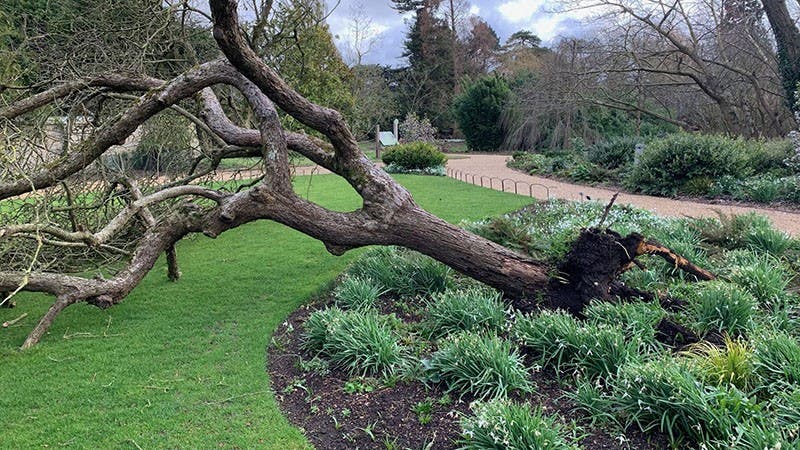
Scion of the apple tree at Woolsthorpe, blown down in a storm, 2022, Cambridge University Botanical Garden (botanic.cam.ac.uk)
If there was an “apple-tree incident,” as it appears there was, then the tree itself is of some importance. Records of the owner show that there was indeed an apple tree in the garden at Woolsthorpe in Newton’s day. It was still there in 1816, when it blew down in a storm. The fallen tree re-rooted and gave rise to a second-generation tree (fifth image). Shoots were removed and grafted, and scions of the original tree were grown, and further offspring cultivated from them. So lots of places today have apple trees that are claimed to be direct descendants of the tree at Woolsthorpe. There are several in Cambridge, one at the University of York, one outside the Babson Institute in Massachusetts, and one at my home University of Wisconsin at Madison (last image), and probably hundreds more. DNA testing has shown that about half of these are true descendants. The one in the Cambridge Botanical Gardens blew down in 2022 (sixth image), just like the original in 1816; presumably, they already have a certified replacement in place.

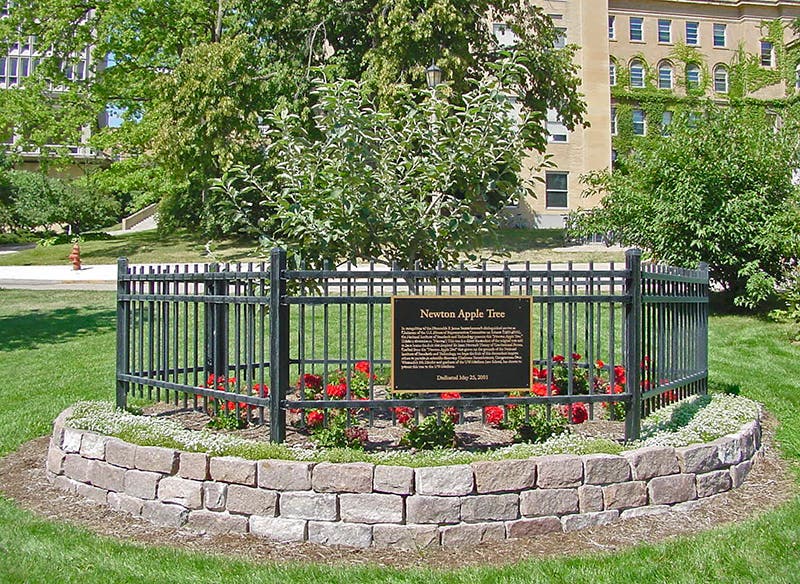
Scion of the apple tree at Woolsthorpe, at the University of Wisconsin, Madison, planted 2001 (physics.wisc.edu)
If you want to grow one yourself, the variety is “Flower of Kent”, and it is available, without pedigree, from a few growers. It is said to be mealy and nearly inedible. But it will fall to the ground if you drop it.
William B. Ashworth, Jr., Consultant for the History of Science, Linda Hall Library and Associate Professor emeritus, Department of History, University of Missouri-Kansas City. Comments or corrections are welcome; please direct to ashworthw@umkc.edu.