Scientist of the Day - Jacques Ozanam Ozanam

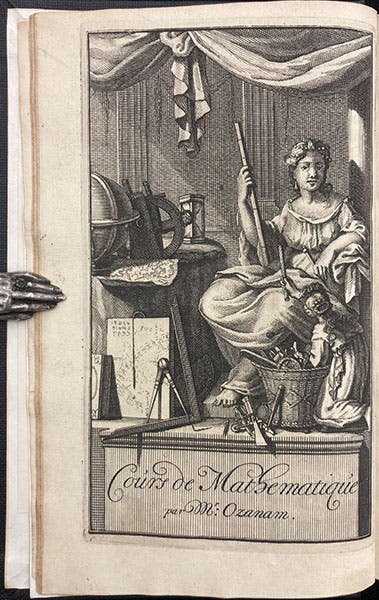
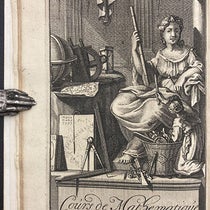
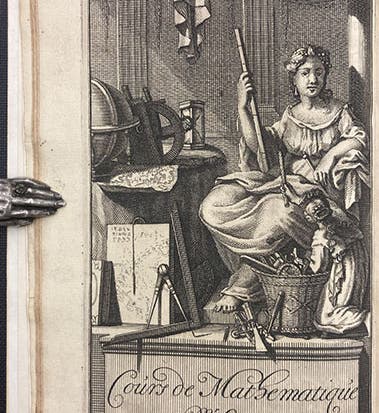
Allegorical frontispiece, engraving, Cours de mathematique, by Jacques Ozanam, rev. ed., vol. 1, 1699 (Linda Hall Library)
Jacques Ozanam, a French mathematician, died on Apr. 3, 1718, at the age of 78. He had been born on June 16, 1640, in Sainte-Olive, in southeastern France. He moved to Paris in 1670 and made his living, a good one, teaching math to foreign students. He came to much wider attention when he started publishing books on math for the general public, such as his Cours de mathematique (1693), which sounds like a textbook, but was not, being in 5 small volumes and written in clear non-mathematical language. It was math for the mathematically illiterate.

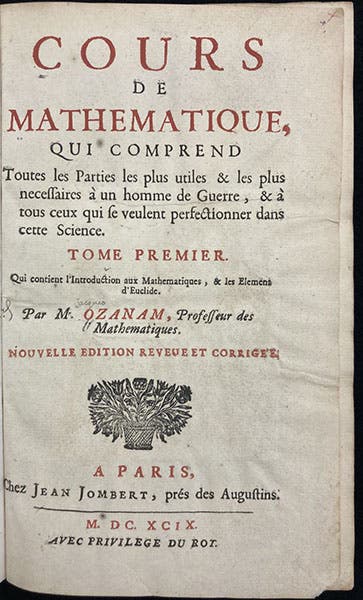
Title page, Cours de mathematique, by Jacques Ozanam, rev. ed., vol. 1, 1699 (Linda Hall Library)
We have the first edition of Cours de mathematique in our collections, but I am going to use our revised edition (also 5 volumes) to write this post, because it is nicer – crisper paper, with many more plates, even if it has been rebound in black buckram.

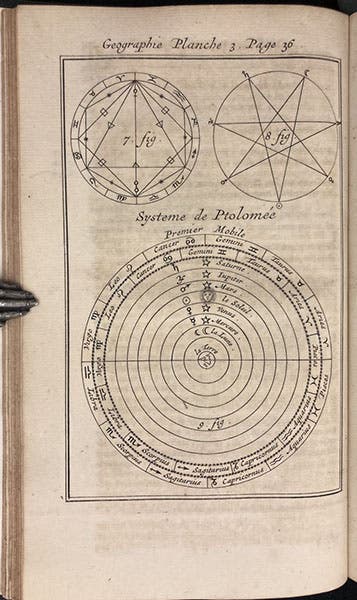
Ptolemaic cosmological system, engraving, Cours de mathematique, by Jacques Ozanam, rev. ed., vol. 5, plate 3, p. 37, 1699 (Linda Hall Library)
Volume 1 begins with an allegorical frontispiece of the Queen of the Sciences herself (first image), an engraving not present in our first edition. The plates in the first few volumes relate to geometry and arithmetic, but by the last volume, Ozanam is discoursing on geography, which to him included spherical astronomy, which is, after all, one of the traditional mathematical sciences. So we find a plate showing the cosmos according to Ptolemy (third image), and another depicting the Copernican system (fourth image), which, after a century of floundering before the public, is now making serious inroads, and yet another with the system of Tycho Brahe (and a bonus image of Saturn’s rings, discovered in 1659 (fifth image).

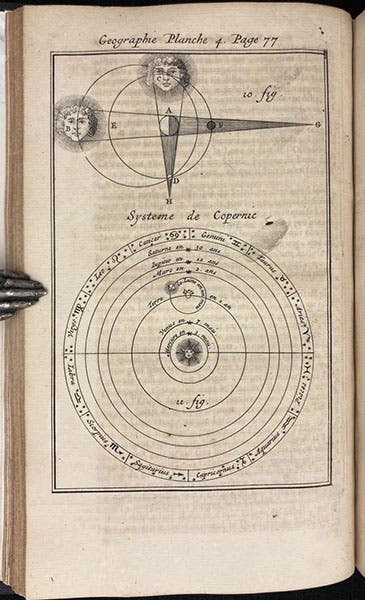
Copernican cosmological system, engraving, Cours de mathematique, by Jacques Ozanam, rev. ed., vol. 5, plate 4, p. 77, 1699 (Linda Hall Library)
My favorite engraving is one that shows the faces of several planets, included, I suppose, because it falls under the heading of planetary geography, a discipline that did not yet exist as such (last image). The figure at top left is Jupiter, as drawn by Giovanni Domenico Cassini in 1690; he had published other such drawings earlier. The bottom two show Mars, with what Cassini saw as hour-glass markings; they had been published earlier as well. But Cassini’s three drawings of Venus (TR, CL, CR), with its spurious teardrop markings, had only appeared unobtrusively in a small corner of a plate in an Academy publication of 1692, and no one really had noticed them. Here the images of Venus are larger and more impressive. So Ozanam was offering the public astronomical views that could not easily be found elsewhere – and this in a book on math.

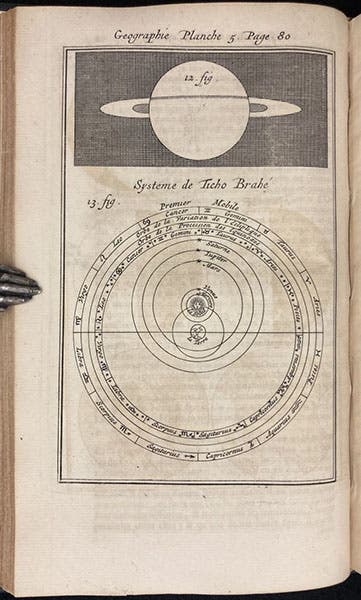
Tychonic cosmological system, with the rings of Saturn at top, engraving, Cours de mathematique, by Jacques Ozanam, rev. ed., vol. 5, plate 5, p. 80, 1699 (Linda Hall Library)
Ozanam followed up his Cours with an even more interesting book, called Récréations mathématiques et physiques (1694), about mathematical puzzles and games. It is not the first such book, even in French, but it was by far the most popular, and went through many editions, being expanded to 4 volumes. We do not have this work in our collections, which is a bit shocking, and I have only myself to blame, as I was responsible for recommending rare books for library purchase for 30 years, and I must have had my chances, but failed to fill this lacuna. Shame on me. Perhaps my successors can bail me out and add the Récréations to our collections.

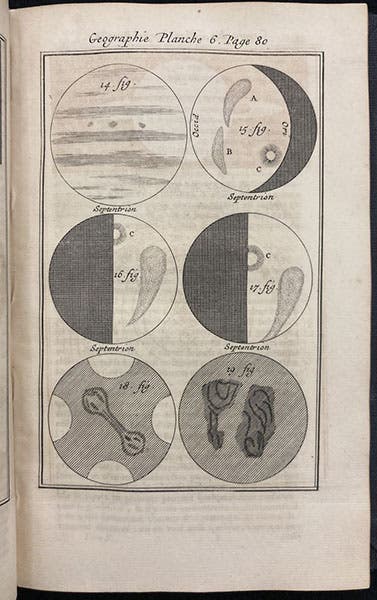
Views of the faces of Jupiter (TL), Venus (TR, CL, CR), and Mars (BL, BR), aftet drawings by G.D. Cassini, engraving, Cours de m)athematique, by Jacques Ozanam, rev. ed., vol. 5, plate 6, p. 80, 1699 (Linda Hall Library)
Ozanam, born Jewish but a convert to Catholicism, was a happily married man, who unfortunately lost most of his children to childhood diseases, as happened far too often in the days before vaccines. He also lost his wife in 1701, which devastated Ozanam, and then much of his income, when the French declared war on the Spanish Netherlands, and foreign students quit coming to Paris to study. The success and continued republication of his books must have been some comfort in the last years of his life.
There is no documented portrait of Ozanam. For more details on his life and works, I recommend, as always for a mathematician, the biographical page on the MacTutor website.
William B. Ashworth, Jr., Consultant for the History of Science, Linda Hall Library and Associate Professor emeritus, Department of History, University of Missouri-Kansas City. Comments or corrections are welcome; please direct to ashworthw@umkc.edu.