Scientist of the Day - James Watson

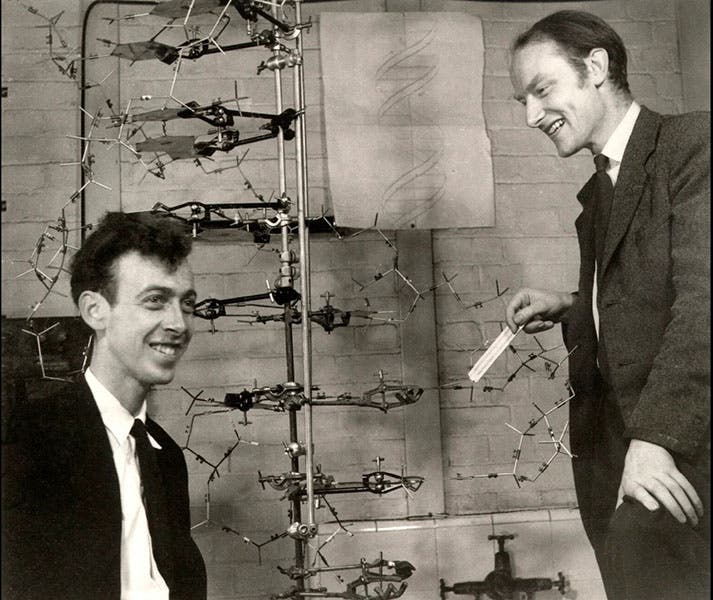
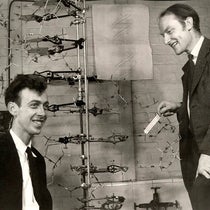
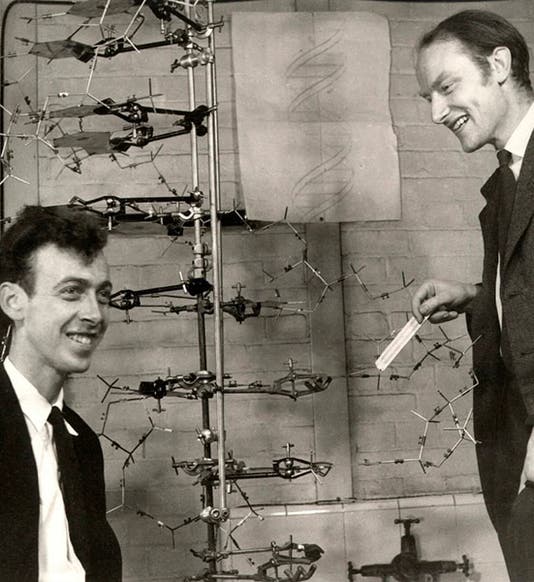
James D. Watson (left) and Francis Crick, posing with their model of DNA structure, photograph by Antony B. Brown, May 21, 1953 (npg.org.uk)
James Dewey Watson, an American molecular biologist, was born in Chicago on Apr. 6, 1928. In 11 years of writing this series, I have refused to write about Watson, because he was, in my opinion, a most unpleasant human being, and unworthy of celebration. But he died last year, and the fact is that he played a major role in the most important biological discovery of the 20th century, the structure of DNA. This occurred in 1953, when Watson was a socially awkward and somewhat offensive postgrad at Cambridge University in England, but not yet possessing or espousing the views on genetic racial inferiority that he would later defend. Being an ugly duckling is not a crime, or even a detriment, when you are a genius, as Watson undoubtedly was. So today we relent and tell the story of the discovery of the double helix.

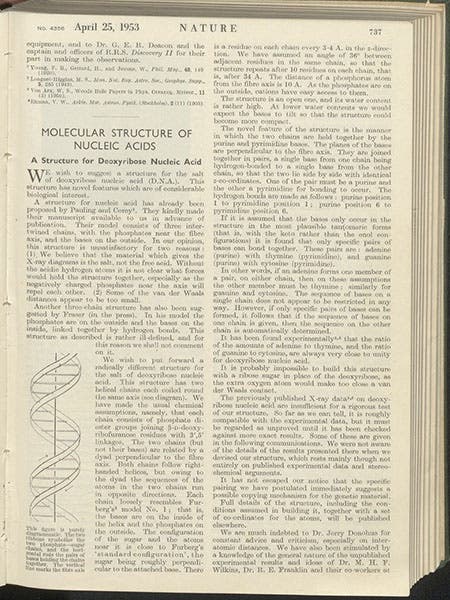
First page of “Molecular structure of nucleic acids: A structure for deoxyribose nucleic acid," by James D. Watson and Francis Crick, Nature, vol. 171, p. 737, Apr. 25, 1953 (Linda Hall Library)
In 1950, inheritance was a mystery. It had been known since Gregor Mendel in 1865 (well, since Mendel’s work was rediscovered in 1900), that there are genes in organisms that carry hereditary information and that pass from parent to offspring in predictable ways, and it was later discovered that genes are part of larger structures called chromosomes, the behavior of which can be observed with microscopes. But no one knew how chromosomes and genes carry information, how they replicate, and how their instructions are implemented by organisms.

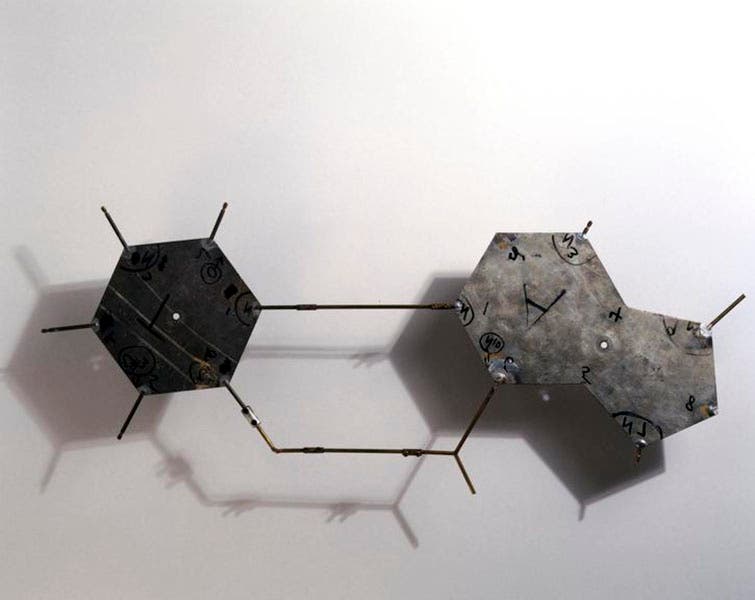
Two of the original aluminum plates used to model the bases in the Watson-Crick model of 1953; here thymine and adenine make up one base-pair, Science Museum, London (collection.sciencemuseumgroup.org.uk)
By the 1940s, it was known that chromosomes contain both proteins and DNA, but the jury was out on which carried genetic information. Since proteins, built of 20 different amino acids, are almost infinitely complex, while DNA, with only 4 "bases," seemed to have limited variety, most were betting on proteins as being the right genetic stuff. However, Oswald Avery did an impressive set of experiments in 1944 in which he showed that you could remove the protein from a chromosome and it still worked, but when you removed the DNA, the hereditary information was lost. However, not many knew of, or accepted, Avery's wartime announcement.

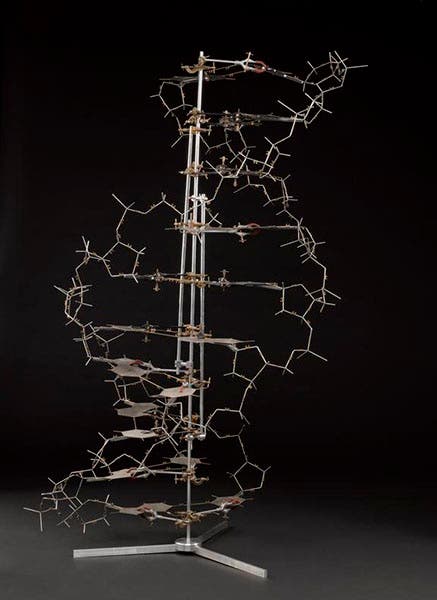
Reconstruction of the 1953 Watson-Crick model of DNA structure, using some of the original metal base plates, on display at the Science Museum, London (collection.sciencemuseumgroup.org.uk)
Watson, with a PhD in hand from Indiana, came to Copenhagen on a postdoc in 1950, and he attended a conference in Italy in where he heard a paper given by Maurice Wilkins about attempts to determine the structure of DNA by X-ray crystallography, where X-rays are bounced off substances, such as crystallized DNA, and the resulting interference patterns ae interpreted to reveal structure.

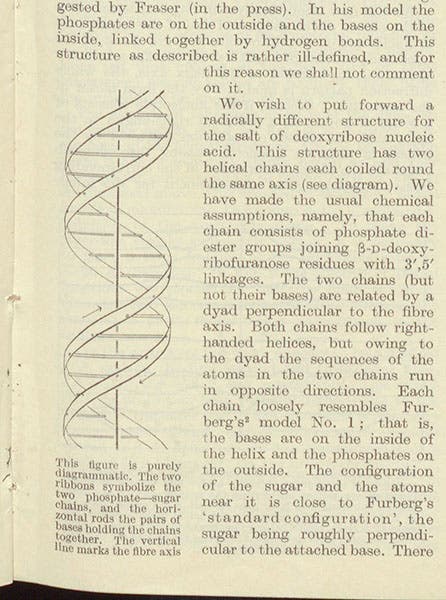
Diagram of the double-helix model of DNA, detail of second image, the first page of Watson-Crick article (Linda Hall Library)
Watson decided that this was an interesting problem, and he met Francis Crick at Cambridge, who was also interested in the structure of DNA, and the two decided to work together. It was, in a way a race, since Linus Pauling, a brilliant chemist in Pasadena who had recently determined the structure of the alpha helix of proteins, was also now working on DNA.
Watson knew nothing about X-ray crystallography, but at Wilkins' lab at King's College, London, Rosalind Franklin, a young physical chemist, had become a skilled X-ray crystallographer and was obtaining excellent interference photographs of different forms of DNA. Watson had heard her give a paper on her DNA patterns in 1951, but he hadn’t paid attention.

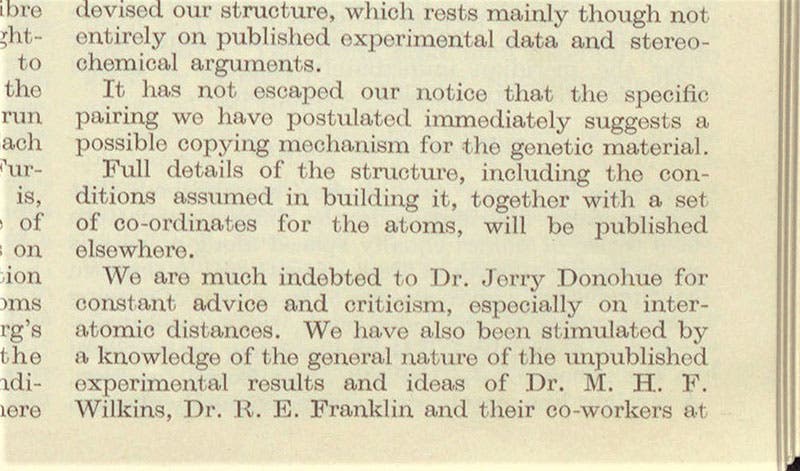
Detail of the final paragraphs of “Molecular structure of nucleic acids: A structure for deoxyribose nucleic acid," by James D. Watson and Francis Crick, Nature, vol. 171, p. 737, Apr. 25, 1953 (Linda Hall Library)
In early 1953, Watson was shown some of Franklin’s photographs by Wilkins, and he and Crick both realized that the “X” pattern was evidence of a helical structure, and that the repeat interval of the helix could be determined from measurements of the photos. Watson had metal templates made of the four bases (guanine, cytosine, adenine, and thymine) and attempted to construct a model that fit the X-ray pattern. It was a tedious process, and Watson made some basic mistakes, but he ultimately managed to construct a model that fit all the evidence (not just the X-ray evidence). It had two sugar-phosphate backbones snaking around each other, with the base plates extending into the center and lightly binding with their opposite numbers, thymine with adenine and guanine with cytosine. Both sets of base-pairs were exactly the same size, so everything fit together neatly and snugly.
Best of all, Watson now knew how replication works. Pull the two strands apart, and each half was now a mirror-image template on which a replica could be assembled, yielding two identical molecules from the original.

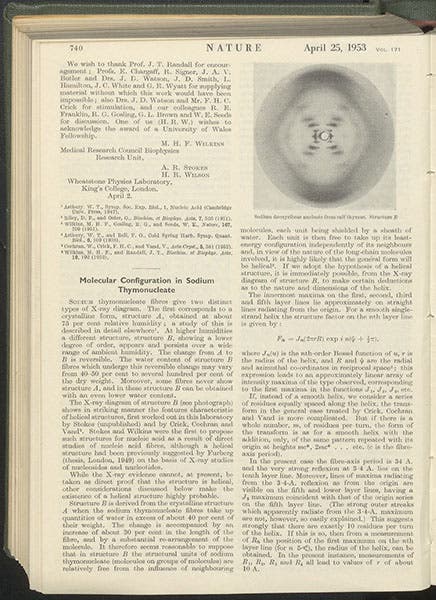
First page of “Molecular configuration in sodium thymonucleate,” by Rosalind Franklin and Raymond Gosling, including Photo 51, Nature, vol. 171, p. 740, Apr. 25, 1953 (Linda Hall Library)
Everyone who saw the model agreed that it conformed to all the evidence and made sense, and Watson and Crick drafted and sent off a paper to Nature, which was published on Apr. 27, 1953, immediately followed by papers by Wilkins and 2 associates, and by Franklin and her student, Raymond Gosling. For their work, Watson, Crick, and Wilkins shared the Nobel Prize in 1962. Franklin had died of ovarian cancer in 1958 and could not share in any Nobel award, since they are never given posthumously.

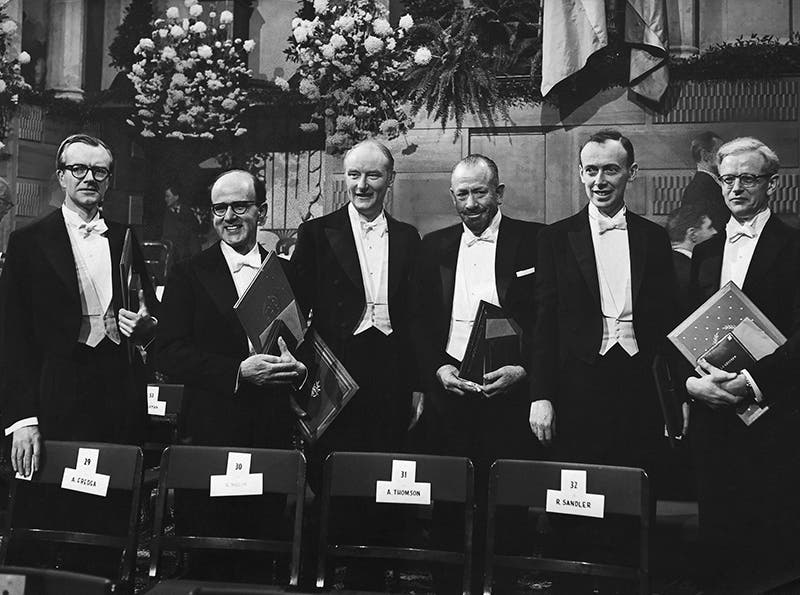
Group photograph of the 1962 Nobel Prize winners in Stockholm, with James Watson, second from right, and Francis Crick, third from left. Novelist John Steinbeck is third from right, looking uneasy(www.achievement.org)
Watson later published an account of the discovery process, called The Double Helix (1968), in which he wrote disparagingly of Franklin, and he has since been widely criticized for this, even though he was much more generous about her importance in an Epilogue to the book. But it has also been often stated that Watson stole Franklin’s work and used it without her permission, and this does not seem to be true. Watson was shown Franklin’s photos by her boss, Wilkins, which he had every right to do, and Watson did nothing underhanded. He just tried to explain the evidence, and did so in a spectacular fashion.
We keep the 1953 volume of Nature in our vault, next to the 1905 volume of Annalen der Physik, which contains Einstein’s famous 3 papers, including the one on special relativity. The Watson-Crick paper is one of a small handful of truly epochal papers that completely transformed their disciplines. And it is the only one of such papers that can be readily understood by an intelligent 12-year-old. That is perhaps its most remarkable feature.
William B. Ashworth, Jr., Consultant for the History of Science, Linda Hall Library and Associate Professor emeritus, Department of History, University of Missouri-Kansas City. Comments or corrections are welcome; please direct to ashworthw@umkc.edu.