Scientist of the Day - Johannes de Sacrobosco

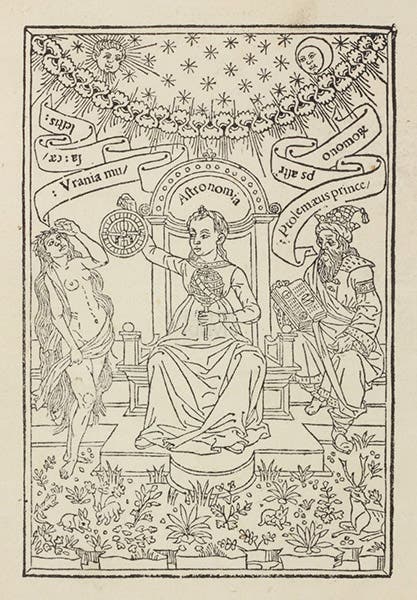
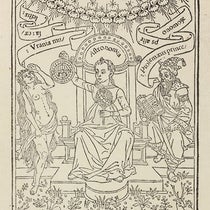
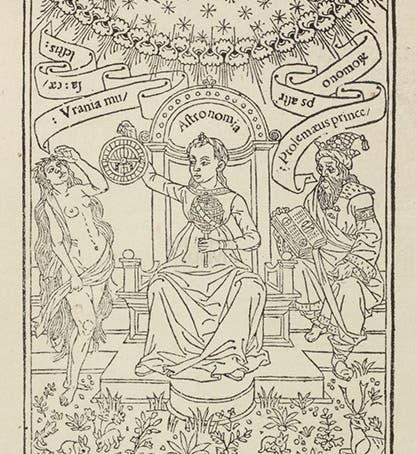
Frontispiece, woodcut, depicting Urania, Astronomia, and Ptolemy, Sphaera mundi, by Johannes de Sacrobosco, publ. by Octavius Scotus, 1490 (Linda Hall Library)
Last week, we featured the Library’s copy of the 1482 edition of the Sphere of Johannes de Sacrobosco, printed by the renowned German/Venetian printer, Erhard Ratdolt, with several hand-colored woodcuts of planetary astronomical models. We promised a follow-up post focusing on a 1490 edition of the Sphere in our collections, which was innovative in several ways. This is that post.

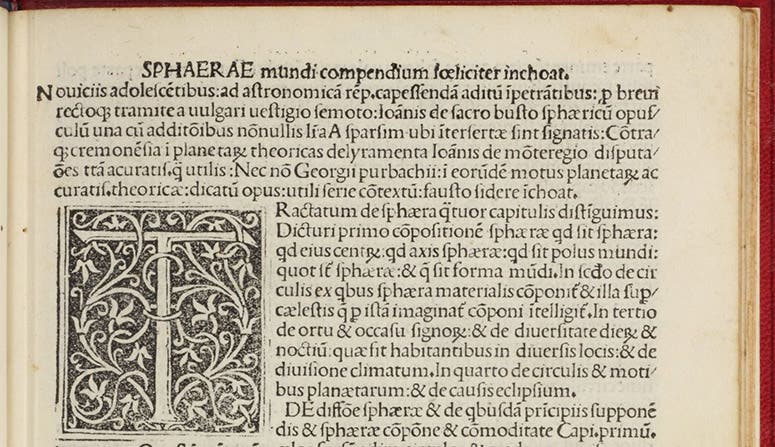
First paragraph with book titles and illuminated letter, Sphaera mundi, by Johannes de Sacrobosco, publ. by Octavius Scotus, 1490 (Linda Hall Library)
Octavius Scotus was a new kind of figure in the world of printing, a publisher and editor who hired others to print his books. Although he started out as a printer, he found he could greatly increase his output by having others set the type and run the sheets through the presses.

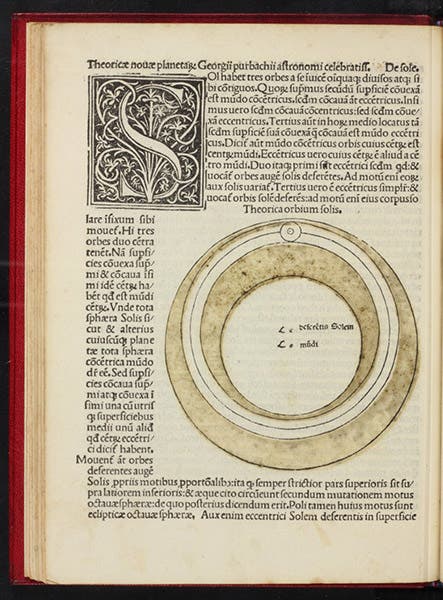
First page of section with Peurbach’s New Theory of the Planets, with woodcut of the model for the Sun, printed in color, Sphaera mundi, by Johannes de Sacrobosco, publ. by Octavius Scotus, 1490 (Linda Hall Library)
Scotus did not print many scientific books – he was more partial to music – but he did publish a splendid edition of Sacrobosco's Sphere in 1490. He farmed it out to one of his favorite printers, Boneto Locatello of Bergamo. Like Ratdolt, Scotus chose to include the New Theory of the Planets by Georg Peurbach as an accompaniment to Sacrobosco’s Sphere.

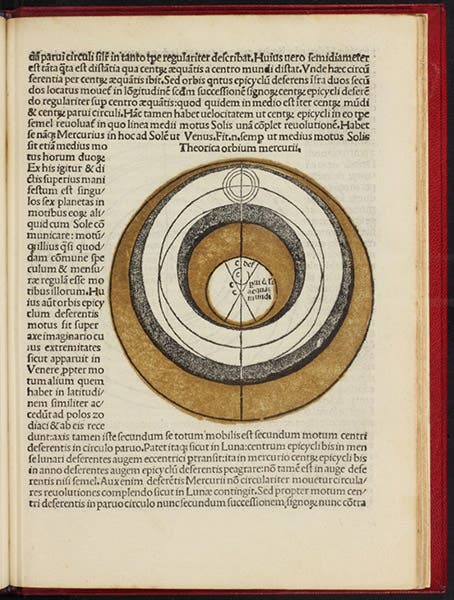
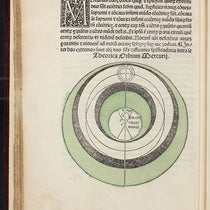
Woodcut of the planetary model for Mercury, printed in color, Sphaera mundi, by Johannes de Sacrobosco, publ. by Octavius Scotus, 1490 (Linda Hall Library)
And Scotus utilized a relatively new practice – color woodblock printing – for his edition of Sacrobosco. He apparently got the idea from printing musical scores, where he discovered that by passing sheets through the press multiple times, he could print the staff first, and then the notes. For several of the woodcuts in his edition of Sacrobosco, he used a separate color block, such as for the model for the Sun, and the model for Mercury (third and fourth images), where he overprinted with a yellow or a dark yellow/brown (at least that is the color it is now). For a woodcut of lunar eclipses, he overprinted with two colors, red and yellow (sixth image). Since the offset is different for the two colors, he probably used one additional block for each color - three blocks in all.

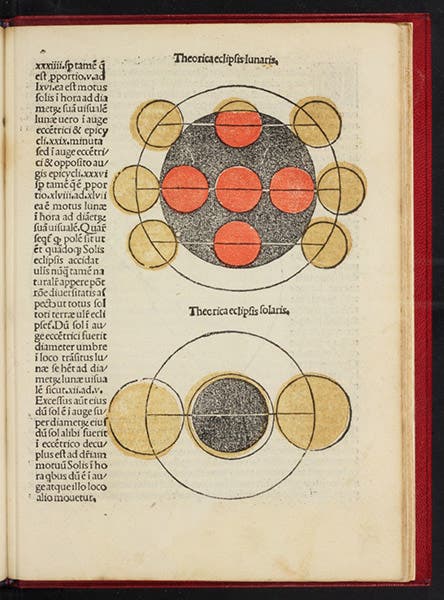
Diagrams explaining eclipses of the Moon (top) and Sun (bottom), woodcuts printed in color, Sphaera mundi, by Johannes de Sacrobosco, publ. by Octavius Scotus, 1490 (Linda Hall Library)

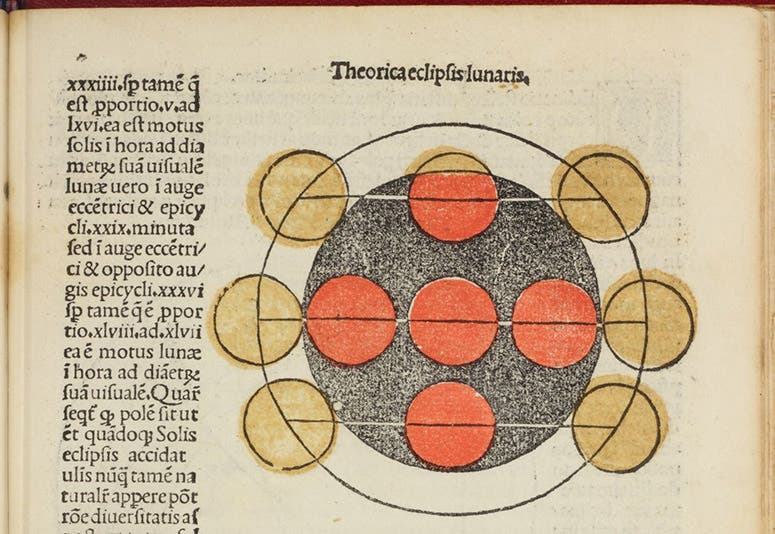
Diagram explaining eclipses of the Moon, woodcut printed in color, detail of fifth image, Sphaera mundi, by Johannes de Sacrobosco, publ. by Octavius Scotus, 1490 (Linda Hall Library)
Scotus also included a more elaborate frontispiece than Ratdolt had used for his edition, one that had two allegorical figures, Urania and Astronomia, and one historic one, Ptolemy of Alexandria, who provided the planetary models that Sacrobosco and Peurbach used and depicted (first image).

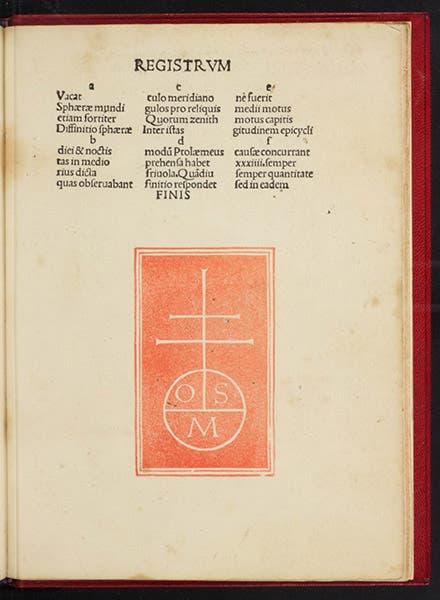
Last page of text, with the large publisher’s mark of O.S.M. (Octavius Scotus of Monza), Sphaera mundi, by Johannes de Sacrobosco, 1490 (Linda Hall Library)
We also show the last page of the book (seventh image). The penultimate page has the colophon, with the date, MCDXXXX, and the place of printing. The final page has what we usually call a printer's mark, except in this case it is a publisher's mark, the initials O.S. M. telling us that this book was underwritten by Octavius Scotus of Monza.

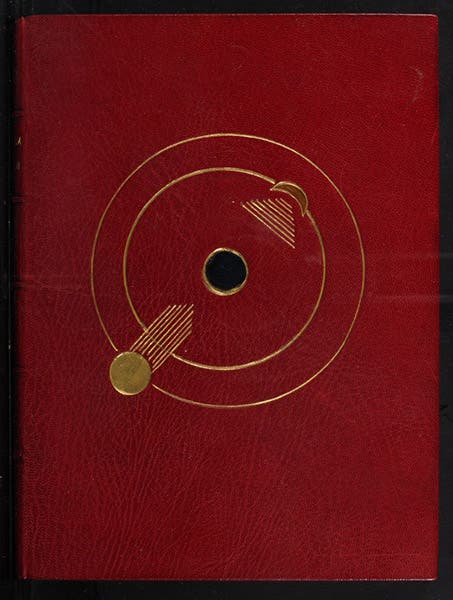
Tooled binding, library’s copy of Sphaera mundi, by Johannes de Sacrobosco, publ. by Octavius Scotus, 1490 (Linda Hall Library)
Finally, we show the binding of our 1490 Sacrobosco (eighth image). This is what we might call a collector's binding, and we normally don't get too excited by 20th-century bindings on 15th-century books. But this one seems worth showing, since the owner chose a woodcut from the book (last image) and instructed his binder to create a version in red Morocco, which he did very nicely.

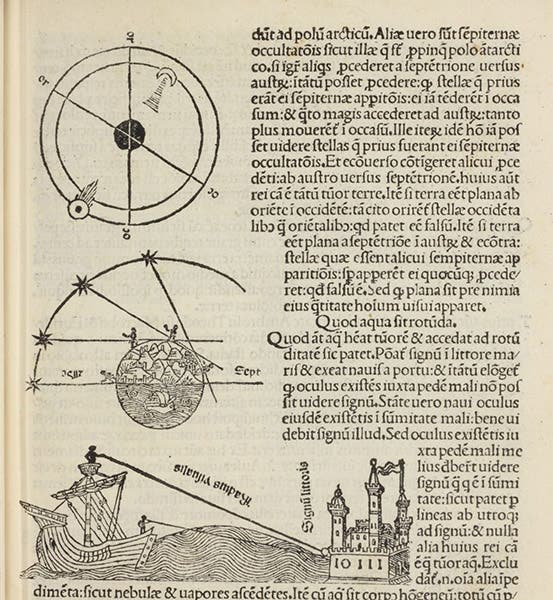
Three woodcuts, the top one being the source of the design on the tooled binding (eighth image), Sphaera mundi, by Johannes de Sacrobosco, publ. by Octavius Scotus, 1490 (Linda Hall Library)
William B. Ashworth, Jr., Consultant for the History of Science, Linda Hall Library and Associate Professor emeritus, Department of History, University of Missouri-Kansas City. Comments or corrections are welcome; please direct to ashworthw@umkc.edu.