Scientist of the Day - Karl Hencke

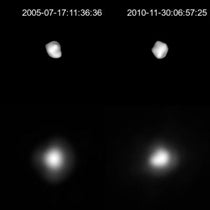
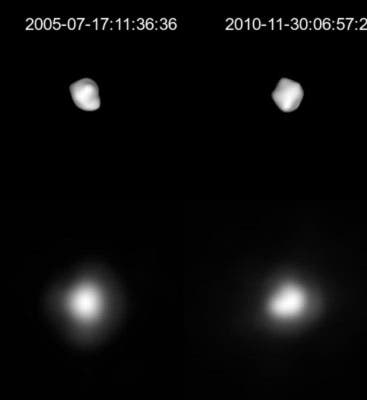
Two images of 5 Astraea, taken in 2005 and 2010, at bottom; top images are an attempt to draw more detail from the photographs (Wikimedia commons)
Karl Hencke, a German amateur astronomer, was born Apr. 8, 1793. In 1845, Hencke discovered the 5th known asteroid, Astraea, at his private observatory in Driesen (now in Poland), and then two years later, in 1847, he sighted the 6th asteroid, Hebe. This would seem to be an unremarkable achievement, except that the first four asteroids (or minor planets, as they are properly called) were discovered between 1801 and 1807, and then nearly forty years passed without anyone seeing any more. Consequently, most astronomers were convinced that there were only four, namely Ceres, Pallas, Juno, and Vesta.

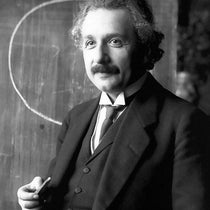
Portrait of Karl Hencke, January 1891 issue of The Sidereal Messenger, Jan. 1891 (Linda Hall Library)
Once Hencke broke the barrier with five and six, and reawakened interest in asteroids, they began to appear in proliferation; by 1850, ten had been discovered; by 1900 the number was up to five hundred; by 1980 we hit 100,000, and we are currently assigning numbers greater than 890,000. And there are almost that many that don’t yet have numbers, because their orbits haven’t yet been worked out.

Four photographs of 6 Hebe, at bottom; top images are an attempt to draw more detail from the photographs (Wikimedia commons)
All of the early-discovered asteroids bear both a name and a number, so that Hencke's discoveries are called 5 Astraea and 6 Hebe, and its four predecessors were, until recently, 1 Ceres, 2 Pallas, 3 Juno, and 4 Vesta. Unfortunately for 1 Ceres, in 2006, it was promoted to the rank of “dwarf planet,” and it has lost its “1”. The number has apparently been retired. The Hayden planetarium (the first public institution to remove Pluto from its model solar system, when it was demoted to dwarf planet), should hang a “1 Ceres” jersey from its rafters.
No spacecraft has ever flown near either of Hencke's asteroids, so our only photographs are Earth-based, and not very good (first and third images). 5 Astraea and 6 Hebe are small asteroids (Astraea is 105 mi. long and 75 mi. wide), so the images have little detail, except for a crater on Hebe. Small asteroids tend to have irregular shapes, as evidenced by 951 Gaspra and 243 Ida, two tiny specimens that were photographed by the Galileo spacecraft on its way to Jupiter on the early 1990s.
In 1973, a Swiss astronomer named Paul Wild discovered one of his 40 asteroids, and once it got its number (2005), he named it 2005 Hencke, after our birthday subject. So it took Hencke about 130 years to earn his own asteroid, which could be seen as a lack of respect, except that Karl Harding, who discovered 3 Juno in 1804, is only two ahead of Hencke on the list, at 2003 Harding, and two ahead of Harding is 2001 Einstein. That at first appears shocking, that there are 2000 names ahead of Einstein on any list, but if you think about it, who is going to have the nerve to name a "minor planet" after a major figure like Einstein.
William B. Ashworth, Jr., Consultant for the History of Science, Linda Hall Library and Associate Professor emeritus, Department of History, University of Missouri-Kansas City. Comments or corrections are welcome; please direct to ashworthw@umkc.edu.