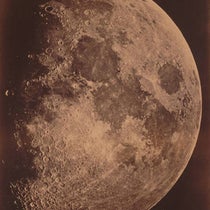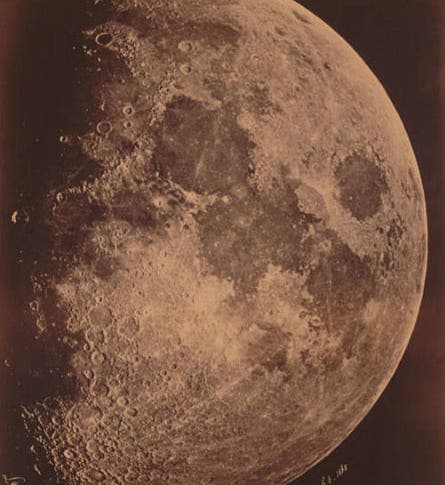
Scientist of the Day - Lewis Rutherfurd

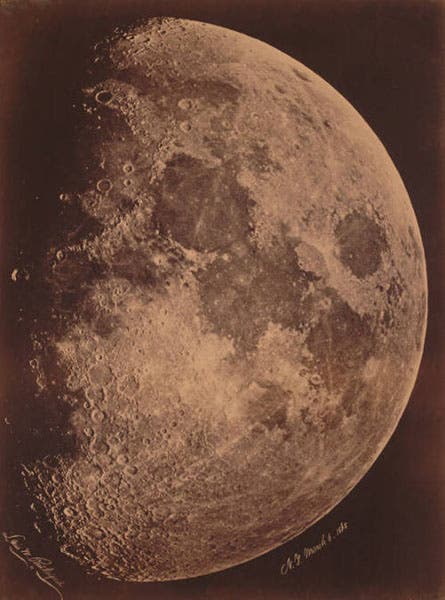
“Moon, March 6, 1865,” albumen silver print from an original negative by Lewis M. Rutherfurd, Mar. 6, 1865, Hallmark Collection, Nelson-Atkins Museum of Art, Kansas City (art.nelson-atkins.org)
On Mar. 6, 1865, Lewis Morris Rutherfurd exposed a photographic plate to the light of a nine-day-old Moon in his backyard observatory at 11th St. and 2nd Ave in New York City. He had taken scores of these, and would take hundreds more. But this one, for some reason, he singled out as special. Perhaps it was the first exposure that really pleased him since he finished installing his unique telescope designed solely for photography. He printed up a large number of albumen silver prints, which are linen-paper prints with egg white as a binder and silver nitrate as the light-sensitive agent. He made enough of these, intending to send them as gifts to colleagues, so that every major museum with a photography collection is likely to have a print, including the MET, the V&A, the NMAH in Washington, D.C., and our own Nelson-Atkins Museum of Art here in Kansas City, with its superb Hallmark Collection of Photographs (first image).

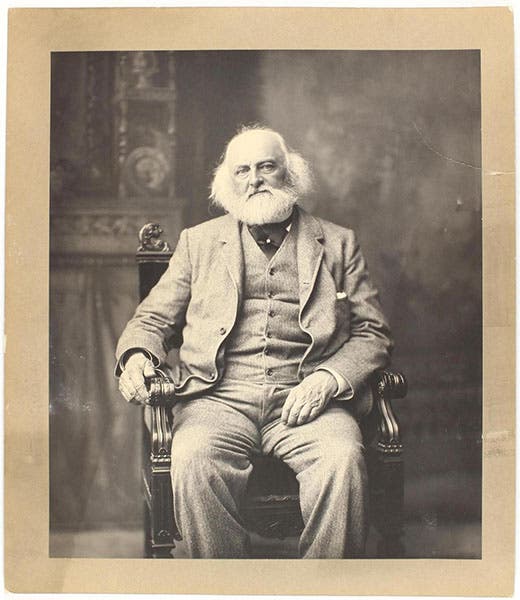
Portrait of Lewis Morris Rutherfurd, unknown source, date, or location, but clearly Rutherfurd (villagepreservation.org)
The Mar. 6 prints are larger than you might think, if you are used to photos of the Moon in books (see sixth image below). The Nelson Gallery print, which they call “Moon, March 6, 1865,” is about 23 inches tall and 17 inches wide. The negative was signed by Rutherfurd at bottom left, and the date (and/or title) was added at bottom right.

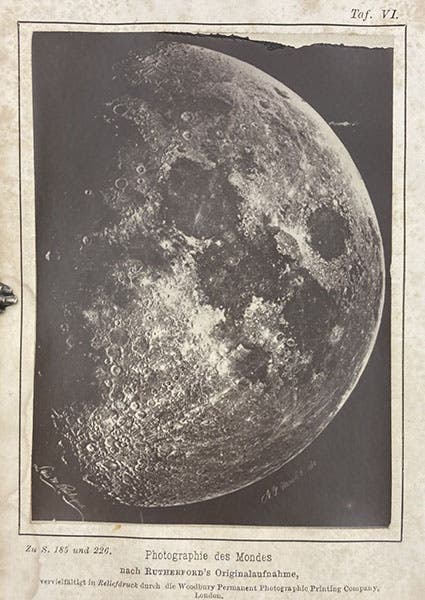
The Moon, Mar. 6, 1865, reduced copy of original print by Lewis M. Rutherfurd, frontispiece in Die chemischen Wirkungen des Lichts und die Photographie: in ihrer Anwendung in Kunst, Wissenschaft und Industrie by Hermann Wilhelm Vogel, 1874 (Linda Hall Library)

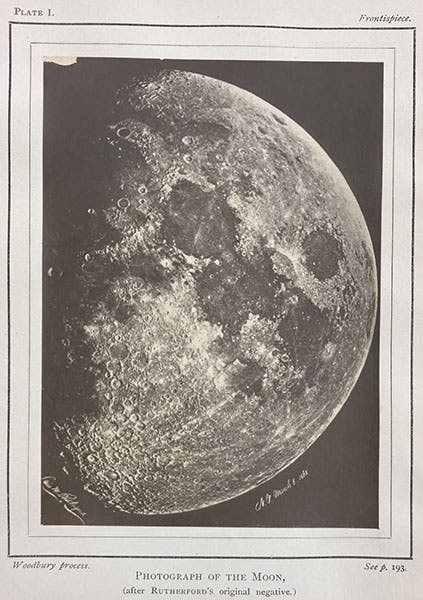
The Moon, Mar. 6, 1865, reduced copy of original print by Lewis M. Rutherfurd, Woodburytype frontispiece, The Chemistry of Light and Photography, by Hermann Wilhelm Vogel 1875 (Linda Hall Library)
The nine-day moon of Mar. 6, 1865, had just the right proportions to fit, reduced, onto the page of a book (a full moon, being square, is not such a good fit), and Rutherfurd's moon appeared in several octavo-size books that I know about, and probably quite a few more that I don’t. We show you an average-quality reproduction that appeared as the frontispiece to Die chemischen Wirkungen des Lichts und die Photographie, by Hermann Wilhelm Vogel, 1874 (third image), and another, much better in quality, that served as the frontispiece to the English translation of Vogel’s book, The Chemistry of Light and Photography, 1875 (fourth image). Both are Woodburytypes, which usually yield the highest quality reproductions of photographs, but perhaps American printers were better at this than Germans. Curiously, when Richard A. Proctor published his popular book The Moon in 1873, he included three Rutherfurd photos of the moon, but not the famous one of 1865; instead, he chose Rutherfurd exposures from 1870 and 1871. I suppose he thought that more recent photos would make his book look more up to date.

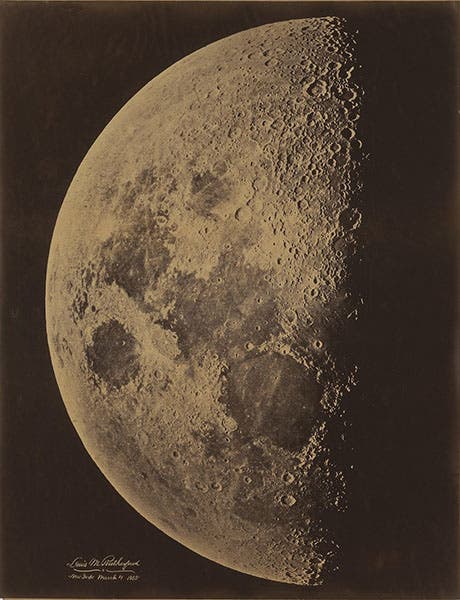
“Moon, March 4, 1865,” albumen silver print from an original negative by Lewis M. Rutherfurd, Mar. 4, 1865, National Gallery of Canada, Ottawa (gallery.ca)
The National Gallery of Canada in Ottawa has a large print of a Rutherfurd moon photo, which they displayed in an exhibition in 2018 (fifth image). Interestingly, it is not the Mar. 6 photograph, but one taken two days earlier, on Mar. 4, 1865, showing a 7-day or first-quarter moon. Even more oddly, it has south at the top, so all the features on the right in the Nelson-Atkins print are on the left here, and inverted. Strangest of all, the reorientation was done by Rutherfurd himself, who turned the negative upside down before he signed and dated it, leaving you no choice but to mount it with south at the top. The photo below of the Mar. 4 print on display in 2018 gives you a good idea of the size of the original Rutherfurd prints.

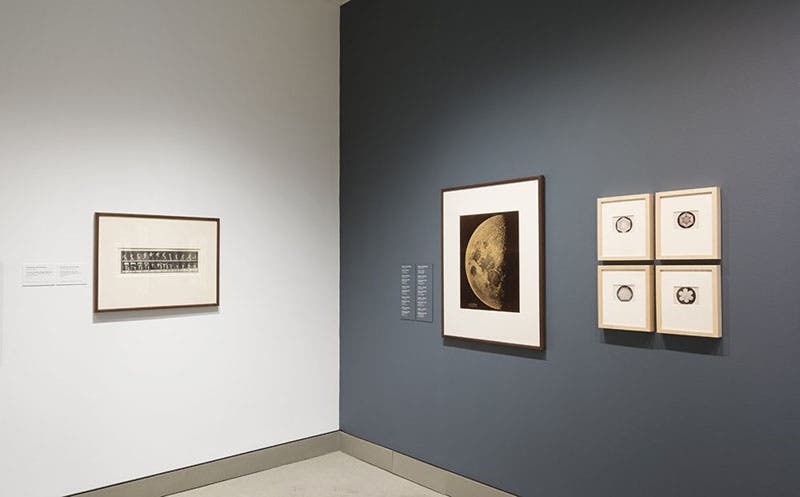
The March 4 Rutherfurd moon print on display in 2018 at the National Gallery of Canada, Ottawa (gallery.ca)
On Antiques Roadshow last spring, a woman brought in two full-sized Rutherfurd moon prints that she had found at a town dump recycling center in Wellesley, Mass., and one of them (on the right in this video) was the Mar. 6, 1865 print. The appraiser told the lady that they were worth $4-6,000, which, considering that the one on the right was a signed presentation copy to the great American astronomer Benjamin Apthorp Gould, was a shockingly low figure. I am curious as to whether it has or will turn up in the rare book marketplace. We wouldn’t mind giving it a home right here.
Rutherfurd gave his entire collection of instruments and photographic plates to Columbia University, on whose board of trustees Rutherfurd sat for many years. The Archives there still have those negatives, in 78 custom boxes made by Rutherfurd. Presumably, the Mar. 6 moon negative is among them, and the enigmatic Mar. 4 plate as well.
There are not many portraits of Rutherfurd online. We showed the most common one, from an 1893 obituary, in an early post on Rutherfurd. The one we show here I cannot track down, but I really like it. If anyone knows more about it, please let me know.
William B. Ashworth, Jr., Consultant for the History of Science, Linda Hall Library and Associate Professor emeritus, Department of History, University of Missouri-Kansas City. Comments or corrections are welcome; please direct to ashworthw@umkc.edu.