Scientist of the Day - Menai Suspension Bridge

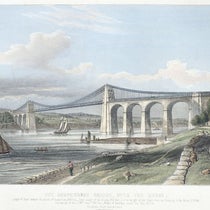
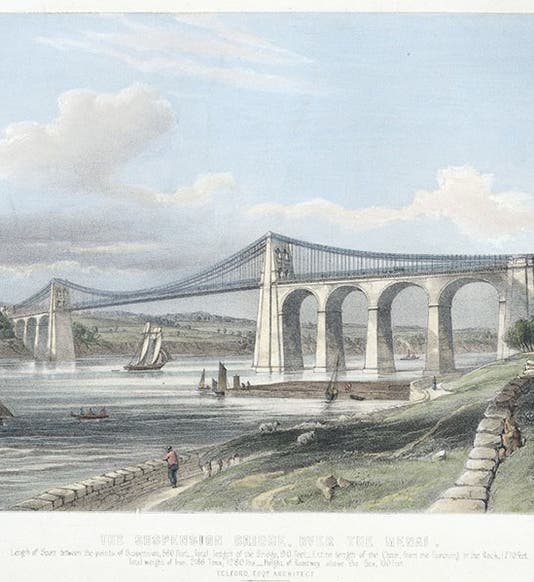
View of the Menai Suspension Bridge, opened on Jan. 30, 1826, tinted lithograph, 1840, National Library of Wales (Wikimedia commons)
The Menai Suspension Bridge over the Menai Strait in northern Wales opened on Jan. 30, 1826, so they are probably having a fine 200th-anniversary celebration today in the towns of Bangor (Wales) and Menai Bridge (Anglesey). We have featured the bridge several times in this series, in posts on Thomas Telford, the design engineer; William Hazeldine, the ironsmith who did all the wrought-iron work; and T. G. Cumming, who published a book about the building of the bridge. But a 200th birthday is not to be passed up, so we honor the bridge again, with some different photos and engravings, and a few additional odd facts.
.jpg#/media/File:Menai_suspension_bridge_(1132623).jpg)
Another contemporary view of the Menai Suspension Bridge, from a distance, etching, 1840, National Library of Wales (Wikimedia commons)
The Menai Suspension Bridge is often described as England's first suspension bridge, but in fact it was the second, preceded by the Union Chain Bridge over the River Tweed in Scotland, completed in 1820. The Menai bridge was a little longer, with a central span of 577 feet, and a lot higher, with a clearance of 100 feet. Another difference is that the Union Bridge builder, Samuel Brown, made his own wrought-iron chains, while Telford contracted the Menai Bridge chains to Hazeldine. We owe ourselves a post on Brown someday soon.
.jpg#/media/File:Bangor,_View_on_Suspension_Bridge_(8571590364).jpg)
Closer view of the 16 chains, in four groups of four, that support the Menai Bridge roadway, each link in the chain being formed of 5 wrought-iron rods bolted together, photograph, ca 1880, National Media Museum (Wikimedia commons)
The chains of the original Menai Suspension Bridge were interesting. They were not like modern chains, but consisted of flat wought-iron rods held together by pins. Each rod was 9-10 feet long and weighed over 250 pounds, with a hole in each end so they could be linked together. Each chain was 5 rods thick, and there were 16 chains holding up the roadway, which means a cross-section of the bridge at any point would cut through 80 rods (third image).

The Menai Suspension Bridge, with Anglesey at the left and Bangor, Wales, on the right, recent photograph by Ian Capper (Wikimedia commons)
There were 935 rods in each chain, for a total of 14,960 rods in all. Each of the 16 chains was over 1700 feet long. That was a lot of iron, all wrought by Hazeldine at his forge in Shropshire, dipped individually in hot linseed oil to prevent rust, and shipped – there were no railroads yet – to Bangor. The chains were then assembled on site. The chains were supported by the massive stone piers and were anchored in bedrock at both ends of the span.

View of the Menai Suspension Bridge, foreground, and the Britannia Bridge in the distance, engraving by Alfred Ashley after drawing by Joseph Burell, 1850, National Library of Wales (Wikimedia commons)
The original roadway was made of wood. That was replaced by steel in the 1880s. The load-bearing capacity of the wrought-iron rods eventually proved insufficient for a major highway, and beginning in 1938, the wrought-iron links were gradually replaced with steel ones, over the course of 2 years, and without disturbing traffic – quite a feat, in my opinion.
The most unusual feature of the Menai Suspension Bridge is that the spans on either end, although they appear to be suspended from the cables, are actually supported by stone piers, 9 in all, which gives the bridge its distinctive and elegant appearance.

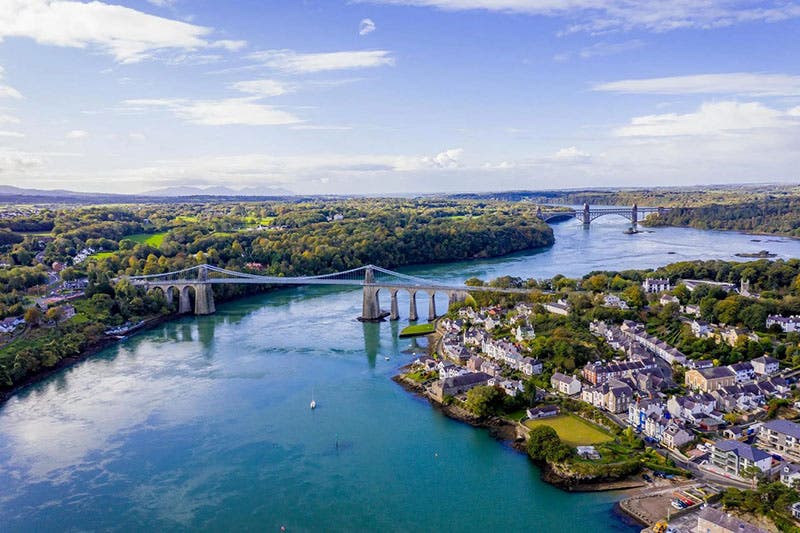
Aerial view of the Menai Suspension Bridge, foreground, and the Britannia Bridge, background, with the town of Menai Bridge, Anglesey, on the right, recent photograph (visitanglesey.co.uk)
And if the Menai Straits are new to you, I might point out that the reason we keep inserting "Suspension" between “Menai” and “Bridge” is that there is another Menai Bridge, not too far from Telford's, called the Britannia Bridge, where the roadway, intended for trains rather than carriages and wagons, runs through an iron tube. It is an engineering marvel as well. But it is quite a different bridge, completed in 1850. We discussed it, and showed pictures, in posts on Robert Stephenson and Edwin Clark. Our final image shows both historic bridges from the air.
William B. Ashworth, Jr., Consultant for the History of Science, Linda Hall Library and Associate Professor emeritus, Department of History, University of Missouri-Kansas City. Comments or corrections are welcome; please direct to ashworthw@umkc.edu.