Scientist of the Day - Osbert Salvin

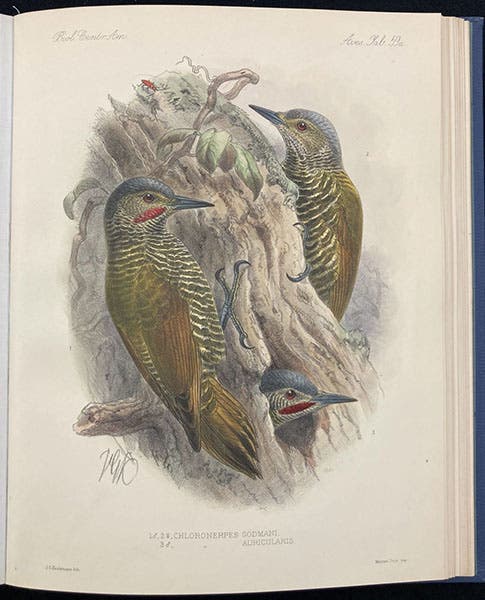
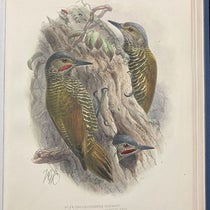
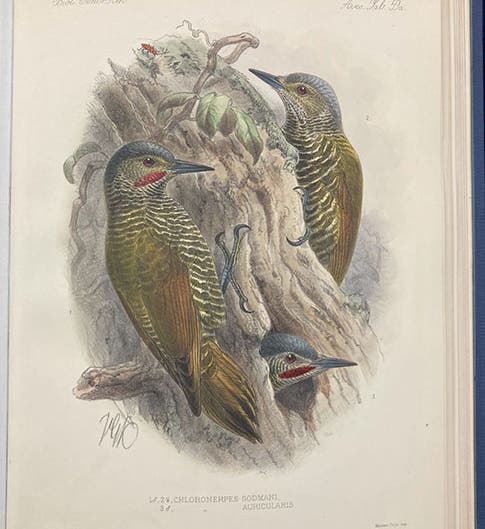
Grey-crowned woodpeckers, lithograph by Johan Keulemans, in Biologia Centrali-Americana: Aves, by Osbert Salvin and Frederick DuCane Godman, vol. 4, plate 59a, 1879-1904 (Linda Hall Library)
Osbert Salvin, an English naturalist with a special interest in birds, was born in Elmshurst, Middlesex, on Feb. 25, 1835. He was the son of an architect, and was educated at Trinity Hall, Cambridge, where Stephen Hawking would later get his education. Like Charles Darwin, who 30 years earlier had spent much of his free time, wandering the fens at Cambridge and collecting birds and insects, Salvin did the same, and after graduating in 1857, he headed to Guatemala to collect Neotropical specimens. He returned to Cambridge for graduate work, and then headed for Guatemala again, and again.

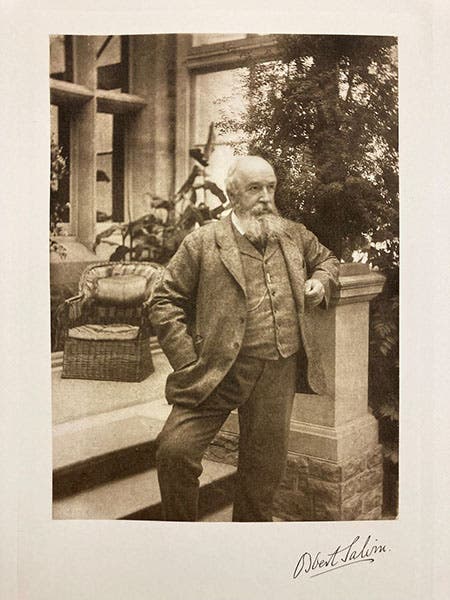
Portrait of Osbert Salvin, heliogravure frontispiece, Biologia Centrali-Americana: Introductory Volume, by Frederick DuCane Godman, 1915 (Linda Hall Library)
On one of those trips to Central America, Salvin was accompanied by Frederick DuCane Godman, and they formed a friendship and a professional collaboration that would last a lifetime. Sometime before 1876, the two decided to edit a reference work on the flora and fauna of Central America. They would call it Biologia Centrali-Americana. They would write some of the articles themselves, and farm out the rest to experts. They decided to issue it by numbers, with each number having a modest amount of text and half-a-dozen plates. That way, they could work on birds and insects and reptiles all at once. The numbers were designed so that they could be collected in subject volumes with continuous pagination and plate numbers.

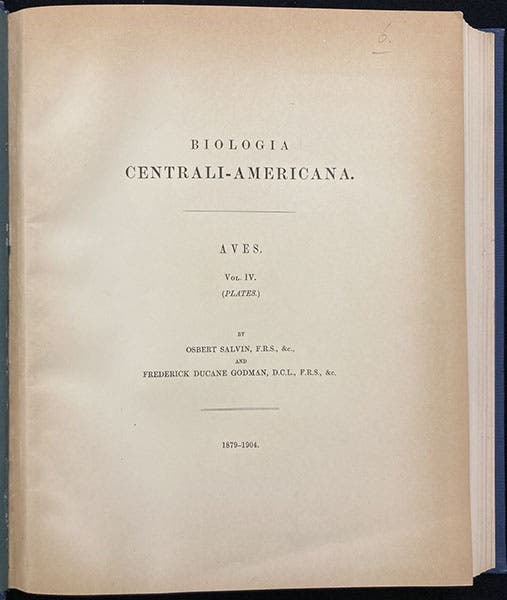
Title page, Biologia Centrali-Americana: Aves, by Osbert Salvin and Frederick DuCane Godman, vol. 4 (plates), 1879-1904 (Linda Hall Library)
The first numbers were published in 1879, although the first volume, the introductory volume, did not appear until 1915, after everything else had been issued. The complete set comprised 215 numbers, bound up into 63 volumes. Salvin died in 1898, before the Biologia was completed, but Godman managed to see everything else through the press. Salvin and Godman were responsible for writing the four volumes on birds, and three volumes on a large group of butterflies, and presumably they commissioned the beautiful colored plates of birds, drawn and lithographed by Johan Keulemans, which filled an entire volume, and also the volume of butterfly illustrations, lithographed by various artists.

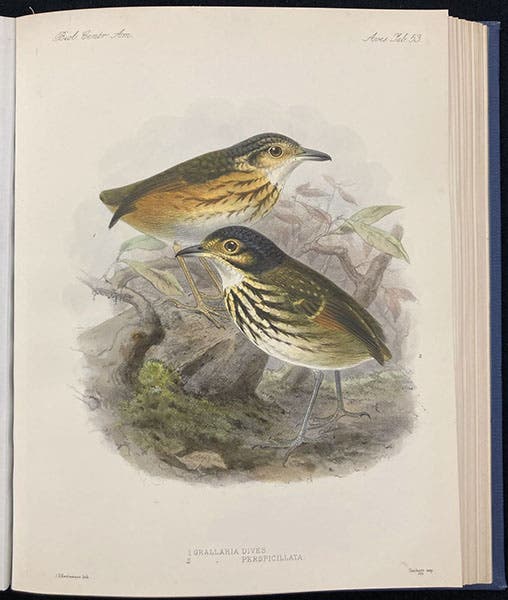
Antpittas, lithograph by Johan Keulemans, in Biologia Centrali-Americana: Aves, by Osbert Salvin and Frederick DuCane Godman, vol. 4, plate 53, 1879-1904 (Linda Hall Library)

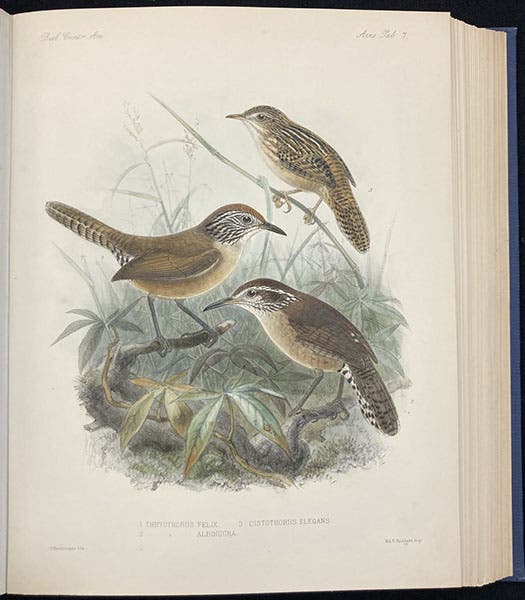
Happy wrens, lithograph by Johan Keulemans, in Biologia Centrali-Americana: Aves, by Osbert Salvin and Frederick DuCane Godman, vol. 4, plate 7, 1879-1904 (Linda Hall Library)
We have a set of the Biologia in our rare book vault which is complete as far as the flora and fauna is concerned, but is missing all the volumes on archaeology that were added after all the splendid Mayan ruins were discovered. It is hard to be certain if our set is otherwise complete, since each section – birds, reptiles, insects, plants – is cataloged separately, with different titles for each. We have 45 volumes in all, and they look to be complete, sans the archaeology volumes.

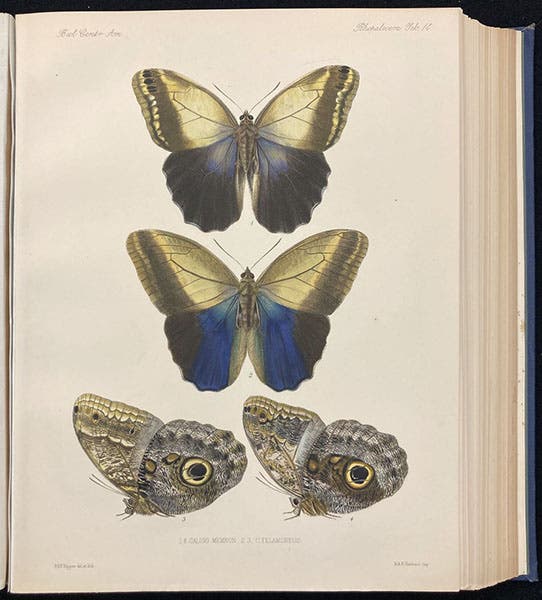
Owl butterflies, in the genus Caligo, lithograph by Robert H.F. Rippon, in Biologia Centrali-Americana: Insecta: Lepidoptera-Rhopalocera, by Frederick DuCane Godman and Osbert Salvin, vol. 3, plate 14, 1879-1901 (Linda Hall Library)
The first volume, added in 1915 by Godman as a kind of summing up, only four years before his own death, has a useful 12-page introduction by Godman that describes his relationship with Salvin over the 40 years they worked together. It also includes two fine frontispiece portraits, of himself and Salvin. We used Salvin’s portrait here as our second image. We will save Godman’s portrait for his own entry, which he certainly deserves.

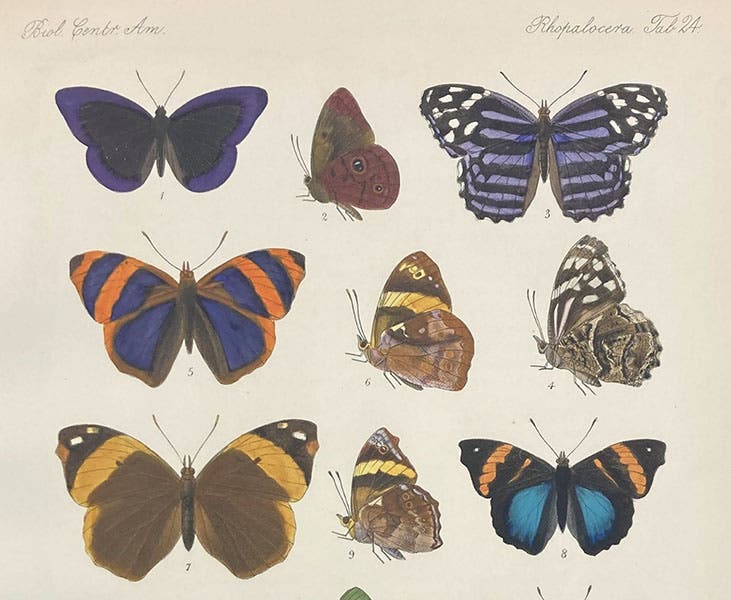
Various butterflies of the genus Eunica, detail of a lithograph by William Purkiss, in Biologia Centrali-Americana: Insecta: Lepidoptera-Rhopalocera, by Frederick DuCane Godman and Osbert Salvin, vol. 3, plate 24, 1879-1901 (Linda Hall Library)
Salvin died on June 1, 1898, after years of poor health, and was buried in Fernhurst Burial Ground, Fernhurst, West Sussex, England.
William B. Ashworth, Jr., Consultant for the History of Science, Linda Hall Library and Associate Professor emeritus, Department of History, University of Missouri-Kansas City. Comments or corrections are welcome; please direct to ashworthw@umkc.edu.