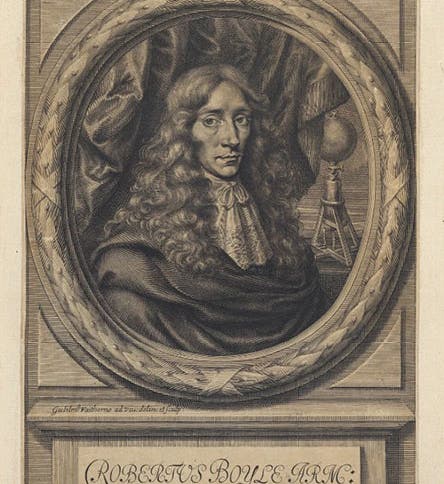
Scientist of the Day - Robert Boyle

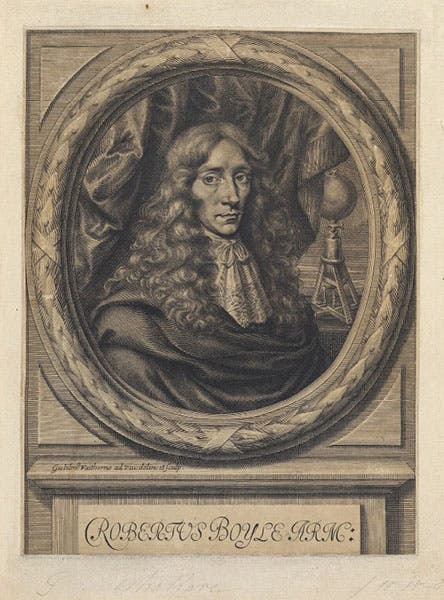
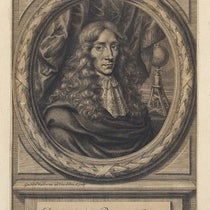
Portrait of Robert Boyle, engraving by William Faithorne, 1664, National Portrait Gallery, London (npg.org.uk)
Robert Boyle, an Irish/English experimental natural philosopher and chemist, died in London on Dec. 30, 1691, at the age of 64. Boyle is well known as a founder of the Royal Society of London, an early experimenter with vacuum pumps, with which he discovered Boyle's Law and the "spring of the air," and as the author of The Sceptical Chymist (1661). We discussed some aspects of his early career in a post on his pneumatic experiments and in a second post on his sympathetic attitude toward alchemy.

Title page, The Christian Virtuoso, by Robert Boyle, 1690, University of Pennsylvania Libraries (Wikimedia commons)
Boyle was also one of the first English natural philosophers to argue that study of the natural world could help us understand the nature and attributes of God, an approach that came to be called natural theology. Especially in his later works, such as Some Considerations Touching the Usefulness of Experimental Natural Philosophy (1664-71)
A Free Enquiry into the Vulgarly Receiv'd Notion of Nature (1686), and The Christian Virtuoso (1690) (first editions of all of which, except for The Christian Virtuoso, are in our collections), Boyle maintained that just as a watch implies the existence of a watchmaker and tells us something about his craftsmanship, so does the created order of nature require a Creator and reveal His wisdom and other attributes. Natural history necessitates natural theology and is the most powerful antidote to atheism that one can find.
Boyle inspired colleagues at the Royal Society, such as John Ray and Nehemiah Grew, to adopt natural theology as the goal of natural history, and Ray’s The Wisdom of God Manifested in the Works of the Creation (1691) is perhaps the quintessential example of a genre that would flourish in England until the 1840’s.

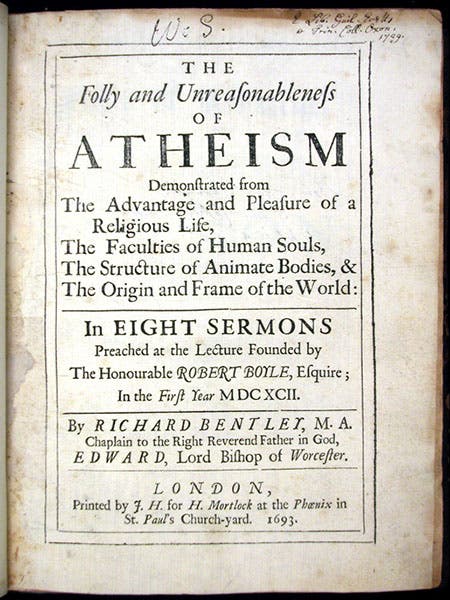
Title page, The Folly and Unreasonableness of Atheism: Demonstrated from … the Structure of Animate Bodies, & the Origin and Frame of the World, by Richard Bentley, 1693 (Linda Hall Library)
Boyle took one further influential step to encourage natural theology as a supplement for revealed religion. He left a bequest in his will to fund an annual set of 8 lectures (sermons, really) “proving the Christian religion against notorious infidels, viz. Atheists, Deists, Pagans, Jews, Mahometans, not descending to any controversies that are among Christians themselves." These came to be called the Boyle Lectures, and the first set was delivered by the classical scholar, Richard Bentley, who was famously advised by Isaac Newton in a series of four letters. Bentley’s Boyle Lectures were delivered in 1692-93 and published as The Folly and Unreasonableness of Atheism: Demonstrated from … the Structure of Animate Bodies, & the Origin and Frame of the World (1693). We have a copy in our collections (third and fourth images).

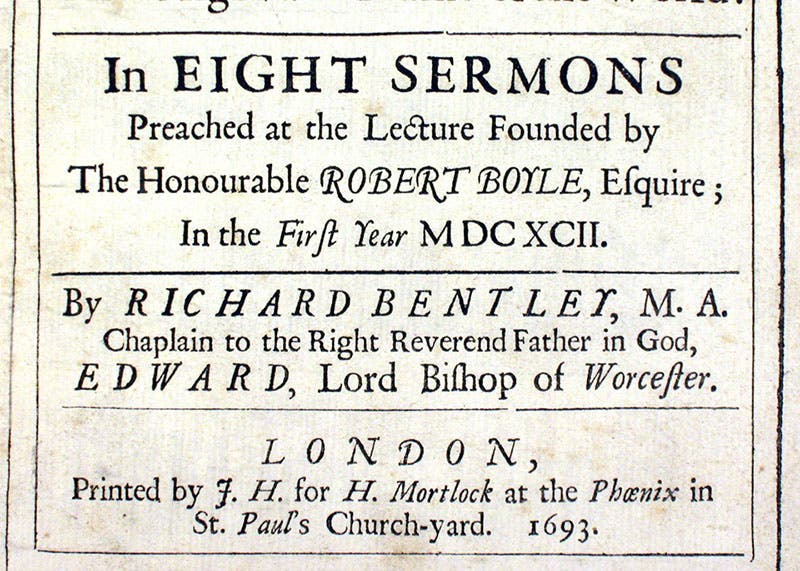
Detail of third image, describing the contents as Boyle Lectures, The Folly and Unreasonableness of Atheism, by Richard Bentley, 1693 (Linda Hall Library)
New sets of Boyle Lectures were delivered semi-regularly well into the 19th century, the most famous (or at least best-selling) being those of William Derham, published as Physico-Theology: or, A Demonstration of the Being and Attributes of God, from his Works of Creation (1714). After a lapse in the 20th century, the Boyle Lectures were resumed in 2004 and are, I believe, still being delivered. How many notorious infidels have been thus confounded, I could not say.
It should be mentioned that although Boyle and Ray have been described as natural theologians for centuries, scholars have recently begun to describe their works as physico-theology, rather than natural theology, maintaining, probably correctly, that natural theology, which goes back to Seneca, also embraces a kind of rational religion that Boyle and his contemporaries explicitly rejected, drawing their evidence from sensible observations only, which require no reason to interpret. I can agree, but I can't help lament the loss of a mellifluous "natural theology" to a less-fluid, hyphen-burdened "physico-theology."
William B. Ashworth, Jr., Consultant for the History of Science, Linda Hall Library and Associate Professor emeritus, Department of History, University of Missouri-Kansas City. Comments or corrections are welcome; please direct to ashworthw@umkc.edu.