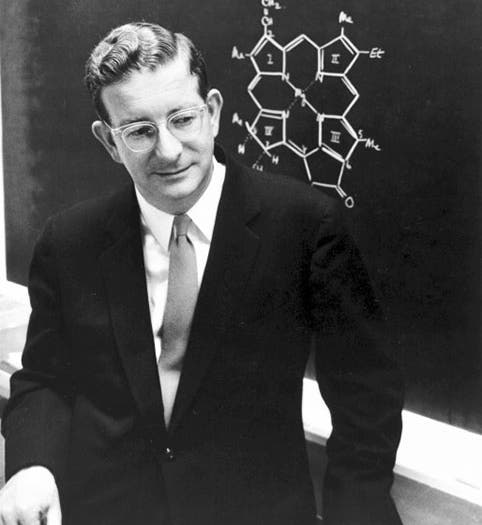
Scientist of the Day - Robert Burns Woodward

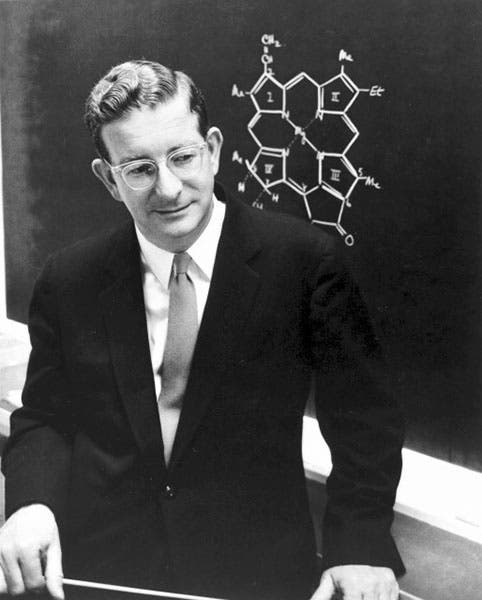
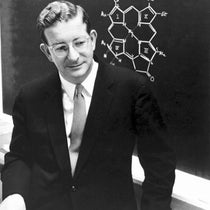
Portrait of Robert Burns Woodward, undated photograph, Dept. of Chemistry, Michigan State University (chemistry.msu.edu)
Robert Burns Woodward, an American organic chemist, was born Apr. 10, 1917, in Boston. His father died when he was only 1 year old (in the flu pandemic of 1918), but his mother managed to get him a good secondary education, and he seems to have focused on chemistry early on. He attended MIT and received his PhD there as well, became a fellow at Harvard, and then moved from fellow to Harvard faculty, a step that very few Harvard fellows manage to pull off. He was at Harvard for the rest of his career.
Woodward was a synthetic organic chemist, which means that he made compounds in the laboratory that Nature made in living organisms, what chemists call natural products. He was, many think, the most accomplished synthetic chemist of the entire 20th century. The list of compounds he synthesized is mind-boggling, and include: quinine, cortisone, chlorophyll, strychnine, cholesterol, and the piece de resistance, vitamin B-12 (second image), which he accomplished with a Swiss collaborator.

Diagram of vitamin B-12, synthesized in 1972 by Robert Woodward and Albert Eschenmoser of Switzerland (Wikimedia commons)
Before Woodward, chemical synthesis was largely a trial-and-error affair – add a chemical, see what happens. Woodward was able to predict what bonds would form when various molecules were added in certain orientations, which greatly speeded up the synthesis. From the 1960s on, he was aided by the collaboration of a theoretical chemist, Roald Hoffmann.
We have mentioned Hoffmann several times in these posts, since he was a poet and a philosopher as well as a chemist, and an insightful writer for the non-chemist, which would include me (see our posts on Fritz Haber and Peter Hjelm). Hoffmann was not only a collaborator with Woodward, he was an admirer, and he once wrote a book, Beyond the Finite: The Sublime in Art and Science (2011), in which he singled out two scientists who both managed to approach the sublime with a sequence of papers – Albert Einstein, with his four papers that appeared in the Annalen der Physik in 1905, and Woodward, with his series on the total synthesis of natural products, which were published in the Journal of the American Chemical Society from 1945 to 1968. Both sets of papers were beautiful and elegant, terms not often used to describe scientific articles. Einstein and Woodward made a fine pair. Woodward and Hoffmann developed some important rules that allowed chemists to predict certain reactions, for which they won the first Cope Award in 1973 (third image).

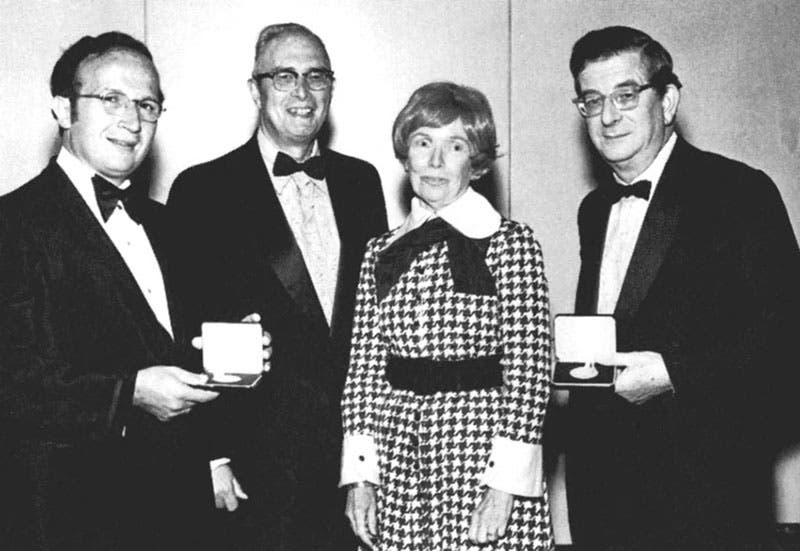
Robert Woodward (right) and Roald Hoffmann (left), receiving the first Cope award, 1972, photograph, American Chemical Society (researchgate.net)
Woodward received the Nobel Prize in Chemistry in 1965 “for his outstanding achievements in the art of organic synthesis.” A photo taken of the 1965 Nobel winners (fourth image) has Woodward at far left, showing his award to physicists Julian Schwinger and Richard Feynman, while Francois Jacob, Andre Lwoff, and Jacques Monod, winners in Medicine/Physiology, look on tolerantly from the right. Who knows what the Nobelist in literature, Mikhail Sholokhov, thought about the photo session, since he has been cropped right out of the picture.

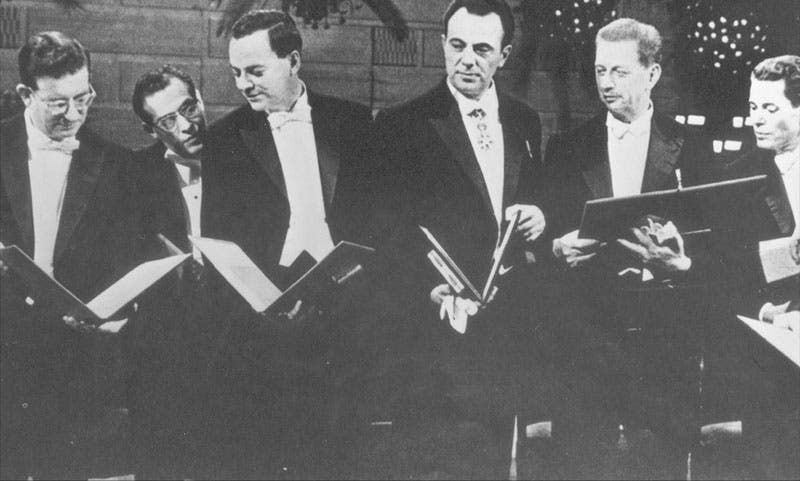
Nobel Prize recipients for 1965; Robert Woodward is at far left, showing his award to physicists Julian Schwinger and Richard Feynman, who have awards of their own that look just like it, Caltech Archives (digital.archives.caltech.edu)
Woodward died of a heart attack on July 8, 1979, at the age of 62, and was buried in Mount Auburn Cemetery in Cambridge.
William B. Ashworth, Jr., Consultant for the History of Science, Linda Hall Library and Associate Professor emeritus, Department of History, University of Missouri-Kansas City. Comments or corrections are welcome; please direct to ashworthw@umkc.edu.