Scientist of the Day - Robert Wiliamson


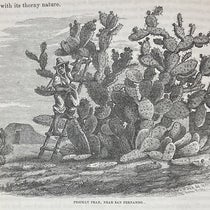
Prickly pear, wood engraving, Report of Explorations in California for Railroad Routes, By Robert S. Williamson (Pacific Railroad Reports, vol. 5), p. 74, 1855 (Linda Hall Library)
Robert S. Williamson, an American Army officer, topographical engineer, and explorer, was born Jan. 21, 1825, in Oxford, New York. He graduated from West Point in 1848, just as the Mexican War ended, and was sent west to survey portions of the Sierras just north of San Francisco in 1849.

Portrait of Robert S. Williamson, photograph, Civil War, Library of Congress (Wikimedia commons)
In 1853, the U.S. Congress authorized and provided funds for four survey expeditions to search for the optimal route for a transcontinental railroad. Surveying parties were sent west along the 32nd, 35th, 38-39th, and 47-49th parallels to search for passes across the Rockies and to map geological features, water sources, and indigenous settlements. Three additional expeditions were dispatched up and down California to find passes through the Sierra Nevada range to connect with the four western routes. The results of all the expeditions were published in 12 volumes (really 13, as one volume was double), that are known collectively as the Pacific Railroad Reports (PRR), published between 1855 and 1861. We have two complete sets in our library, and we have discussed many of the volumes in this forum.


Title page, Report of Explorations in California for Railroad Routes, by Robert S. Williamson (Pacific Railroad Reports, vol. 5), 1855 (Linda Hall Library)
But we have never featured Williamson’s volume, vol. 5. In 1853, although only 28 years old, he was asked by the Corps of Topographical Engineers to lead an expedition to explore the southern Sierra Nevadas just east of the San Joachin Valley and west of the Great Basin, looking for passes that might connect the 32nd and 35th parallel routes with San Diego, Los Angeles, or the San Bernardino valley. They started in Benecia near San Francisco and went south. The survey was finished by fall and Williamson wrote his narrative, edited the substantial accounts of the expedition’s botanist and geologist, and published all the accounts in 1855 as volume 5 of the PRR. All of our accompanying images (except for the portrait) have been taken from this volume.


Geological map of Tejon Pass linking southern California to the Central Valley, engraving in Report of Explorations in California for Railroad Routes, by Robert S. Williamson (Pacific Railroad Reports, vol. 5), map plate 3, 1855 (Linda Hall Library)
The big surprise of the Williamson survey was that they did not find a feasible way to connect the 32nd parallel route to San Diego – a surprise because the 32nd-parallel route was the overwhelming first choice of Congress, and especially of the Secretary of War and the man who authorized the surveys, Jefferson Davis. The Gadsden Purchase of 1854 was made primarily to provide right of way for a southern railway. But San Diego would not be the endpoint for the first transcontinental railroad. That would run much farther north.


Cacti in a valley on the slope of the Great Basin, chromolithograph after a sketch by Charles Koppel, in Report of Explorations in California for Railroad Routes, by Robert S. Williamson (Pacific Railroad Reports, vol. 5), plate 11, p. 215, 1855 (Linda Hall Library)
To most of us, the great appeal of Williamson’s PRR volume lies in the illustrations. There are many full-page chromolithographs of army posts, encampments, mountain ranges, Native Americans, and scenery. There are even more wood engravings in the text, showing geologic features, plants, and sites. And of course, there are maps.


Inclined strata of limestone near San Amédio, wood engraving in Report of Explorations in California for Railroad Routes, by Robert S. Williamson (Pacific Railroad Reports, vol. 5), p. 45, 1855 (Linda Hall Library)
We chose images to reproduce here that are interesting, unusual, or attractive. And my favorite by far is the one I, perversely, saved for last, the “Beauty of the Forest,” a giant sequoia (seventh image). I love the way the height of the tree is conveyed by having the top poke through the margin of the lithograph. The print was based on a sketch by William P. Blake, Williamson’s geologist. The official artist on the expedition was Charles Koppel, who did most of the illustrations in the Report.


Mammoth Tree “Beauty of the Forest,” a sequoia, chromolithograph after a sketch by William P. Blake, in Report of Explorations in California for Railroad Routes, by Robert S. Williamson (Pacific Railroad Reports, vol. 5), plate 13, p. 258, 1855 (Linda Hall Library)
Williamson led another railroad survey the next year, looking for routes that could connect San Francisco to Oregon and Washington, should the transcontinental route selected be a northern one. But Williamson became ill halfway through, and the report (vol. 6 of the PRR) was written by the second in command, Henry Abbot. We wrote about the expedition artist, John J. Young, last fall, and showed some chromolithographs of other California conifers, including a marvelous Douglas fir.


General title page, which precedes Williamson’s title page (third image), Reports of explorations and surveys, to ascertain the most practicable and economical route for a railroad from the Mississippi River to the Pacific Ocean (Pacific Railroad Reports, vol. 5), 1855 (Linda Hall Library)
Williamson served as a Topographical Engineer during the Civil War for the Army of the Potomac, ending up in San Francisco, where he stayed on after the war, in charge of the entire western coastline. He made the first harbor improvements to San Pedro Bay, initiating what would become the Port of Los Angeles. I am pretty sure there are no statues or memorial plaques for Williamson in San Diego, since he twice shredded their hopes to become the major port of Southern California.
Williamson died on Nov. 10, 1882, and was buried in San Francisco.
William B. Ashworth, Jr., Consultant for the History of Science, Linda Hall Library and Associate Professor emeritus, Department of History, University of Missouri-Kansas City. Comments or corrections are welcome; please direct to ashworthw@umkc.edu.