Scientist of the Day - SCORE

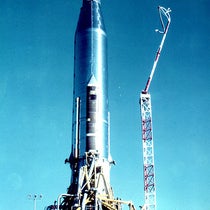
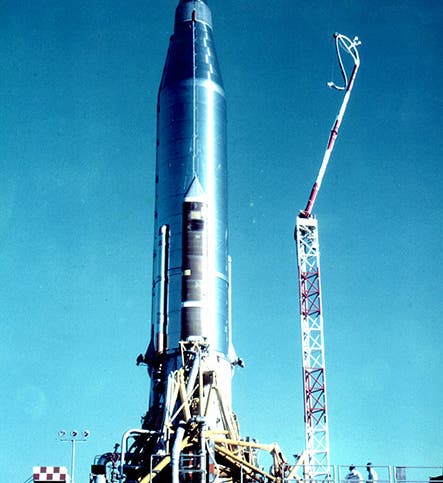
Atlas 10B rocket on the launch pad at Cape Canaveral, with the SCORE tape recorders and radios under the fairings at top, photograph, December 1958 (Wikimedia commons)
On Dec. 18, 1958, the United States successfully launched and put into orbit the world's first communications satellite, called SCORE. It was carried into space by a new breed of rocket, the Atlas (to be specific, the Atlas 10B). This was a strange launch, because it was top secret – only three dozen people knew what was going on; most of the rest of the nascent American space community, including even the launch crew, and the press, were kept in the dark, being told this was just a test launch. The secrecy was deemed necessary because the U.S. had suffered 4 straight failures attempting to orbit a satellite; another would be unacceptable. If SCORE did fail, it could be passed off as a test launch, its true mission undisclosed.
SCORE was one of those inane acronyms that only becomes an acronym later, when someone finally thinks of 5 words to match the 5 letters. In this case, SCORE was said to stand for: Signal Communications by Orbiting Relay Equipment. The acronym may have been dumb, but the mission was ingenious: to put up a satellite with a tape recorder and a short-wave radio that could broadcast a prepared message, or receive and record one from ground and rebroadcast it. The second possibility became vital when President Eisenhower decided at the last minute that he wanted his to be the voice broadcast from space, replacing the message already taped and installed, with the voice of the Secretary of the Army. A tape with Eisenhower’s greeting was sent by courier to Cape Canaveral, but it was too late – the payload was already sealed up in the fairings of the nose cone. So they broadcast Eisenhower’s message to the second tape recorder there on the launch pad – there were two recorders on board – and the day after the launch, Dec. 19, Eisenhower’s words were broadcast to the world – the first ever broadcast from space. Hardly anyone could pick up the faint signal – the radios ran on batteries – but the news networks of the world rebroadcast it, so it was heard. You can hear it yourself at this link (click on the play arrow).

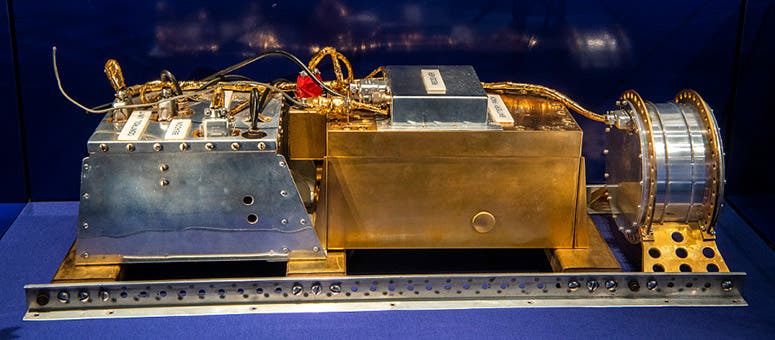
One of the backup tape recorders/radio sets for Project SCORE, on display at the National Air and Space Museum, Smithsonian Institution, Washington, D.C. (airandspace.si.edu)
A backup of one of the tape recorder/radio sets for Project Score is on display in the National Air and Space Museum (second image). The two recorders and radios, and their batteries, together weighed about 150 pounds, and this is sometimes given as the weight of the payload. In fact, the entire Atlas rocket, all 80 feet and 8700 pounds of it, minus the booster engines, was placed into orbit, making it by far the heaviest payload ever put into Earth orbit. It stayed there for over a month, receiving and resending new messages, until the batteries went dead and atmospheric drag took its toll, and SCORE came down in the Pacific. The Space Race was now officially ON.
The SCORE spacecraft was developed and launched by a new agency, ARPA, with a valid acronym (Advanced Research Projects Agency). NASA had been formed in the summer of 1958 and so far had four failed Pioneer launches and four failed Vanguard launches on its ledger, with no successes (the two previous successful attempts at orbit, Explorer 1 and Vanguard 1, in February and March of 1958, were pre-NASA). No doubt NASA administrators were not pleased at the singular success of ARPA, and must have cried foul, for almost immediately all of ARPA's space programs were transferred to NASA, and the director of ARPA resigned. So much for small, secretive (and successful) space programs. Fortunately, NASA did finally get a handle on things. But it would never bat one for one in orbital attempts, as ARPA did.
William B. Ashworth, Jr., Consultant for the History of Science, Linda Hall Library and Associate Professor emeritus, Department of History, University of Missouri-Kansas City. Comments or corrections are welcome; please direct to ashworthw@umkc.edu.