

Scientist of the Day - Umberto Eco

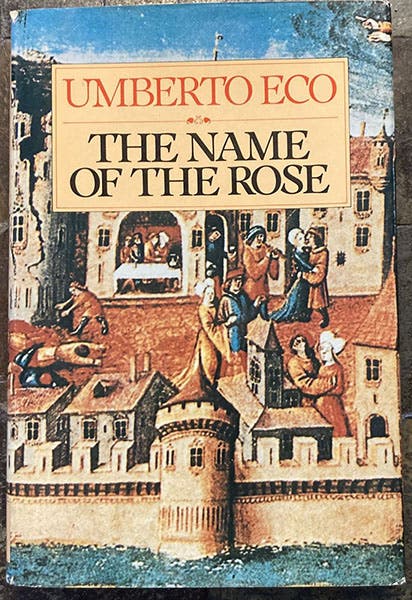
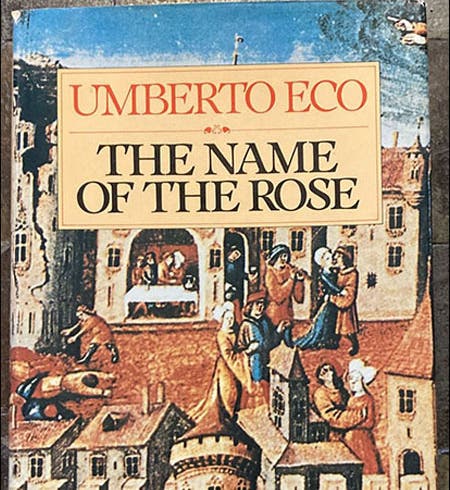
Dust jacket, The Name of the Rose, by Umberto Eco, first English edition, 1983 (author’s copy)
Umberto Eco, an Italian historian, semiotician, and novelist, was born Jan. 5, 1932. Eco was a professor of semiotics at the University of Bologna for many years, and unless you yourself are a semiotician, concerned with signs and semantics, and fluent in Italian, you are unlikely to encounter anything Eco wrote before he was 50. However, in 1980, he published his first novel, The Name of the Rose, so titled in the English translation of 1983, which sold millions of copies. The book, a medieval murder mystery, had no overtly scientific theme (although one of the monks in the monastery was murdered by having his head smashed by an armillary sphere, which might be a literary and astronomical first), but the setting in 1327, when the new mendicant orders, Franciscans and Dominicans, were protesting against the rampant amassing of wealth by the Church, provides parallels with what is happening in medieval science and philosophy with the rise of scholasticism (the chief protagonist in the book, William of Baskerville, is a Franciscan).

Portrait of Umberto Eco, photograph, 1984 (Wikimedia commons)
I liked the fact that the monastery setting included a vast library with hidden rooms and mysterious books, and a lost treatise by Aristotle, as well an aged abbot, Jorge of Burgos, who was apparently modeled on Eco's friend, Jorge Luis Borges, who was also fascinated by libraries, especially infinite ones (see our post on Borges). William fails as Sherlock Holmes in the end, not the typical outcome of a murder mystery, and the book can be a heavy slog (500 pages), but it is still well worth reading, especially if you already know a little about Thomas Aquinas and William of Ockham and medieval science. The film of 1986, with Sean Connery as William of Baskerville, was entertaining, but quite a different experience from reading the book.


Dust jacket, Foucault’s Pendulum, by Umberto Eco, first English edition, 1989 (author’s copy)
In 1988, Eco published his second novel, Foucault's Pendulum, and this book displays an easy familiarity with science and its history that is unusual among writers. Foucault's Pendulum starts out in the church of Saint-Martin-des-Champs in Paris, now part of the Musée des Arts et Métiers, the French equivalent to the Science Museum in London or the Museum of Science and Industry in Chicago. The main character, Casaubon, is watching the original Foucault's pendulum, which in 1851 was hung from the ceiling of the Pantheon and, as its plane of oscillation slowly changed, gave unequivocal evidence of the rotation of the earth. The pendulum was moved to the church in 1855 and has swung back and forth ever since (see our post on Leon Foucault). When not watching the pendulum, Casaubon discourses on the Salle Lavoisier, where much of Antoine Lavoisier's original laboratory equipment is installed, and the various airplanes and automobiles that can still be seen there, such as the original steam-powered car built by Nicolas-Joseph Cugnot back in 1770. Most of the rest of the novel is concerned with the attempt of Casaubon and his two colleagues at a vanity press in Milan to invent a conspiracy theory, for amusement, built on the legendary history of the Knights Templar, and how the theory takes on a life of its own as it attracts adepts and acolytes. If this sounds familiar to those who read The Da Vinci Code, just remember that Foucault's Pendulum was written in 1988 and Dan Brown's book came out in 2003. It is also worth noting that when Eco talked of secret histories and cosmic ciphers, he had his tongue firmly in his cheek, while The Da Vinci Code took it all very seriously. Anyway, Foucault’s Pendulum is highly recommended, provided that you have a month or so of reading time available to get through its 640 pages.


Dust jacket, Postscript to the Name of the Rose, by Umberto Eco, first English edition, 1984 (author’s copy)
Eco published a third novel in 1994, this one again historical, and called The Island of the Day Before, in the English translation of 1995. It also has a scientific subplot, concerning 17th-century attempts to use the satellites of Jupiter to determine longitude at sea. I have not read this one, nor have I read any of Eco's published lectures or occasional pieces, all of which are readily available in English. I do recommend his Postscript to the Name of the Rose (1984), which in its 84 whimsical pages provides rare insight into what a semiotician thinks about when he is trying to write a historical novel.
William B. Ashworth, Jr., Consultant for the History of Science, Linda Hall Library and Associate Professor emeritus, Department of History, University of Missouri-Kansas City. Comments or corrections are welcome; please direct to ashworthw@umkc.edu.


