Scientist of the Day - Albert Albert

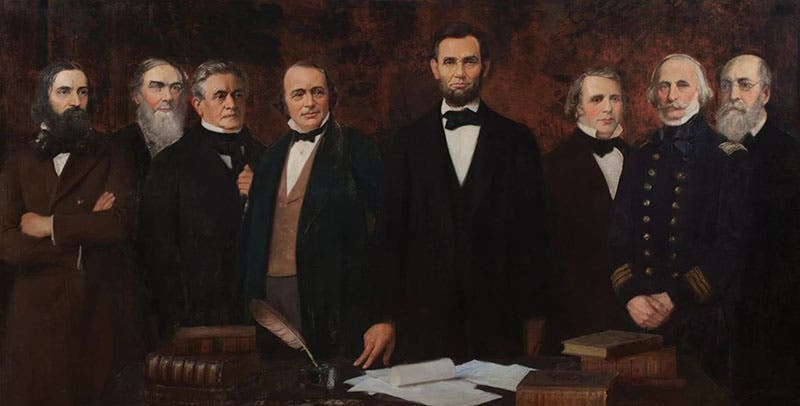
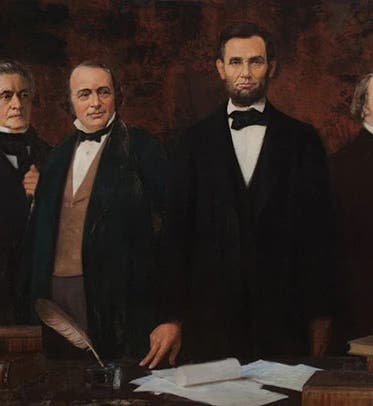
Signing the charter of the National Academy of Sciences, Mar. 3, 1863, oil on canvas by Albert Herter, 1924, National Academy of Sciences, Washington, D.C. (pnas.org)
Albert Herter, an American painter, was born Mar. 2, 1871. Herter was a portrait and genre painter in his younger days, but later he specialized in, of all things, painting murals in court houses and government buildings. In my graduate days at the University of Wisconsin, I remember seeing Herter's mural of the signing of the U.S. constitution in the State Supreme Court Hearing Room at the State Capitol in Madison. But perhaps Herter’s best-known painting is one he did in 1924, to commemorate the signing of the charter of the National Academy of Sciences on Mar. 3, 1863 (first image).

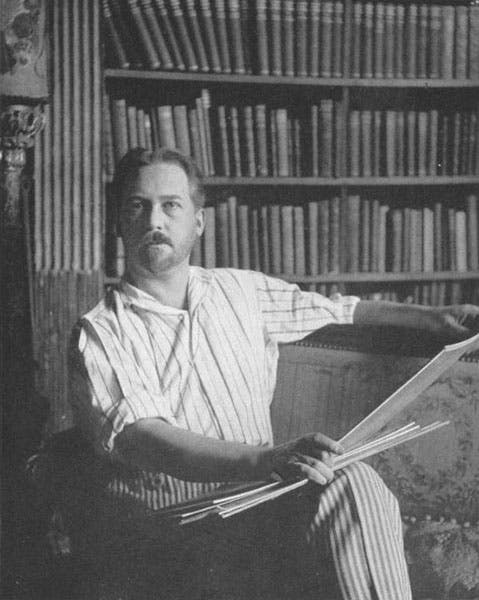
Portrait of Albert Herter, undated photograph (mydailyartdisplay.uk)
Abraham Lincoln is the most noticeable figure in the painting, and he is of course the one doing the signing. But the other persons depicted include most of the important public scientific figures in mid-19th-century America. There is Louis Agassiz, the Harvard zoologist who had come to the United States from Switzerland after discovering the Ice Age – he is just to the viewer’s left of Lincoln. Next to Agassiz is Joseph Henry (third from left), who was Secretary (i.e., head) of the Smithsonian Institution and a pioneer in the fields of electromagnetism and telegraphy.
At the far left is Benjamin Peirce, a Harvard astronomer, and next to him is Alexander Dallas Bache (second from left), head of the U.S. Coast Survey. At the far right stands Benjamin Apthorp Gould, another prominent astronomer at Harvard. The other two individuals are Henry Wilson, a senator from Massachusetts who introduced the bill establishing the National Academy into Congress in 1863; he is just to the right of Lincoln, and would be elected vice-president of the United States a decade later. Next to Wilson is Charles Henry Davis (second from right), a Navy Admiral who was the first superintendent of the American Nautical Almanac Office, and who provided the military connections thought necessary in founding the academy.
There used to be several photos of Herter's painting and its boardroom setting on the National Academy of Sciences website, but those links do not work anymore, and I cannot find new ones. Fortunately, we have shown those photos in posts on Bache and Peirce, and you may still see them there. The Proceedings of the National Academy of Sciences ran a story in 2013 on the 150th anniversary of the signing of the charter, with a photo of Herter’s painting, and that one is still up online, and provided us with our reproduction today.
Herter appears to have been blessed from birth – he was handsome, had real artistic talent, and was filthy rich with family money. But his only foray into the sciences was the painting we feature today, so it is unlikely we will encounter him again. But if you ever visit the National Academy in Washington, please be sure to ask to see the boardroom. I am sure Herter's painting is much more impressive in person.
William B. Ashworth, Jr., Consultant for the History of Science, Linda Hall Library and Associate Professor emeritus, Department of History, University of Missouri-Kansas City. Comments or corrections are welcome; please direct to ashworthw@umkc.edu.