Scientist of the Day - Torbern Bergman

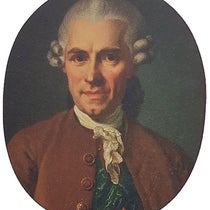
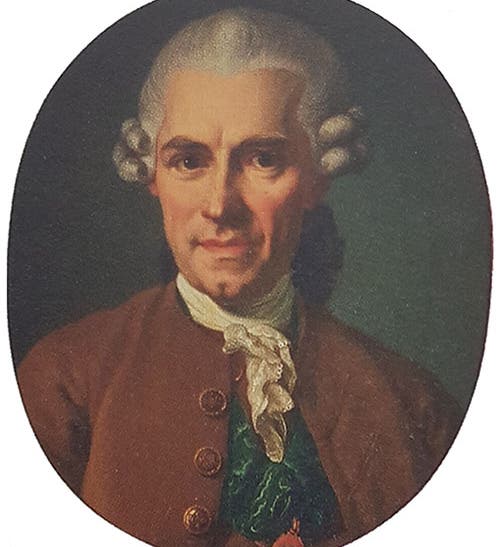
Portrait of Torbern Bergman, oil on canvas, by Per Krafft the Elder (Wikimedia commons)
Torbern Bergman, a Swedish chemist and geologist, died July 8, 1784, at age 49. He was born on Mar. 20, 1735, and attended Uppsala University, where Carl Linnaeus presided over the teaching of natural history, inspiring Bergman, as well as dozens of other young Swedes. It is not clear how much chemistry Bergman studied at Uppsala, where Johann Wallerius had become the first professor of chemistry in 1750, but when Wallerius retired in 1767, Bergman was nominated to be his successor, even though he had never taught chemistry. His nomination prevailed, and he went on to become the most distinguished Swedish academic chemist of the century, even though he died prematurely. His principal rival for distinction, and protégée and close friend, Carl Scheele, discoverer of oxygen, was a pharmacist, not a professor.

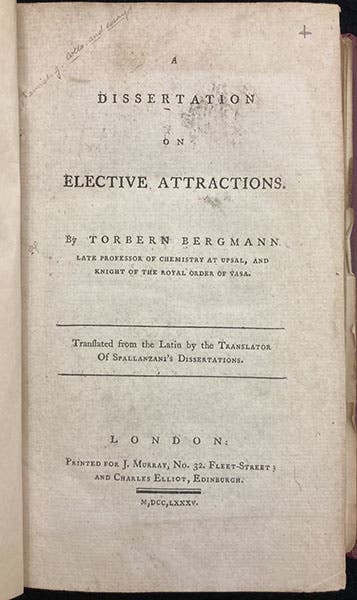
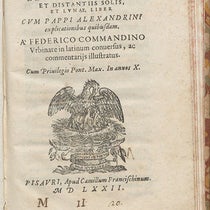
Title page, A Dissertation on Elective Attractions, by Torbern Bergman, transl. by Thomas Beddoes, 1785 (Linda Hall Library)
Bergman’s most notable contribution to chemistry was to prepare a large “Table of Elective Attractions” in 1775. Most elements have a propensity – an affinity – to combine with other elements, and these affinities have a pecking order. Bergman selected 50 substances – some elements, some compounds – and determined all the other substances that have a chemical affinity for each of the 50. He then ranked them in order, and assembled all this information in the form of a large folding table. The table was included in a monograph published in the 1775 volume of the Nova Acta of the Swedish Royal Academy of Sciences. We have a good run of this journal, but not the early volume that contains Bergman’s table. That is just as well, for Bergman represented each of his substances with a chemical symbol of his own making, not the ones you are used to, so the table would be meaningless to modern readers. Fortunately, Bergman's paper and tables were translated into English in 1785, and the translator substituted English words for the symbols, which does wonders for our understanding. We have this translation, and we show you the complete table (third image), and a detail of some of the substances, which include the calxes (oxides) of copper and iron. The substances with which they react, mostly acids, are lined up below them in the order of their affinities, with the most reactive at the top. In the English version, Bergman’s original table became three tables; we show the third of the three.

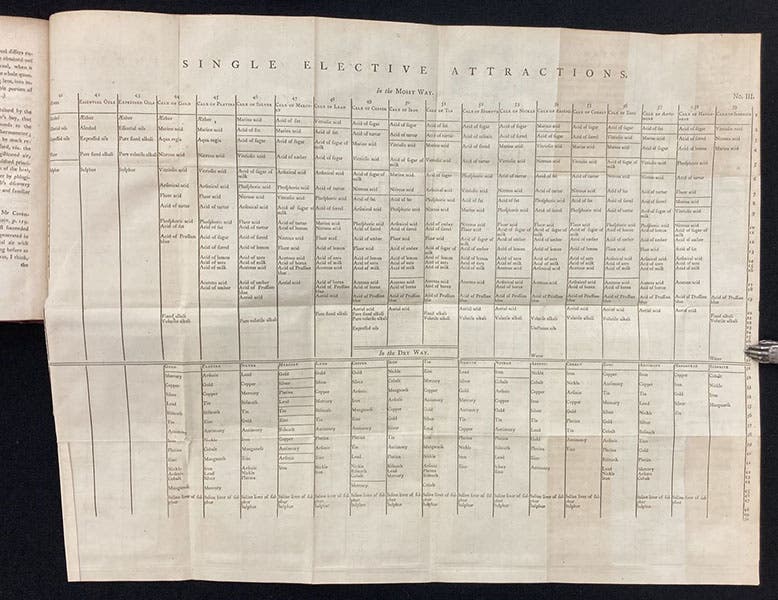
“Single Elective Attractions,” the third of three tables of affinities, in A Dissertation on Elective Attractions, by Torbern Bergman, transl. by Thomas Beddoes, 1785 (Linda Hall Library)
Unfortunately for Bergman, he attached his affinity table to a chemical theory that was about to be replaced. The phlogiston theory was very popular in the 1770s and 80s; at its heart was the belief that there was an element – phlogiston – that was responsible for, and given off during, combustion. Indeed, one of Bergman's 50 substances – no. 29 – was phlogiston. However, Antoine Lavoisier was about to show, in the 1780s, that combustion (and calcination) involved the taking on of oxygen (oxidation) rather than the giving off of phlogiston, the existence of which was denied by Lavoisier and his school. As the oxygen theory of combustion rose in popularity, anything attached to the phlogiston theory became less appealing, and that included Bergman's affinity tables. They never had the unifying effect that the periodic table would have nearly a century later. It did not help that Bergman died prematurely, in 1784.

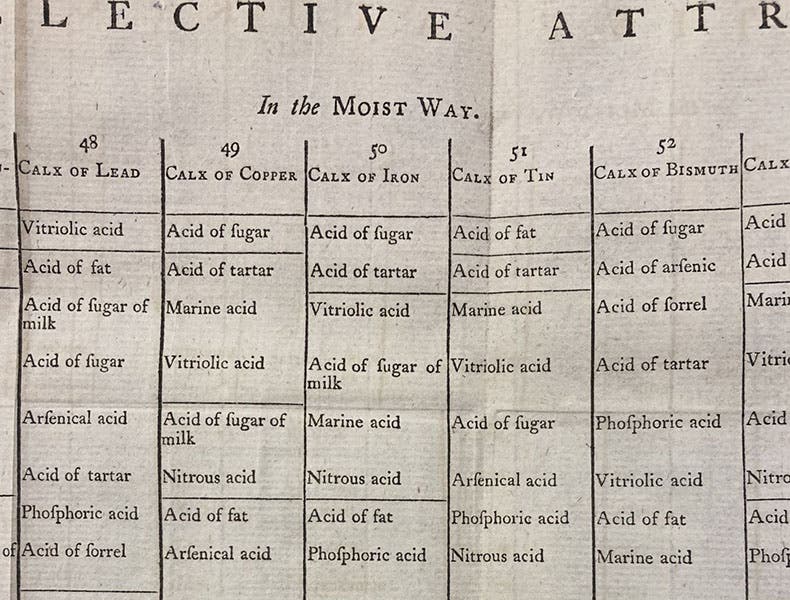
Detail of “Single Elective Attractions,” the third of three tables of affinities, showing the calxes (oxides) of copper, iron, and tin, and below, the substances for which they have chemical affinities, in order, in A Dissertation on Elective Attractions, by Torbern Bergman, transl. by Thomas Beddoes, 1785 (Linda Hall Library)
Bergman was adept in quite a few branches of science, close to being a polymath, and he wrote, among other works, the first book in Swedish on physical geography: Physical Description of the Earth (1766). We included an edition of that book in our exhibition, Theories of the Earth, 1644-1830: The History of a Genre (1984). We will write a second post about it one day
William B. Ashworth, Jr., Consultant for the History of Science, Linda Hall Library and Associate Professor emeritus, Department of History, University of Missouri-Kansas City. Comments or corrections are welcome; please direct to ashworthw@umkc.edu.