Scientist of the Day - Lawrence Bragg

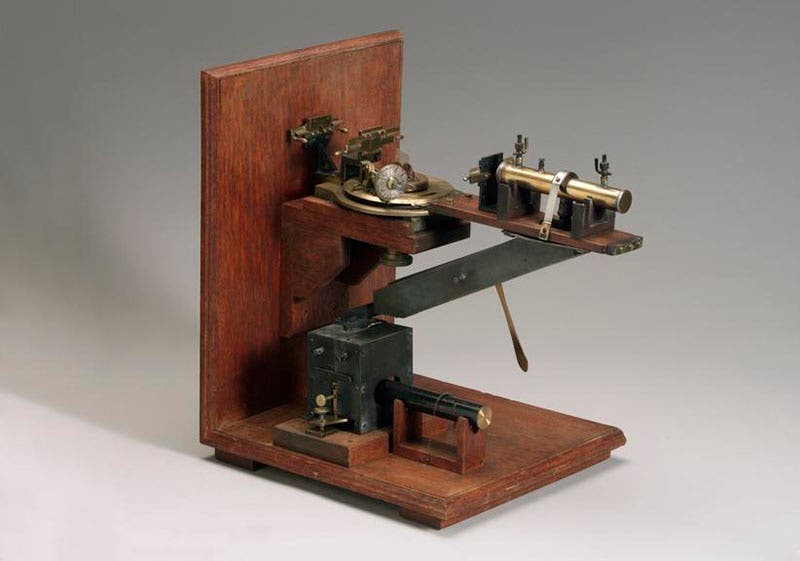
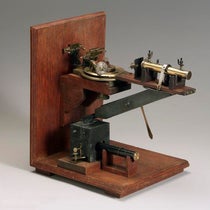
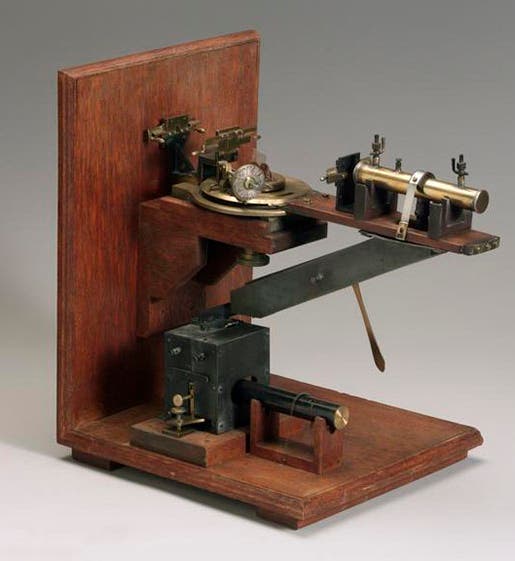
An original X-ray spectrometer used by William and Lawence Bragg in their experiments of 1913-14, Science Museums Group Collection, London (collection.sciencemuseumgroup.org.uk)
William Lawrence Bragg, an Australian/British physicist, died July 1, 1971, at age 81. He is usually known as Lawrence Bragg, because his father, William Henry Bragg, also a well-known physicist, went by the name William. William was teaching at the University of Adelaide when Lawrence was born, on Mar. 31, 1890, and continued to teach there until 1908, when he accepted a position back in England, at the University of Leeds. Lawrence came along, but not to Leeds. He was 18 years old, and he enrolled at Trinity College, Cambridge, to study physics.

Portrait of Lawrence Bragg, photograph, 1930 (Wikimedia commons)
Father and son were both interested in X-rays, which had been discovered by Wilhelm Röntgen in Wurzburg in 1895. No one knew if X-rays were electromagnetic waves or particles. It was known how to produce them – put a metallic target in a "Crookes tube," an early form of cathode-ray tube – and out they came, able to penetrate human flesh and produce an image on film. Otherwise, they were a mystery.

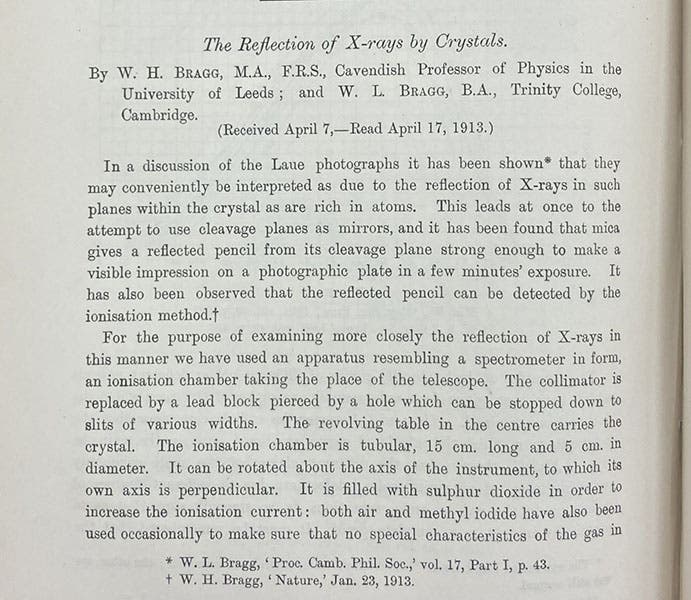
First paragraph, “The Reflection of X-rays by Crystals,” by William H. and W. Lawrence Bragg, Proceedings of the Royal Society of London, vol. 88, p. 428 (Linda Hall Library)
Then, in 1912, a German physicist, Max von Laue, engineered an experiment in which X-rays were bounced off a slab of rock salt and directed at a piece of photographic film. The developed film showed dots of light, an unmistakable diffraction pattern, indicating that the X-rays were being bounced off the crystal lattice and interfering with each other, producing patterns of light and dark. X-rays appeared to be waves after all, which meant they had wavelengths, waiting to be measured. It was guessed that these waves were very short, if they could be diffracted by crystals. But no one knew how to measure them.

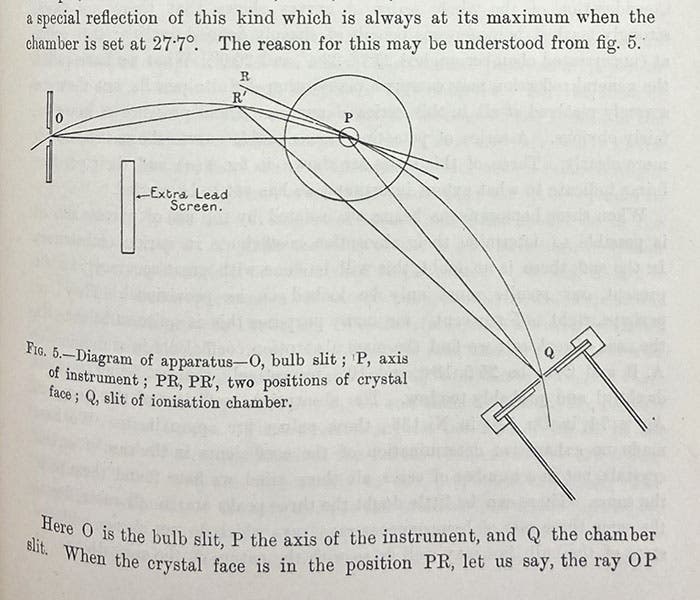
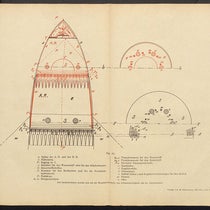
Diagram of the first X-ray spectrometer, with X-ray source at left, crystal lattice target at center, and ionization chamber detector at lower right, “The Reflection of X-rays by Crystals,” by William H. and W. Lawrence Bragg, Proceedings of the Royal Society of London, vol. 88, p. 433 (Linda Hall Library)
Laue sent his photograph around to various physics societies, and both William and Lawrence saw it and knew what it meant. William immediately invented an instrument, an X-ray spectrometer, which bounced X-rays off a crystal face at a shallow angle and into an ionization chamber, where intensities could be measured. They discovered that when platinum was used as a target in the Crookes tube, it emitted X-rays of three different wavelengths, which they could measure, Lawrence discovered a formula that predicted the wavelengths from the angle of incidence and the thickness of the crystal lattice. It was as exciting as when Kirchhoff and Bunsen had discovered in 1859 that sodium, when burned, produced two yellow lines in the visible spectrum. Now the invisible spectrum could be mapped as well.

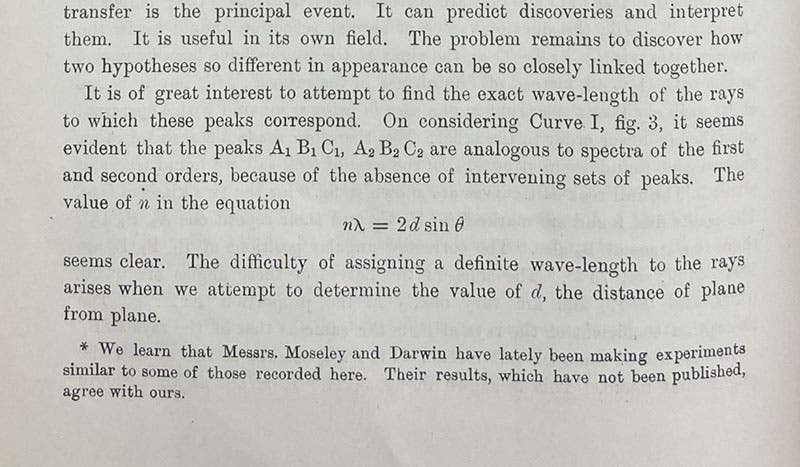
First statement of Bragg’s law, discovered by Lawrence Bragg, relating the wavelengths of X-rays to the size of the crystal lattice target and the angle of incidence, “The Reflection of X-rays by Crystals,” by William H. and W. Lawrence Bragg, Proceedings of the Royal Society of London, vol. 88, p. 436 (Linda Hall Library)
The two Braggs announced their results in a paper submitted to the Royal Society of London on April 7, 1913, and it was printed that summer in the Society's Proceedings. It was called “The Reflection of X-rays by Crystals,” and it included a diagram of their newly invented spectrometer (fourth image) and Lawrence's diffraction law (fifth image).

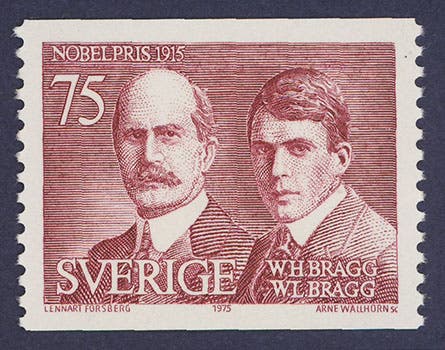
William and Lawence Bagg on a Swedish postage samp, 1975 (jgiesen.de)
The Braggs realized that they could use their apparatus to investigate both the X-rays (X-ray spectrometry) and the crystal targets (X-ray crystallography). It made possible the discovery of all sorts of molecular structures, including that of DNA in 1953.
For their role in founding X-ray spectrometry and X-ray crystallography, William and Lawrence Bragg were jointly awarded the Nobel Prize for Physics in 1915. It is the only time a father-and-son team have shared a Nobel Prize.
Lawrence went on to have a distinguished career as a physicist, first at the University of Manchester, and then back at Cambridge. He lived long enough to celebrate the 50th anniversary of his Nobel Prize, which I would suspect is a rare occurrence. Interestingly, Bragg was director of the Cavendish Lab at Cambridge when James Watson and Francis Crick, working there, discovered the helical structure of DNA. One of the clues seized upon by Watson to unravel DNA structure was provided by the photographs taken of crystallized DNA by Rosalind Franklin, who employed X-ray crystallography, the very technique made possible by Lawrence and his father (and Max von Laue) in 1913.

Group portrait of the participants at the 1927 Solvay Conference in Brussels; Lawence Bragg is 3rd from left in the second row, just behind Max Planck and Marie Curie (Wikimedia commons)
One place you might not think to look for Lawence Bragg is in the official group portrait (seventh image) of the invitees to the 1927 Solvay Conference in Brussels, a portrait made famous by the presence of the entire cast of the quantum physics revolution, including Max Planck, Albert Einstein, Erwin Schrödinger, Werner Heisenberg, and Wolfgang Pauli. But there, just behind and to the left of Marie Curie, sits Lawrence Bragg, third from the left in the second row.

Blue plaque for Lawrence Bragg, University of Manchester (Wikimedia commons)
Lawrence only recently received his Blue Plaque, a requisite for any distinguished scientist in the British Isles (last image); I am not sure why it took a full century after his Nobel Prize to get it designed and mounted. But we shouldn’t complain, for it is on display now, at the University of Manchester, a counterpart to his father’s plaque at the University of Leeds.
William B. Ashworth, Jr., Consultant for the History of Science, Linda Hall Library and Associate Professor emeritus, Department of History, University of Missouri-Kansas City. Comments or corrections are welcome; please direct to ashworthw@umkc.edu.