Scientist of the Day - Jean-Dominique comte de Cassini

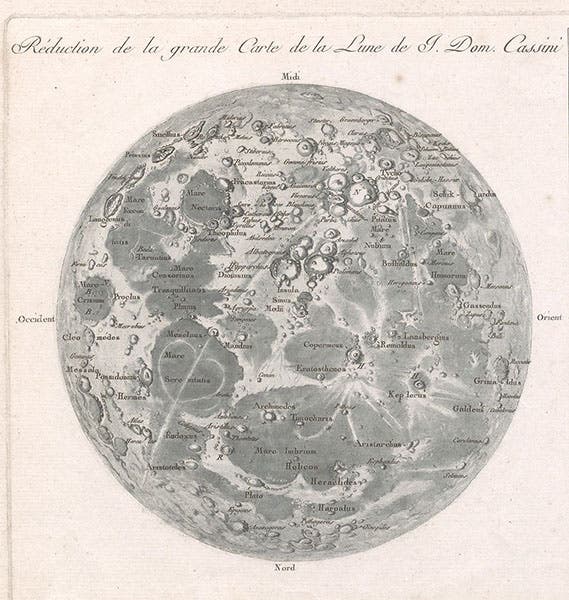
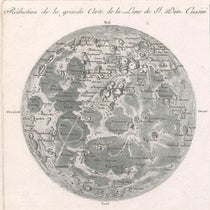
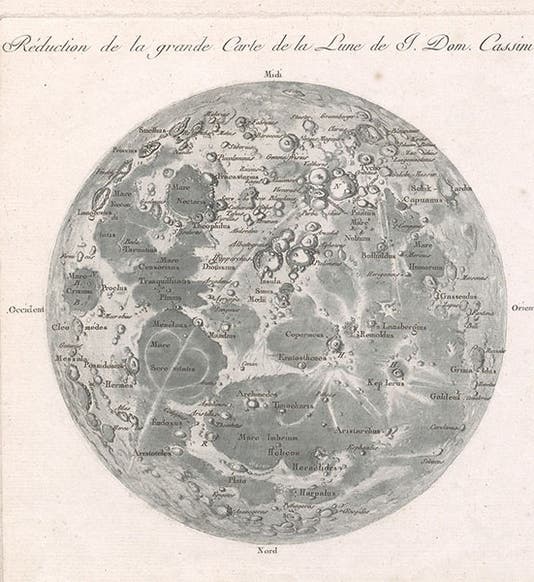
The Full Moon with nomenclature, detail of Réduction de la grande carte de la lune de J. Dom. Cassini, broadside engraving, by Jean-Dominique, comte de Cassini, 1788 (Linda Hall Library)
Jean-Dominique, comte de Cassini, the fourth and last of a dynasty of French astronomers, was born June 30, 1748, in Paris. Indeed, he was born in the very Paris Observatory that had been founded by his great-grandfather and namesake, Giovanni Domenico Cassini, in 1671. Giovanni Domenico, often referred to as Cassini I, had discovered the Cassini division in the rings of Saturn and the Great Red Spot on Jupiter, and had sired the next observatory director, Jacques, known as Cassini II. Jacques surveyed an arc of the meridian that ran through Paris, and produced a son, César-François Cassini de Thury, or Cassini III. He also directed the Paris Observatory, and fathered Cassini IV, our subject today.

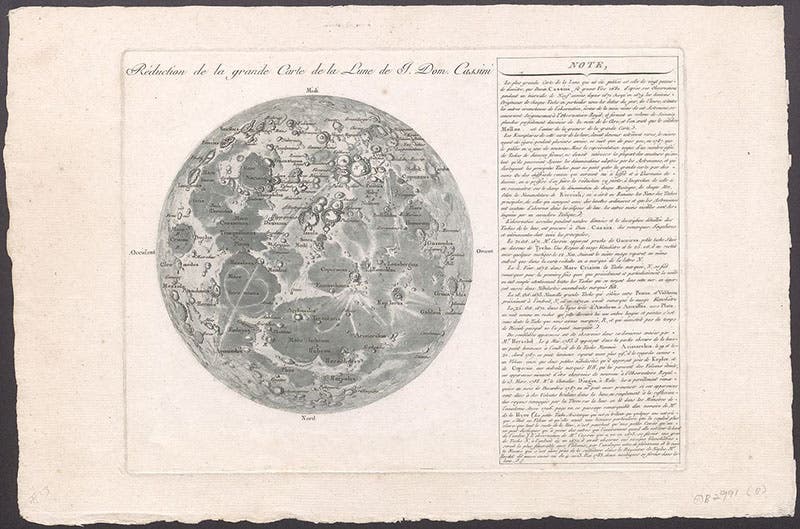
Réduction de la grande carte de la lune de J. Dom. Cassini, broadside engraving, entire sheet (17 x 11.5 inches), by Jean-Dominique, comte de Cassini, 1788 (Linda Hall Library)
It is customary to refer to the great-grandfather by his original (Italian) prenames, Giovanni Domenico, and his great-grandson and namesake, today’s subject, by the French equivalents, Jean-Dominique. Since the latter was given a title, he is also often called comte de Cassini.
Cassini IV succeeded his father as Royal Astronomer in 1784. He, with his father, completed a map of France in 1791, the first to be based entirely on geodetic measurements. He undertook a joint study, with the Greenwich Observatory in England, correlating more exactly the longitudes of their respective meridians. And he wrote and published a history of the Paris Observatory in 1810. However, we have none of these books or maps in our collection.

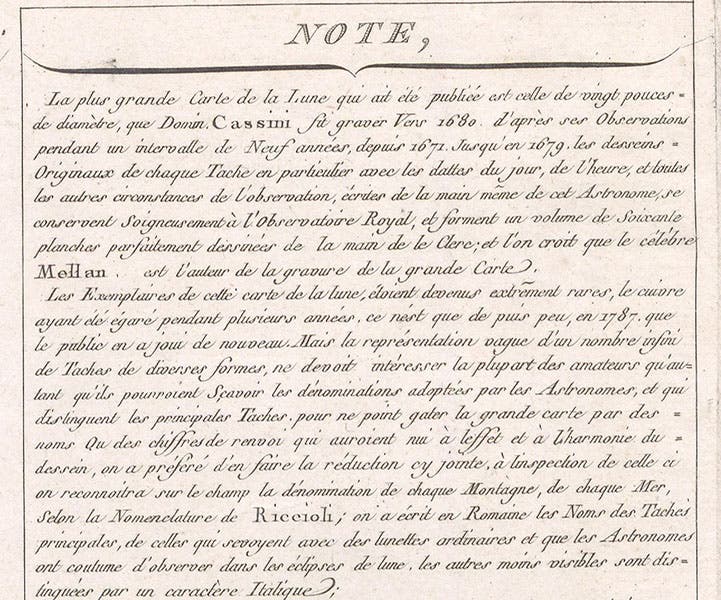
Top third of the caption, detail of Réduction de la grande carte de la lune de J. Dom. Cassini, broadside engraving, by Jean-Dominique, comte de Cassini, 1788 (Linda Hall Library)
So today, we will discuss two Cassini IV items that we DO have, and hardly anyone else does. Both relate to the lunar map compiled and published by Cassini I back in 1680. It was larger than those of Johannes Hevelius and Giambattista Riccioli, and more accurate, but it lacked a nomenclature. It was often reproduced in a smaller form in 18th-century astronomy textbooks, with added nomenclature, but the small maps were very poorly drawn.

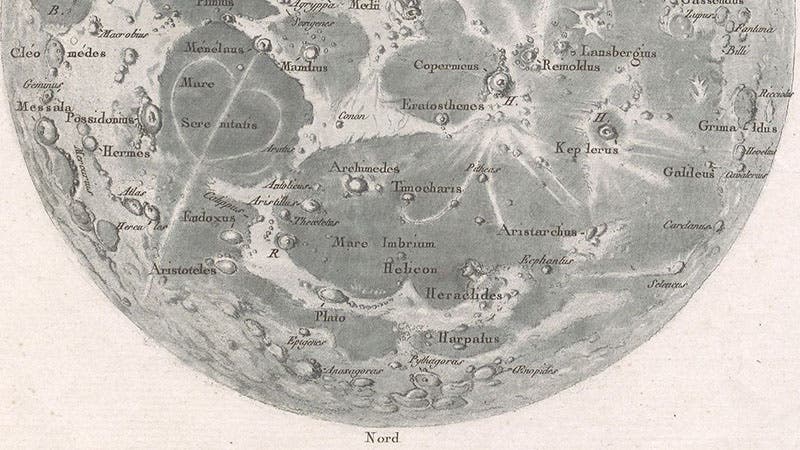
Northern hemisphere of the Moon (north is down), detail of Réduction de la grande carte de la lune de J. Dom. Cassini, broadside engraving, by Jean-Dominique, comte de Cassini, 1788 (Linda Hall Library)
The original copper plate used to print the large Cassini moon map survived in the Observatory, and in 1787, Cassini IV had it cleaned and used to print a new edition of the Cassini moon map. We acquired it just last year, a gift from a collector, Frank Manasek. We wrote a post about it earlier this year. Its most memorable feature is a "moon maiden" who graces a promontory in the northlands of the Moon, which you can see, inverted (north down), in our post.

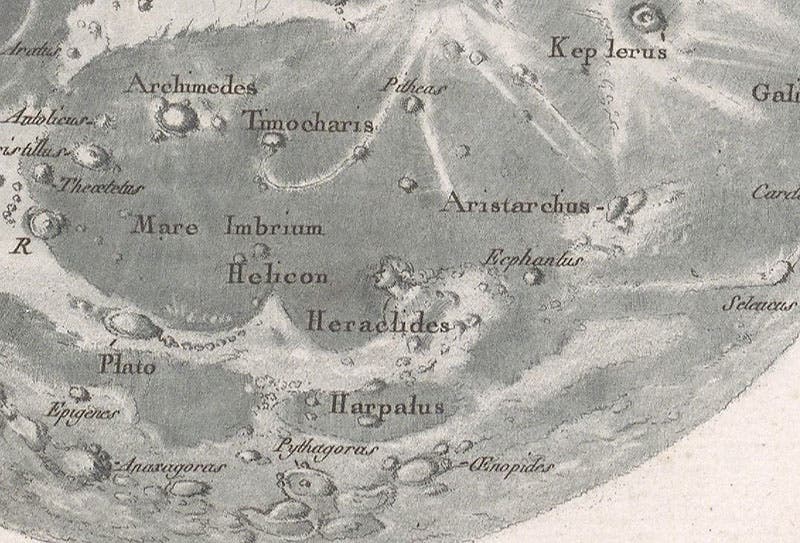
The “Moon Maiden,” embellishment addd by G.D. Cassini to the Heraclides Promontory in the northlands of the Moon, detail of Réduction de la grande carte de la lune de J. Dom. Cassini, broadside engraving, by Jean-Dominique, comte de Cassini, 1788 (Linda Hall Library)
It was nice to have the Cassini map back in circulation, but it still lacked a nomenclature. So Cassini IV commissioned a new reduction of the large moon map, with the names (Riccioli's names) of prominent craters, oceans, and seas added in. He had it engraved and printed as a broadside, with a large caption that discussed various changes in the lunar surface, such as new volcanoes, that had been noted by observers like William Herschel.

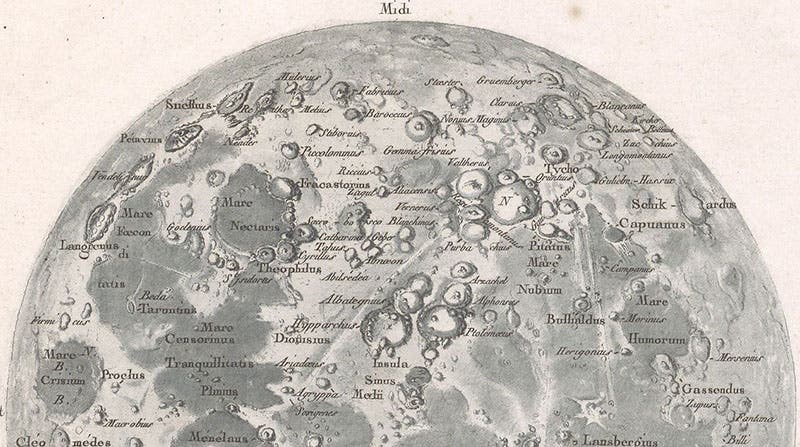
Southern hemisphere of the Moon (south is up), detail of Réduction de la grande carte de la lune de J. Dom. Cassini, broadside engraving, by Jean-Dominique, comte de Cassini, 1788 (Linda Hall Library)
This single-sheet lunar broadside is quite scarce. It was not copied into textbooks because it was out of date, over a hundred years old, and the techniques of lunar mapping had changed considerably, as had telescopes. But the reduced map of 1788 is a great companion to have when studying the large Cassini map, as it identifies the major features of the map. You can learn, for example, that the Moon Maiden is at the end of the Heraclides Promontory and juts out into the Mare Imbrium, the Sea of Rains (fifth image), or that the two long rays that extend out over much of the lunar surface have their origin in the crater Tycho (seventh image).

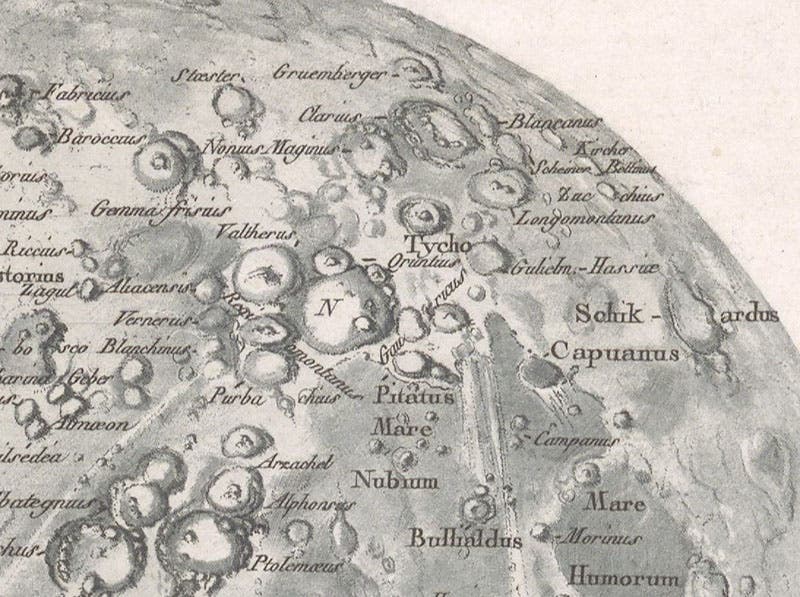
The lunar highlands and the crater Tycho, detail of Réduction de la grande carte de la lune de J. Dom. Cassini, broadside engraving, by Jean-Dominique, comte de Cassini, 1788 (Linda Hall Library)
We are grateful to Mr. Manasek for giving us the reduction of 1788, along with the reissued large map of 1787. They add two sparkling jewels to our already splendid collection of lunar maps, many of which you can see and read about in our exhibition catalog, The Face of the Moon: Galileo to Apollo (1989). Interestingly, it was the paper edition of this catalog that first drew Mr. Manasek's attention to our collection.

Portrait of an elderly Jean-Dominique Cassini, lithograph by Julien Leopold Boilly, 1830s? (Wikimedia commons)
The only documented portrait of Cassini IV that survives (or is in circulation) is a lithograph made when he was in his late 80s. No one should be remembered that way, bewigged and toothless, but I include it nevertheless, since it is part of the historical record, and is all we have (last image). But his homage to his great-grandfather, seven views of which you see here, is a better memento.
William B. Ashworth, Jr., Consultant for the History of Science, Linda Hall Library and Associate Professor emeritus, Department of History, University of Missouri-Kansas City. Comments or corrections are welcome; please direct to ashworthw@umkc.edu.