Scientist of the Day - Hermann Oberth

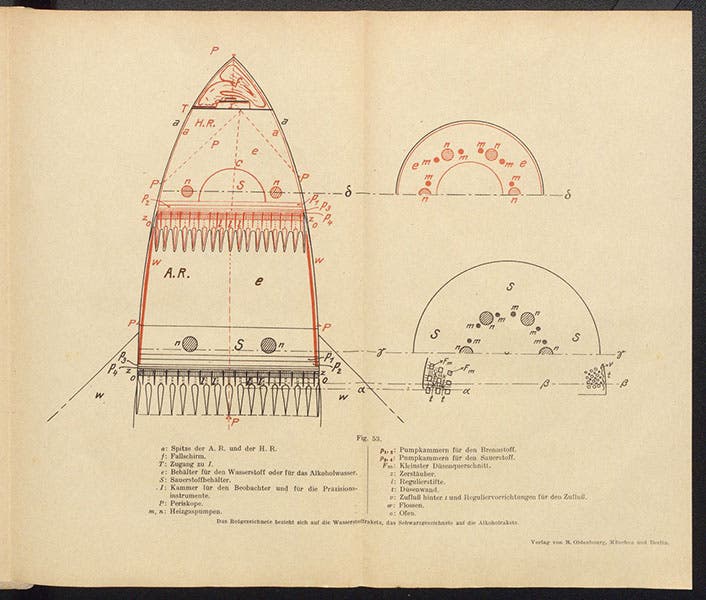
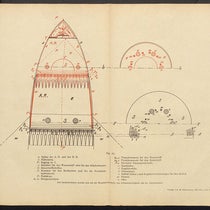
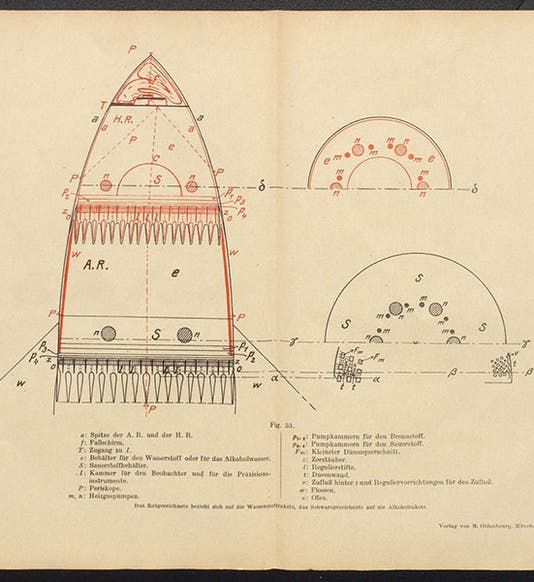
Rocket intended to carry humans into interplanetary space, engraved plate in Die Rakete zu Planetenräumen, by Hermann Oberth, p. 80, 1923 (Linda Hall Library)
Hermann Oberth, a German rocket scientist, was born on June 25, 1894, in Transylvania (modern Romania). He read Jules Verne as a child and decided early on that he wanted to build rockets to go to the Moon, back when there were no rockets except the "red glare" kind. He pursued a degree in physics, and for his dissertation at Göttingen, he showed that it was possible to build rockets that could escape the Earth's gravitational pull, and that human passengers should be able to survive a journey in a rocket. His thesis committee rejected his dissertation as fanciful. Oberth resubmitted it to a school in Transylvania, more successfully this time, and in 1923, he paid to have copies printed up, calling it Die Rakete zu Planetenräumen (The Rocket into Interplanetary Space, 1923). This is a very difficult book to read, filled with equations and obscure language. Oberth concluded that liquid-fuel rockets were the preferred vehicle for spaceflight, and he also advocated that space rockets be multi-stage. He would turn out to be right in most of his conclusions.

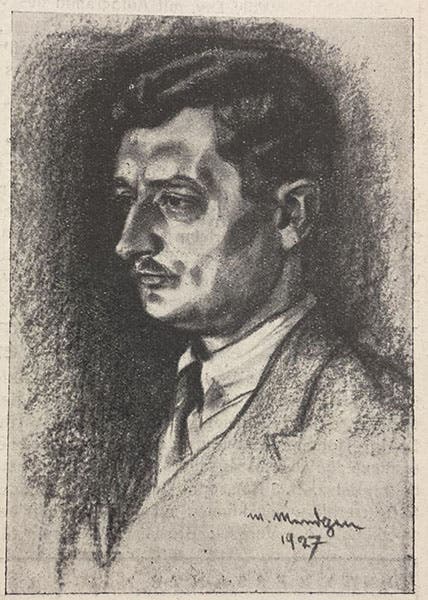
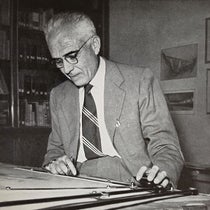
Portrait of Hermann Oberth, Die Rakete, vol. 1, p. 139, 1927 (Linda Hall Library)
Oberth's Die Rakete is one of the two holy grails for collectors of documents of the space age (the other being Robert Goddard's A Method of Reaching Extreme Altitudes (1919), which is more common, being a government publication). We have long held Goddard's book, but until this spring, we had no Oberth. However, our Curator, Bruce Bradley, recently found a copy on the market, and today, we reveal it to the Library’s readership. It is only about 100 pages long, but it rests in a custom-made box that, when opened, reveals the striking paper cover of Oberth's dissertation (third image). There are two plates at the end, one showing his multistage (Model B) rocket in red and black (fifth image), and a third plate within, showing a stubby fat rocket (first image). There are dozens of small diagrams within the text.

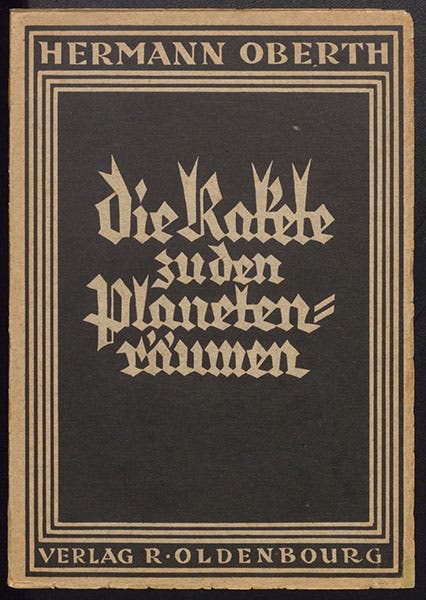
Front paper cover, Die Rakete zu Planetenräumen, by Hermann Oberth, 1923 (Linda Hall Library)
Although Oberth’s thesis was impossible for a layman to read and comprehend, the journalist Willy Ley published a popular account of Oberth’s book in 1926, and both books came to the attention of Thea Von Harbou, who wrote a novelette about a trip to the Moon, which her husband, film-maker Fritz Lang, decided to commit to celluloid. Oberth and Ley were brought on board as consultants. Lang asked Oberth to build an actual rocket, to be fired up at the film's premiere, which Oberth was unable to bring off. But Frau im Mond (The Woman in the Moon), which debuted on Oct. 15, 1929, was a big success, mostly because it was a Fritz Lang film, and it certainly brought rocketry to the masses.

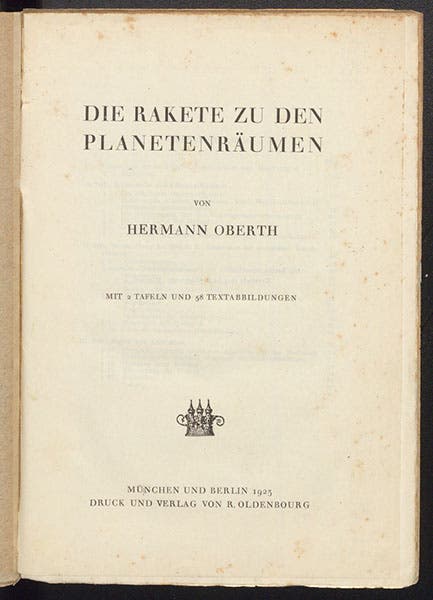
Title page, Die Rakete zu Planetenräumen, by Hermann Oberth, 1923 (Linda Hall Library)
A little earlier, on June 5, 1927, Oberth and Ley and one other enthusiast had founded the world's first rocket society, Verein für Raumschiffahrt (Society for Space Travel), usually referred to, in both German and English, as the VfR. It quickly drew in hundreds of members, including, in 1930, a gifted 18-year-old named Wernher Von Braun, who became something of a protege of Oberth. In a photograph (sixth image), Oberth is just to the right of the larger standing rocket, and Von Braun is at the right, behind the man holding the small rocket.

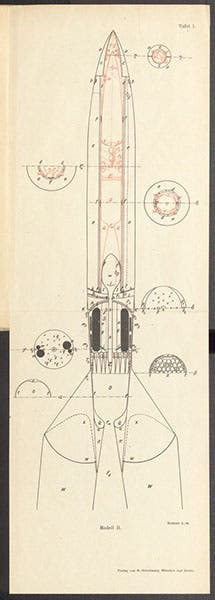
Two-stage liquid-fueled rocket, “Model B,” folding plate 1 at end, Die Rakete zu Planetenräumen, by Hermann Oberth, 1923 (Linda Hall Library)
The VfR began publishing a monthly magazine almost immediately, called Die Rakete, and it continued for three years (1927-29) and three volumes. We have had the second and third volumes for some time, but just yesterday, Mr. Bradley unwrapped a package containing volume 1, which has a portrait drawing of Oberth that we show here (second image). Other German rocket pioneers are featured in its pages, such as Walther Hohmann and Guido von Pirquet, whom we have discussed in earlier posts.

Members of the Verein für Raumschiffahrt (VfR), Berlin, including Hermann Oberth (right of standing rocket) and Wernher von Braun (second from right), photograph, 1930 (Wikimedia commons)
Oberth taught high-school physics in Romania through the pre-War years, and was not a part of the wartime V-2 rocket program, headed up by Von Braun. He came to public prominence only after the war, when his contributions to space flight were finally recognized outside Germany. He died on Dec. 28, 1989, at the age of 95.
William B. Ashworth, Jr., Consultant for the History of Science, Linda Hall Library and Associate Professor emeritus, Department of History, University of Missouri-Kansas City. Comments or corrections are welcome; please direct to ashworthw@umkc.edu.