Scientist of the Day - Roald Amundsen

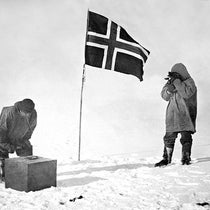
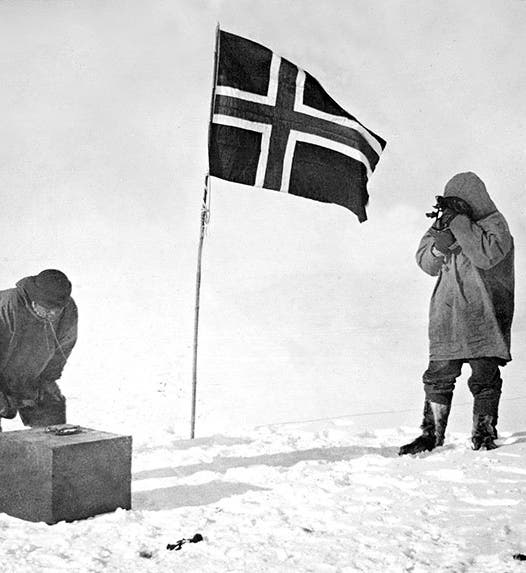
Roald Amundsen (right) measuring the solar altitude at the South Pole, Dec. 14-17, 1911 (Wikimedia commons)
Roald Amundsen, a Norwegian polar explorer, disappeared on June 28, 1928, in a plane crash in the Arctic, and is presumed to have died with his fellow passengers; neither the plane nor any remains have ever been found. He was 55 years old.
Amundsen, bon in 1872, came of age when his countryman Fridtjof Nansen was electrifying Norway, first by crossing Greenland on skis in 1888, and then by trying to drift over the North Pole in his specially constructed ship, the Fram, in 1893-96. It is no surprise that Amundsen decided to become a polar explorer himself.

A younger Roald Amundsen, photograph, 1908 (Wikimedia commons)
His initial attempt at an Arctic “first” was to try to navigate a ship through the Northwest Passage. The British Royal Navy had spent the previous 80 years trying to discover that passage, and had pretty much done so, but no ship had made it across in one continuous trip.
Amundsen reasoned that if none of the big rugged British bomb vessels were able to bull their way through the pack ice, perhaps a smaller, lighter craft of shallow draft might have a better chance. He commissioned such a ship, the Gjoa, and with a small crew of 6, he was able to sail all the way across the Arctic archipelago, from Baffin Bay to the Beaufort Sea, embarking in 1903 and reaching San Francisco in 1906. We told the story of Amundsen and the Gjoa in our first post on Amundsen, where you can see the Gjoa.

The Fram in Antarctica during Amundsen’s assault on the South Pole, 1910-12 (Wikimedia commons)
Amundsen wanted another “first,” and the two best candidates lay at the two poles, North and South. The British had set their sights on Antarctica and the South Pole, and between 1901 and 1910, the Royal Geographic Society (RGS) dispatched 3 national expeditions to the southern contingent, the Discovery expedition (1901-04), the Nimrod expedition (1907-09), and the Terra Nova expedition (1910-13), led by Robert Falcon Scott, Ernest Shackleton, and Scott again, respectively. The stated goal of all 3 expeditions was to gather scientific information about Antarctica, with expeditions to the South Pole as added bonuses.

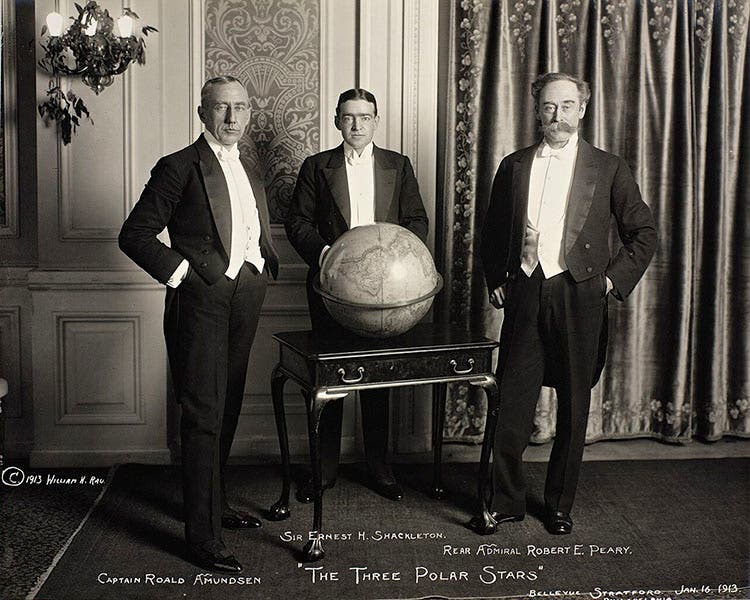
“Three Polar Stars,” Roald Amundsen (left), Ernest Shackleton, and Robert E. Peary, at the National Geographic Society in Washington, D.C., 1913 (Wikimedia commons)
Attempts at reaching the North Pole had become monopolized by the Americans, especially Robert E. Peary, and the British seem to have ceded the Arctic to the U.S. Not so Amundsen, who planned another Nansen-style “drift-over-the-North-Pole” expedition, and even borrowed the Fram for the purpose. But he planned to enter the ice pack in the Bering Sea, which meant sailing around Cape Horn in South America.
Or so Amundsen said publicly. In reality, Amundsen was planning an assault on the South Pole. To that end, he loaded scores of Huskies onto the Fram (which he would not have needed to do in advance if he were headed for Alaska), and he didn’t even tell his crew of their true destination until they got to Madeira. Amundsen set up his base camp in 1911 at the Bay of Whales, far from Scott’s far more massive camp at Ross Island, and Amundsen managed to set off for the pole in November of 1911, just a few days before Scott embarked. Amundsen’s team had dogsleds for the supplies and skis for the humans, and they moved rapidly and easily over the Antarctic glacier, leaving food caches for the return trip as they went. Scott and his team had ponies, and man-hauled sledges that bogged down in the snow, and the race, as it turned out to be, was no contest. Amundsen’s team reached the South Pole on Dec. 14, 1911, and spent three days there. Scott’s men arrived on Jan. 17, 1912, disconsolate to see the Norwegian flag already flying above the pole. Amundsen and his team raced back on their skis and arrived at base camp on Jan. 25, 1912. Scott’s team of 5 never made it back and perished in the ice and cold in the spring of 2012. There are more details in our post on Scott.

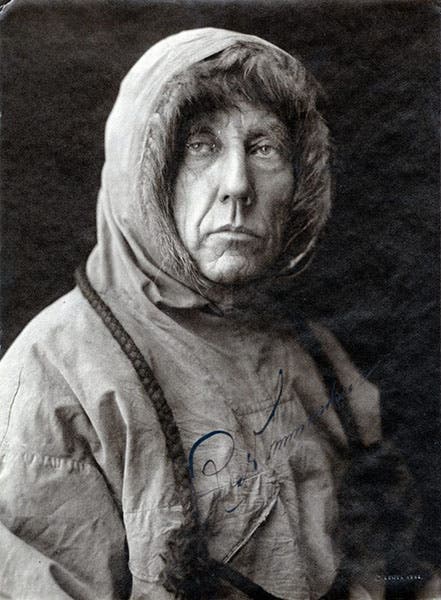
Roald Amundsen, photograph, 1923, Antarctic Heritage Trust (nzaht.org)
The RGS deprecated the Norwegian achievement and praised the failed heroics of Scott, because the Scott expedition did science, while Amundsen made no pretense of doing so. Amundsen never forgot or forgave the British for refusing to recognize his achievement. To the rest of the world, however, and especially to Norway, Amundsen was a true hero, and still is. There is little doubt that Amundsen was a far more competent polar explorer than Scott, and probably the equal of Shackleton.
Robert E. Peary and Frederick Cook both claimed to have reached the North Pole in 1908-09, but both claims, by 1915, were generally disallowed as unverifiable and unlikely. So when an airship, the Norge, crossed the Arctic icecap in May of 1926 (and the North Pole on May 12), that was a first of sorts, and Amundsen was one of 16 onboard, giving him a small share of a second pole. However, two years later, when a second airship crashed in the Arctic, Amundsen's joined the rescue search in a flying boat, and the rescue plane crashed, presumably killing all on board, including Amundsen. The day was June 18, 1928. Neither the crashed plane nor any human remains have ever been found.
My only Nobelist friend, the Cornell chemist Roald Hoffmann, a Polish Jew, was named after the Norwegian Roald Amundsen, 9 years after Amundsen's death. That was one famous and revered explorer.
We do not have any of Amundsen’s books in our collections. Since he disclaimed being a scientist, perhaps that is appropriate. But still …
William B. Ashworth, Jr., Consultant for the History of Science, Linda Hall Library and Associate Professor emeritus, Department of History, University of Missouri-Kansas City. Comments or corrections are welcome; please direct to ashworthw@umkc.edu.