Scientist of the Day - Antoine-François de Fourcroy

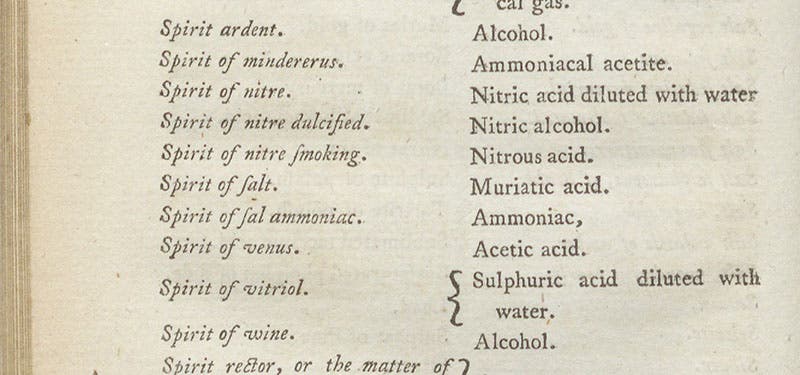
Old system of chemical names beginning with spirit (left), and the new equivalents (right), detail of page 100, in Method of Chymical Nomenclature, Proposed by Messrs. de Morveau, Lavoisier, Bertholet, and de Fourcroy, by Antoine-François de Fourcroy et al., 1788 (Linda Hall Library)
Antoine-François de Fourcroy, a French chemist, was born June 15, 1755, in Paris. The son of an apothecary, he received his medical degree in Paris, but then turned to chemistry in the early 1780s. He became professor of chemistry at the Medical School of Paris in 1784, and was quite a popular teacher.

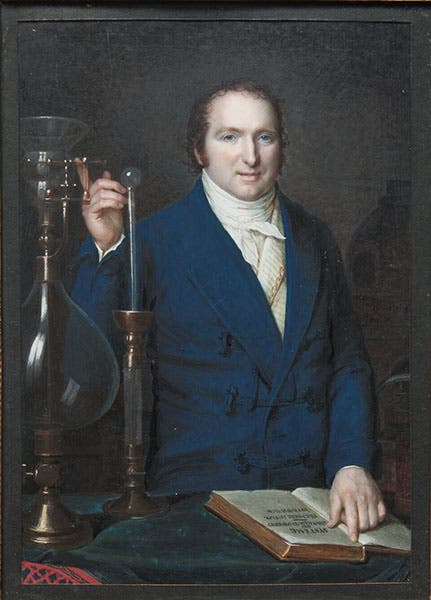
Portrait of Antoine-François de Fourcroy, by François Dumont, oil on canvas, National Museum of Sweden, Stockholm (Wikimedia commons)
Fourcroy got to know Antoine Lavoisier, who in 1778 had offered up a new theory of combustion, the oxygen theory of combustion, which proposed that things burn when they combine with oxygen, a newly discovered gas. Lavoisier's ideas were an attempt to disprove and replace the prevailing phlogiston theory of combustion, which explained combustion as the emission of a substance called phlogiston.

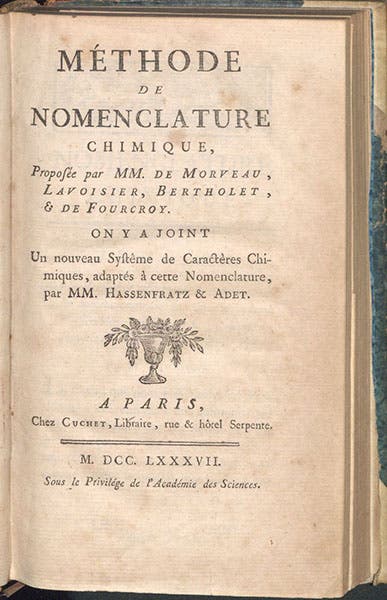
Title page, Méthode de nomenclature chimique, proposée par mm. de Morveau, Lavoisier, Bertholet, & de Fourcroy, by Antoine-François de Fourcroy et al., 1788 (Linda Hall Library)
Lavoisier also proposed a re-evaluation of what is considered an element. In the phlogiston theory, a calx (oxide) was elemental, and a metal was a combination of a calx and phlogiston; for Lavoisier, the metal was elemental, and it combined with a variety of gases (most of them – hydrogen, nitrogen, carbon dioxide – newly discovered) or other elements to form compounds.

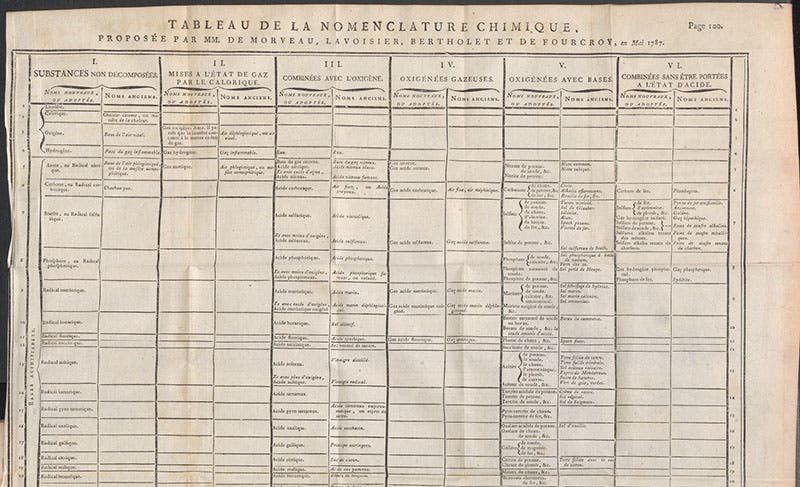
“Tableau de nomenclature chimique,” top half of folding plate, Méthode de nomenclature chimique, proposée par mm. de Morveau, Lavoisier, Bertholet, & de Fourcroy, by Antoine-François de Fourcroy et al., p. 100, 1788 (Linda Hall Library)
Chemistry was also saddled with a nomenclature problem, in that every compound was called by a variety of names, such as sugar of lead or flowers of sulfur, with no rational system behind the names. And this is where Fourcroy joined the budding chemical revolution. Working with Claude-Louis Berthollet and Louis-Bernard Guyton de Morveau, as well as Lavoisier, Fourcroy proposed a new system of chemical nomenclature, in which only one name was to be used for an element or a compound, and the name of the compound would indicate its makeup. Iron oxide was to be the new name for the calx of iron, and likewise, we would have copper sulfide, silver nitrate, and carbonic acid.

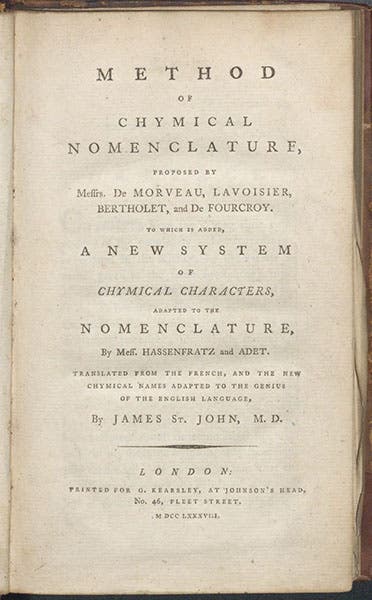
Title page, Method of Chymical Nomenclature, Proposed by Messrs. de Morveau, Lavoisier, Bertholet, and de Fourcroy, by Antoine-François de Fourcroy et al., 1788 (Linda Hall Library)
Fourcroy and his three colleagues combined to publish a book, Méthode de nomenclature chimique, which was published in French in 1787, two years before Lavoisier published his own revolutionary book, Elements of Chemistry, and the nomenclature book was quickly translated into English and published in 1788. We have both versions in our collections (third and fifth images). Each has two dictionaries, where you can look up an old chemical name, or a new one, and find its equivalent(s) in the other system. Each also has a large folding synoptic table, more impressive than useful, that lists chemical names in both systems. We show the top half of the table in French (fourth image), and a further detail of the table In English (sixth image). We also show a snippet from one of the English dictionaries, so you can see how "spirit of Venus" (and other "spirits") are to be named in the new nomenclature system (first image).

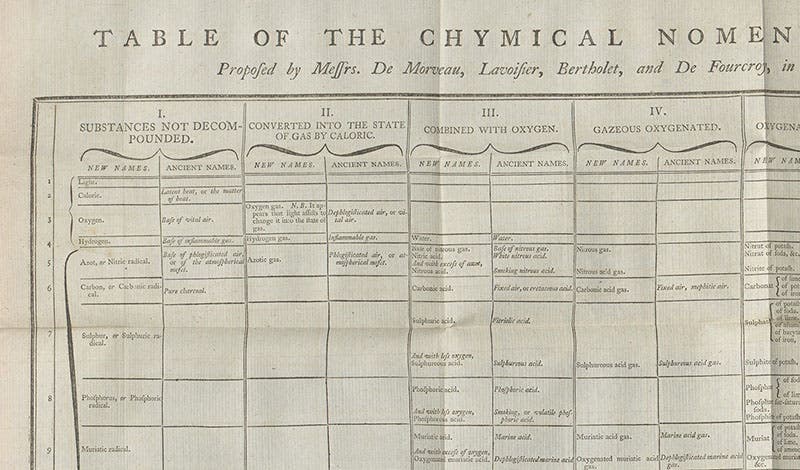
“Table of the Chymical Nomenclature,” detail of top left corner of folding plate, Method of Chymical Nomenclature, Proposed by Messrs. de Morveau, Lavoisier, Bertholet, and de Fourcroy, by Antoine-François de Fourcroy et al., p. 73, 1788 (Linda Hall Library)
Like many scientists of his era, Fourcroy took an active role in the French Revolution, and unlike Lavoisier, he managed to survive it. He wrote several other books on the new chemistry, most of which we have in our Library. Fourcroy died on Dec. 16, 1809, and was buried in the famous Pere Lachaise Cemetery in Paris, which is one of the few cemeteries for which the word "cluttered" immediately comes to mind when we see a photograph of a grave, such as Fourcroy's (last image).

Grave of Antoine-François de Fourcroy, Pere Lachaise Cemetery, Paris (Wikimedia commons)
William B. Ashworth, Jr., Consultant for the History of Science, Linda Hall Library and Associate Professor emeritus, Department of History, University of Missouri-Kansas City. Comments or corrections are welcome; please direct to ashworthw@umkc.edu.