Scientist of the Day - Martin Frobenius Ledermüller

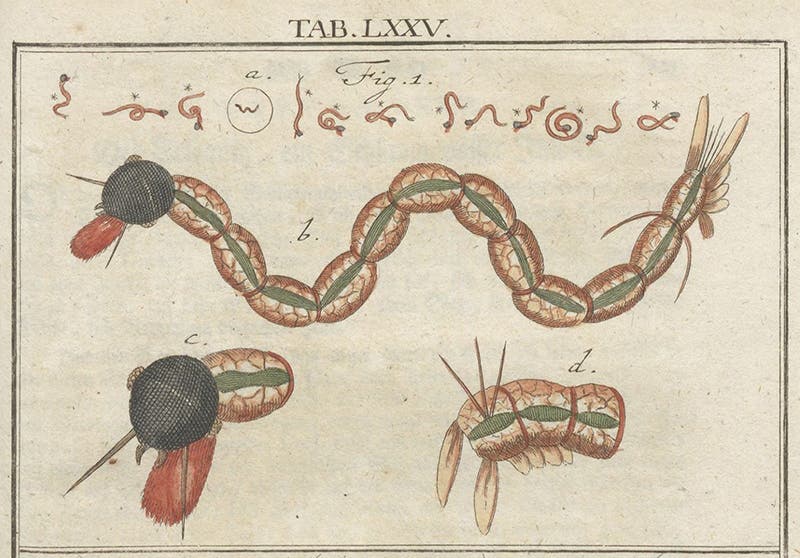
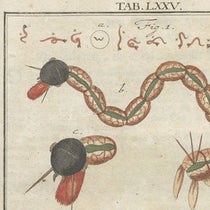
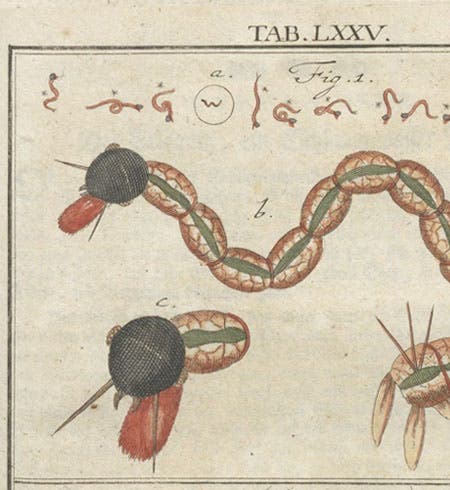
Harlequin worm, detail of hand-colored engraving, Mikroskopische Gemüths- und Augen-Ergötzung, by Martin Frobenius Ledermüller, plate 75, 1761 (The Linda Hall)
Martin Frobenius Ledermüller, a German microscopist, was born Aug. 20, 1719, in Nuremberg. The son of a clerk, he studied law in Jena for a year, before returning to Nuremberg to work as a legal clerk for 15 years, until his hearing failed him. He then turned to his real love, microscopy, and his second love, convincing other people that they too would be excited by views through the microscope.

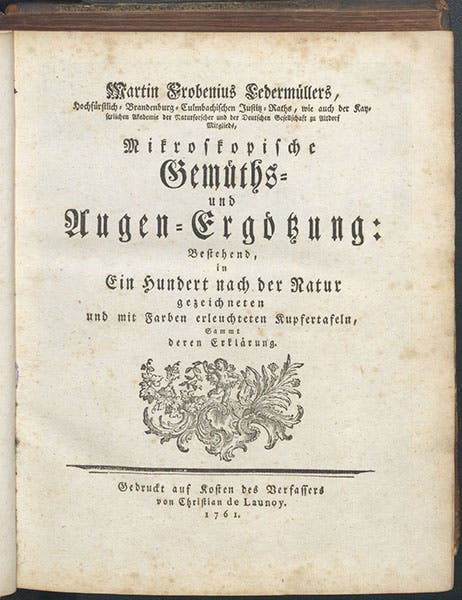
Title page, Mikroskopische Gemüths- und Augen-Ergötzung, by Martin Frobenius Ledermüller, 1761 (The Linda Hall)
Ledermüller published his first book, on spermatozoa as they appear in the microscope, in 1756, and his second one, on the simple or single-lens microscopes of Antoni van Leeuwenhoek, in 1758. We have both in our collections. The first has 8 line engravings, all of spermatozoa; the second has 6. None of the plates are colored. I doubt if many readers were excited by either book.

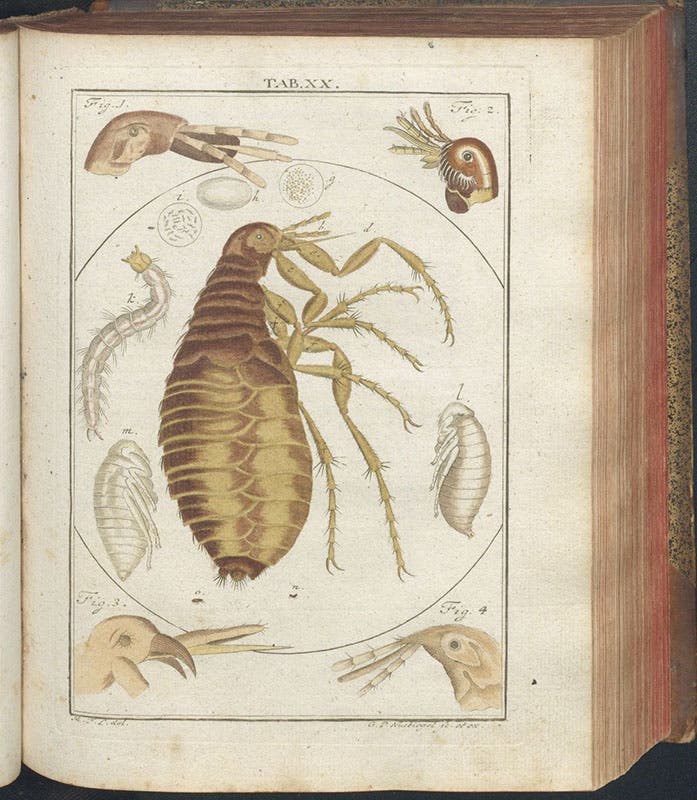
Fleas, hand-colored engraving, Mikroskopische Gemüths- und Augen-Ergötzung, by Martin Frobenius Ledermüller, plate 20, 1761 (The Linda Hall)
But Ledermüller was a quick study. In 1759 he published the first volume of a completely different kind of microscope book, with 50 full-page plates, drawn by himself, of a variety of objects. The book was called: Mikroskopische Gemüths- und Augen-Ergötzung (Microscopic Delight for the Mind and Eye, 1757-63). Best of all, the engravings, made after his drawings, were all hand colored. The first volume was a treat for the eyes, and must have sold well, for volume 2, with 50 more hand-colored plates, was published in 1761, and a third and final volume, with another 50 plates, in 1763. We have only the first two volumes of the set, but those 100 engravings are enough to knock you sideways. All of the images here are from this work. Ledermüller’s descriptions, just like the engravings, were addressed to the general public, not professional naturalists. This would become common in 19th-century England. But it was rare to find such lay treatises in 18th-century Germany.

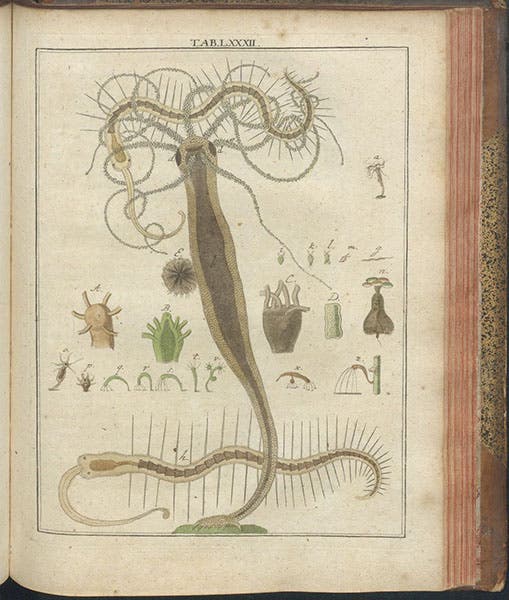
Hydra, hand-colored engraving, Mikroskopische Gemüths- und Augen-Ergötzung, by Martin Frobenius Ledermüller, plate 82, 1761 (The Linda Hall)
And although his primary intent was to educate and excite, Ledermüller made some original observations that escaped the better-trained microscopists. As far as I can tell, he was one of the first, perhaps the first, to observe the peculiar gyrations of the Harlequin worm, which you can see at normal scale just above his magnified view of this odd, black-headed larva, which he also seems to have named (first image).

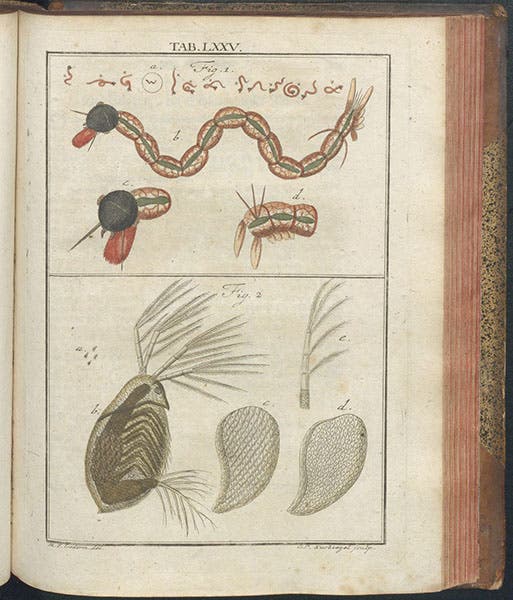
Daphnia, or water-flea (bottom), with Harlequin worm at top, hand-colored engraving, Mikroskopische Gemüths- und Augen-Ergötzung, by Martin Frobenius Ledermüller, plate 75, 1761 (The Linda Hall)
Another figure on that same plate (fifth image) shows Daphnia, the water-flea. Daphnia had first been observed by Jan Swammerdam 90 years earlier, and Jacob Christian Schaeffer had published an entire book on water-fleas in 1755, a professional book that Ledermüller must have known. Still, his was a reasonably good drawing, not copied from Schaeffer. His drawing of Hydra, however (fourth image), may have been inspired by Abraham Trembley's treatise of 1744 on the subject

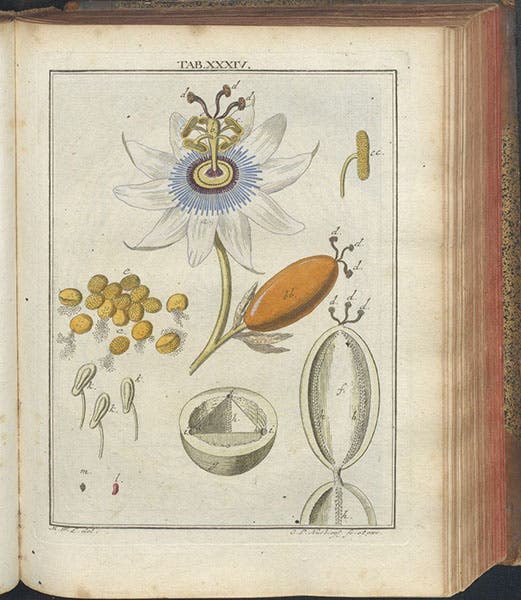
Passionflower, hand-colored engraving, Mikroskopische Gemüths- und Augen-Ergötzung, by Martin Frobenius Ledermüller, plate 34, 1761 (The Linda Hall)
I think there are some plates that Ledermüller included just because they are esthetically appealing, I am not sure you need a microscope to study the passionflower (sixth image), although you might for the pollen, nor does the view of Mexican workers harvesting cochineal scale insects from prickly pear cacti contribute much to microscopy (seventh image). But they are certainly easy to look at.

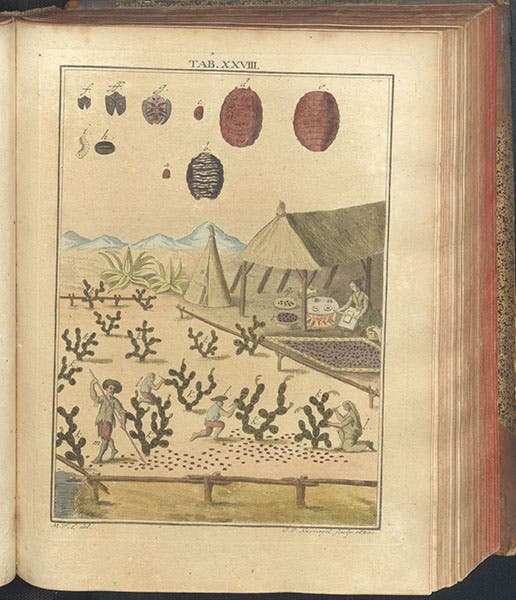
Harvesting cochineal in Mexico, hand-colored engraving, Mikroskopische Gemüths- und Augen-Ergötzung, by Martin Frobenius Ledermüller, plate 28, 1761 (The Linda Hall)
Ledermüller died in 1769, just short of his 50th birthday, the victim of assorted health problems. There is no surviving portrait of which I am aware. His legacy lies in his books, all of which we seem to have, except for the third volume of his magnum opus. This will be hard to find, as a stand-alone volume.
William B. Ashworth, Jr., Consultant for the History of Science, Linda Hall Library and Associate Professor emeritus, Department of History, University of Missouri-Kansas City. Comments or corrections are welcome; please direct to ashworthw@umkc.edu.