Scientist of the Day - Lucretius

Titus Lucretius Carus, a Roman poet, was born in the mid-90s BCE and died in the mid-50s BCE, perhaps 55 or 53 BCE, at the age of around 40. His sole surviving work (and it just barely survived) was a book-length didactic poem, De rerum natura (On the Nature of Things), which is our principal Roman source for Epicurean philosophy and the atomism of Democritus.
We know almost nothing about the life of Lucretius, except that the Lucretius family had been prominent in Rome since the founding of the Republic. His work was known to and praised by both Cicero and Vergil. The only attempt at a short biography was by the patristic Christian Jerome, but almost none of it is believable.

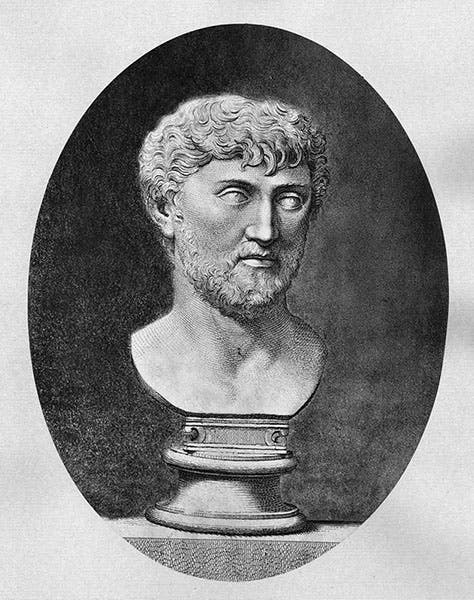
Bust purporting to show Titus Lucretius Carus, unknown location (thecollector.com)
De rerum natura is remarkable in many ways. It presents a theory of matter, Democritean atomism, that was 350 years old at the time Lucretius wrote, but which had been rejected by the major schools of Greek philosophy, those of Plato and Aristotle. The atoms of Democritus (and Lucretius) were infinite in number and moved at random through empty space, occasionally gathering together to form substances, and then breaking up again. Atoms had weight, but no inherent properties like color or smell. Those were the result of the arrangement of atoms in space. Lucretius thought that early humans lacked tools and language and had to discover fire, copper and iron tools, and the art of building. He gave little role to the Gods for anything. To avoid determinism, Lucretius (like Epicurus) introduced something called clinamen (the swerve), which made atoms occasionally veer off in unpredictable directions, thus preserving free will. His goal in the book was to show how to live a life without fear – of gods or death or anything else. He also demonstrated, by way of example, how to write a powerful philosophical poem.
De rerum natura almost failed to make it down to us. A single manuscript copy was found by the remarkable Renaissance humanist, Poggio Bracciolini, in a German monastery in 1417, was copied by his own hand, and then recopied. Only the recopy survived and was the basis for the earliest printed editions, once printing was invented. Fifteen years ago, Stephen Greenblatt published a book – a New York Times bestseller – on Bracciolini's recovery of Lucretius; the book was called The Swerve: How the World Became Modern (2011). Greenblatt maintained that the recovery of Lucretius changed the world. In fact, it had almost no impact until the 17th century. But we are glad it turned up.

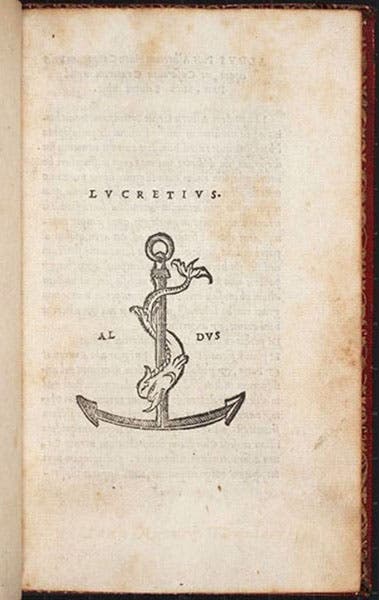
The printer’s mark of the Aldine Press, a dolphin and anchor, with the motto (implied here): festina lente – “make haste slowly” – in the Aldine edition of Lucretius, De rerum naturae, 1515 (The Linda Hall)
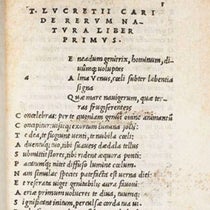
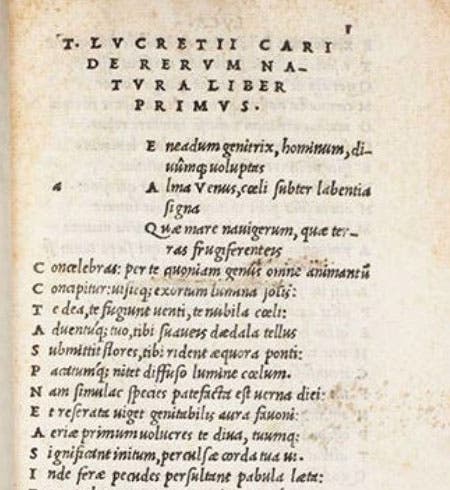
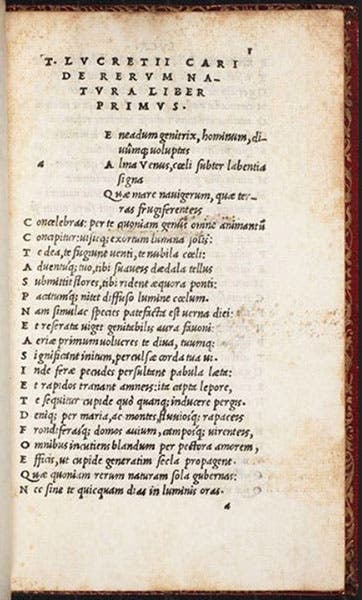
The finest printed edition of De rerum natura appeared in 1515 in Venice, the last book published by Aldus Manutius. Our library has a copy, and it is a beautiful little octavo (a format invented by Aldus), well-laid out, with the text set in the new Italic Aldine type (modeled, interestingly, after the handwriting of Poggio Bracciolini) (first image). And the book also has one of the best examples known of the famous printer's mark of Aldus Manutius, the dolphin and anchor, with the implied motto: festina lente, make haste slowly (last image). For some reason, the press run for De Rerum Natura was larger than normal. I say this because the book is a common one in the trade, and usually offered at a reasonable price for a 1515 imprint. I was able to buy a copy for myself many years ago because it was so cheap, comparatively.
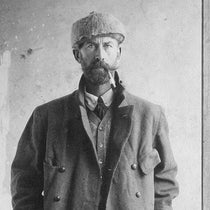
Not surprisingly, we have no idea what Lucretius looked like. There are several busts that purport to show him, and none of them resemble each other, so we picked one more or less at random (second image). To the best of my knowledge, Lucretius has never been on a postage stamp.
William B. Ashworth, Jr., Consultant for the History of Science, Linda Hall Library and Associate Professor emeritus, Department of History, University of Missouri-Kansas City. Comments or corrections are welcome; please direct to ashworthw@umkc.edu.