Scientist of the Day - Henri Breuil

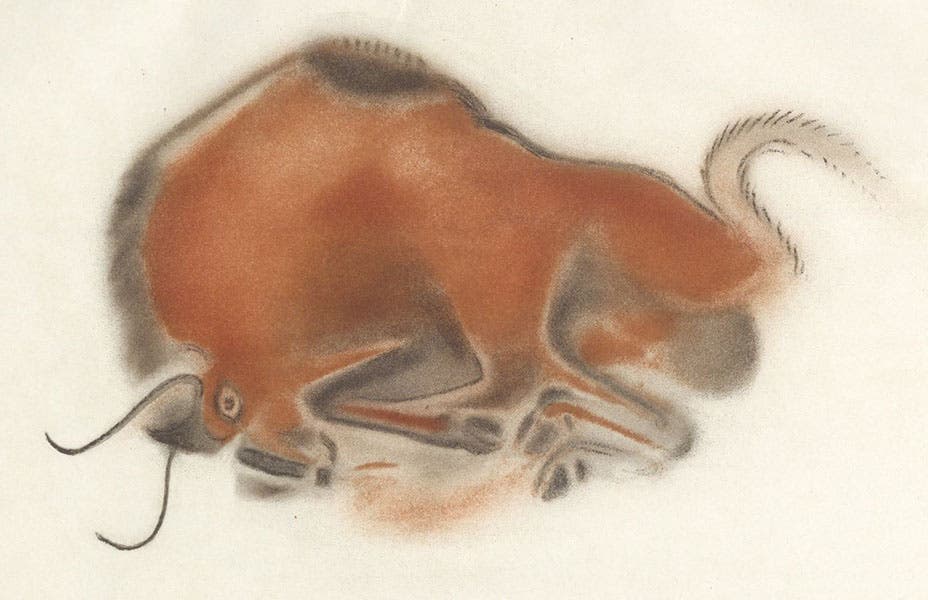
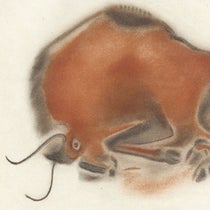
Charging bison, photoprint of a drawing by Henri Breuil, slightly cropped, La caverne d'Altamira a Santillane, by Émile Cartailhac and abbé Henri Breuil, plate XXVII, 1906 (The Linda Hall)
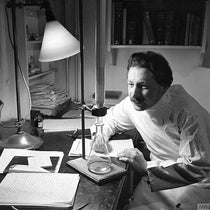
Henri Breuil, a French archaeologist, died Aug. 14, 1961, at the age of 84. Since he was also a Roman Catholic priest, he is usually referred to as abbé Breuil. When he was a young man in his mid-twenties, he journeyed, with Émile Cartailhac, to an archaeological site in northern Spain, called Altamira.

Portrait of abbé Henri Breuil, photograph, undated (Wikimedia commons)
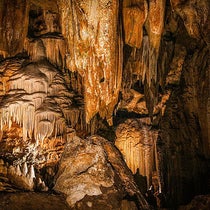
Altamira was and is a cave near the Bay of Biscay that contains, on a side ceiling, the first Paleolithic cave paintings ever discovered. They were found in 1879 by Don Marcelino Sanz de Sautuola, who announced the discovery at a conference of prehistorians in Lisbon in 1880. Unfortunately, for Sautuola and for the archaeological community, his claim for a prehistoric origin for the artwork was universally disbelieved. There was no way, the audience of archaeologists maintained, that primitive cave-dwellers could paint like that. No one would even make the journey from Lisbon to Altamira to take a look for themselves, so convinced were they that it was a fraud or a hoax of some kind. Poor Sautuola died a broken man in 1888, having made the prehistoric discovery-of-the-century, and having been roundly booed and ridiculed for it. We told this much of the story in a post on Sautuola in 2022.

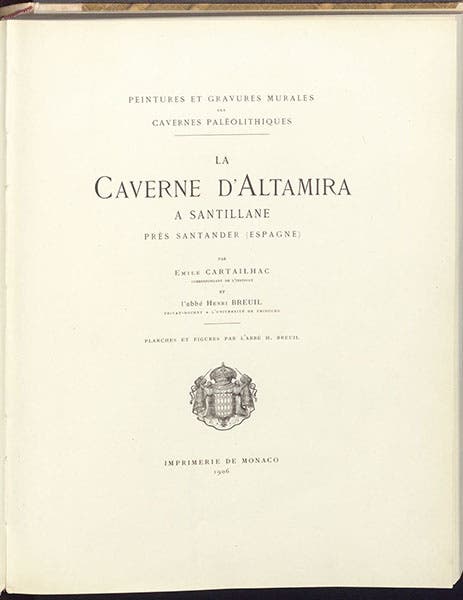
Title page, La caverne d'Altamira a Santillane, by Émile Cartailhac and abbé Henri Breuil, 1906 (The Linda Hall)
By 1902, several other caves had turned up in France that had wall paintings, and French archaeologists were having second thoughts about their ready dismissal of Sautuola and Altamira. One of the skeptics, Émile Cartailhac, who had been in Lisbon in 1880 and had denounced Sautuola and Altamira, now decided – 22 years later – to visit the site, and he immediately did an about-face, convinced now that the Altamira paintings were authentic, and very old. He went back and took young Breuil with him, to make drawings of the paintings. Breuil was not exactly an artist, but he was an excellent draughtsman, and he carefully copied each of the 29 or so animals on the ceiling (they are not easy to count) in full color.

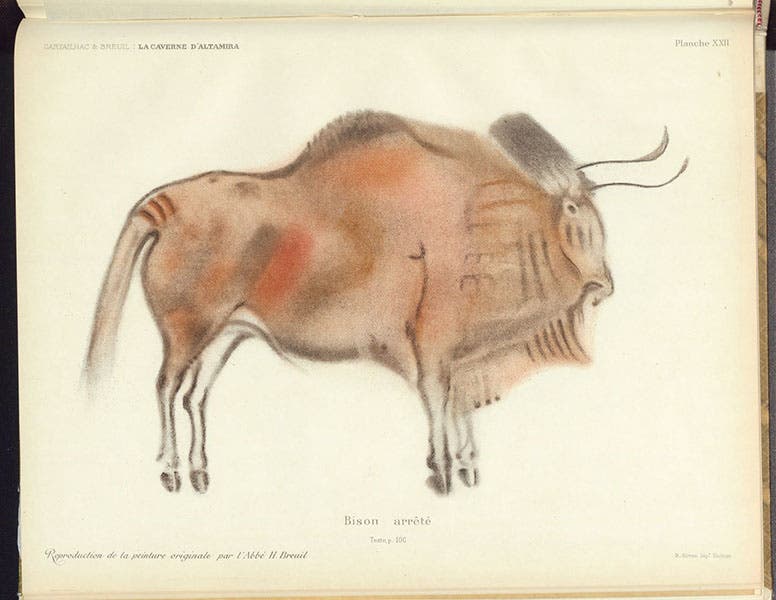
Standing bison, photoprint of a drawing by Henri Breuil, La caverne d'Altamira a Santillane, by Émile Cartailhac and abbé Henri Breuil, plate XXII, 1906 (The Linda Hall)
When they returned to France, the two men collaborated on a book on Altamira, with the text by Cartailhac and the plates by Breuil, colored photoprints of his chalk drawings, and the joint effort produced perhaps the loveliest book on prehistoric archaeology ever published. It was called: La caverne d'Altamira a Santillane, and it was published in 1906 in Monaco. When we wrote other posts that reproduced Breuil's drawings of Altamira, such as our first post on Breuil, or our post on Sautuola, or when we put together an exhibition on the discovery of human antiquity, called Blade and Bone, with several references to Breuil's drawings from Altamira, we had to take our images from publications of 1912 and later, because we did not own the 1906 work. But now we have it, thanks to Bruce Bradley, who acquired this wonderful treasure for the Library earlier this year. We include 4 of the 21 original color prints of individual animals in this essay, and we are saving a few for a post on Cartailhac this November, when we will also show some maps and outline drawings of the cave that were included in Cartailhac's half of the book.
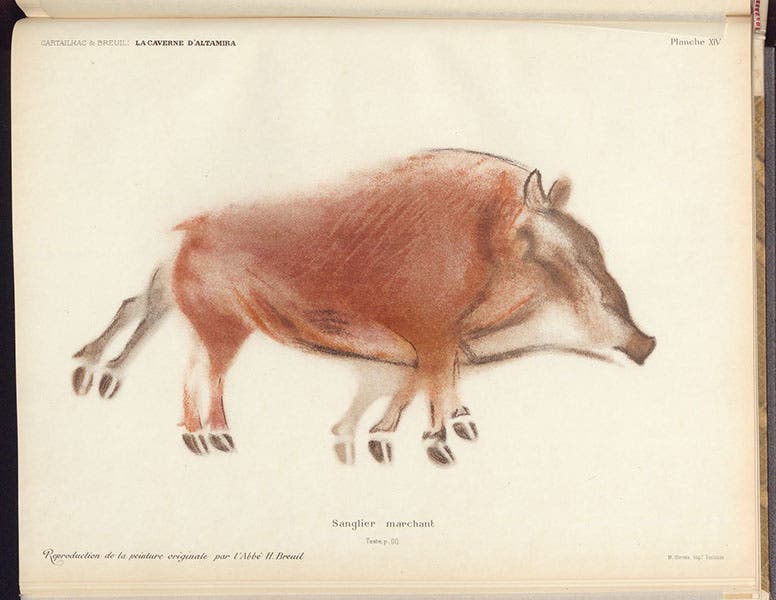
Two wild boars (count the legs), photoprint of a drawing by Henri Breuil, La caverne d'Altamira a Santillane, by Émile Cartailhac and abbé Henri Breuil, plate XXII, 1906 (The Linda Hall)
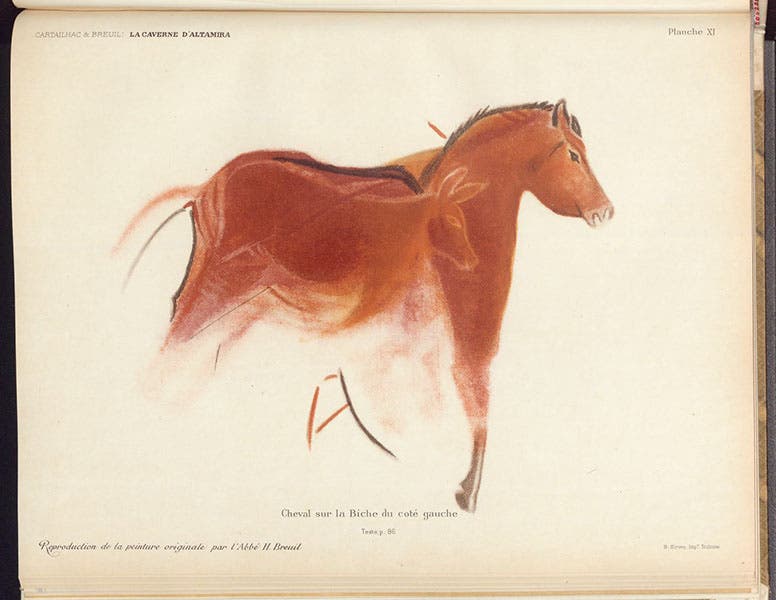
Horse and foal?, photoprint of a drawing by Henri Breuil, La caverne d'Altamira a Santillane, by Émile Cartailhac and abbé Henri Breuil, plate XI, 1906 (The Linda Hall)
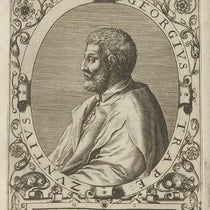
One of them, however, we show today, as our final image – a small inset portrait of Don Marcelino de Sautuola (last image), as a reminder that Altamira was not Breuil's discovery, nor Cartailhac's, but Sautuola's. This was the first portrait of him to be included in any French or English book on prehistory, 27 years after his discovery.

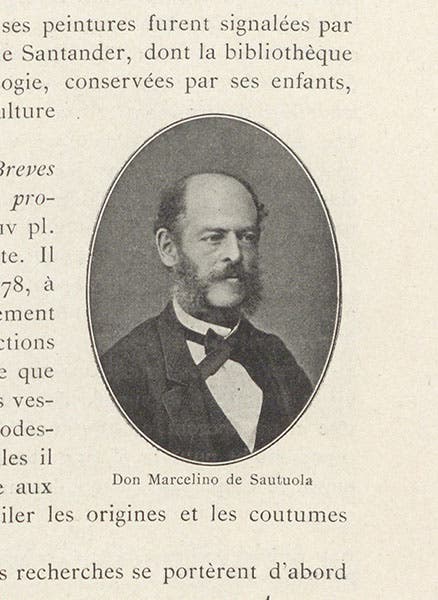
Photograph of Marcelino Sanz de Sautuola, text inset, La caverne d'Altamira a Santillane, by Émile Cartailhac and abbé Henri Breuil, page 1, 1906 (The Linda Hall)
As a last exercise, we ask you to go back and look at our first image, of a bison, charging full speed across an invisible Iberian steppe, and remind yourself that this powerful Paleolithic icon was painted between 36,000 and 22,000 years ago, by a man or a woman, a cave-dweller, with only handfuls of charcoal and ocher and their own saliva as a binder, lying on his or her back on a low platform on the rocky cave floor, with a lamp burning bear-fat nearby, for illumination. Then think about whether the term “primitive savage” is really the right descriptor for this unknown artist.
William B. Ashworth, Jr., Consultant for the History of Science, Linda Hall Library and Associate Professor emeritus, Department of History, University of Missouri-Kansas City. Comments or corrections are welcome; please direct to ashworthw@umkc.edu.