Scientist of the Day - Jonas Moore

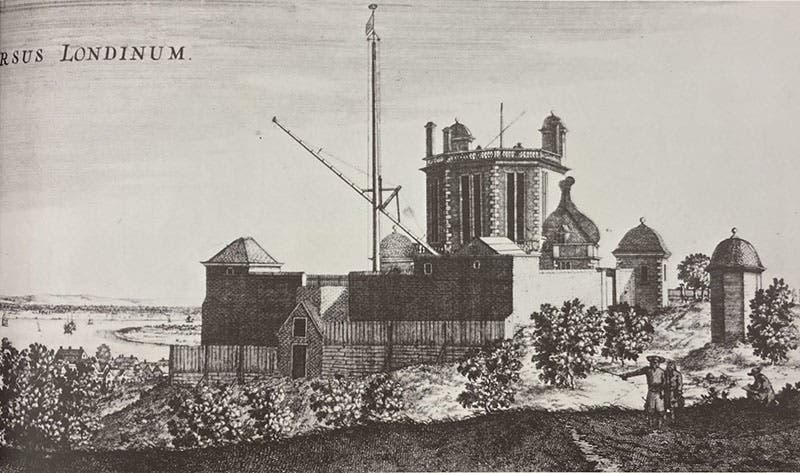
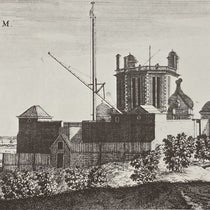
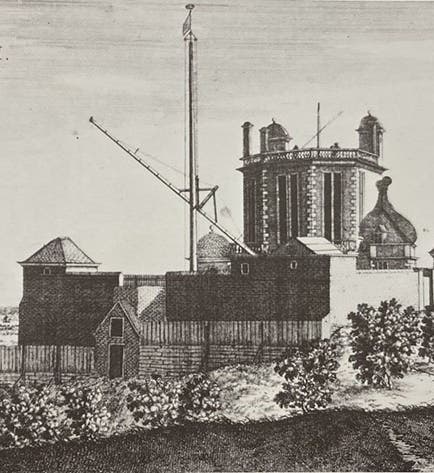
“Prospect toward London,” right half of plate IV, facsimile etching, Francis Place and the Early History of the Greenwich Observatory, by Derek House, Science History Publications, 1975 (The Linda Hall)
Greenwich Observatory was founded on Aug. 10, 1675, when the first foundation stone was laid. It was the brainchild of Jonas Moore, Surveyor General of the Ordinance and an advisor to King Charles II. One of Charles' mistresses had a male friend who claimed he had a solution to the "longitude problem," or how to determine longitude at sea, a pressing need of the Royal Navy, and indeed, of ships everywhere. A panel of experts was convened in the spring of 1675 to evaluate the proposal, mostly members of the Royal Society, such as Christopher Wren and Robert Hooke, but also including Moore and his young mathematical assistant, an astronomer named John Flamsteed.

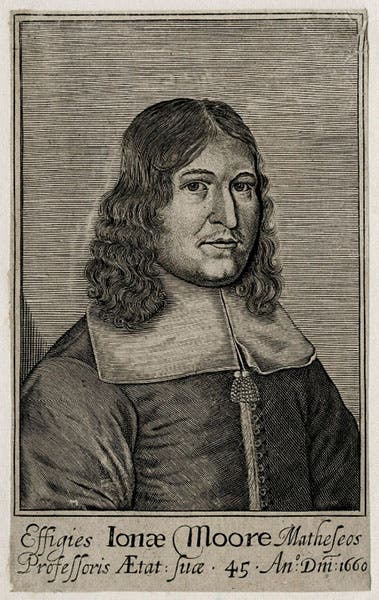
Portrait of Jonas Moore, engraving, unknown artist, 1660, National Portrait Gallery, London (npg.org.uk)
The committee shot down the proposal of the friend of the King’s mistress, but agreed that something needed to be done immediately to find a way to determine longitude at sea, and if it involved astronomy, then the country needed an Observatory. Or so Moore told King Charles II. He even offered up his assistant, and Charles agreed to appoint Flamsteed as his "Observator," at a salary of £100 per annum. And, again at Moore's urging, Charles warranted £500 for the building of a national observatory. Time was not wasted; a site was selected on Greenwich Hill on the outskirts of London, Wren was tapped to design the building, with input from Hooke, and construction was begun on this day in 1675. Flamsteed even facetiously created a horoscope for the building’s birth (third image).

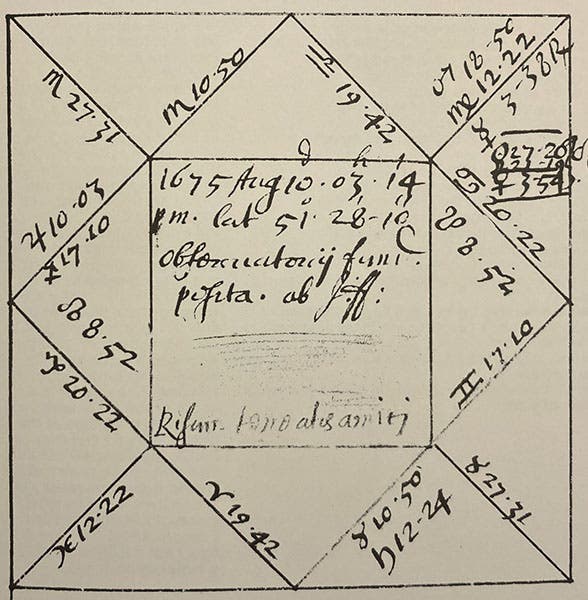
“Horoscope of Royal Observatory cast by John Flamseed,” for Aug. 10, 1675, original in RGO, facsimile in Francis Place and the Early History of the Greenwich Observatory, by Derek House, Science History Publications, p. 19, 1975 (The Linda Hall)
The initial building had a spacious observation room with a large quadrant and a medium-size telescope (fifth image); a much larger long-lens instrument was to be mounted from a mast in a courtyard outside. The most important need, if one wants to grapple with longitude, was an accurate clock, and the observatory was provided with two tall pendulum clocks (which had just been invented, by Christiaan Huygens). The clocks were too expensive for the budget, so they were paid for by Moore.

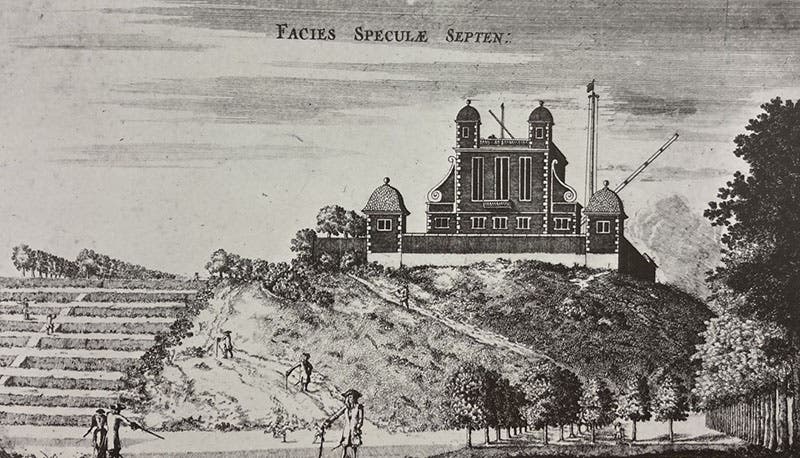
“North Face of Observatory,” plate VI, facsimile etching, Francis Place and the Early History of the Greenwich Observatory, by Derek House, Science History Publications, 1975 (The Linda Hall)

![“Star Chamber [Octagon Room],” plate IX, facsimile etching, Francis Place and the Early History of the Greenwich Observatory, by Derek House, Science History Publications, 1975 (The Linda Hall)](https://preview-assets-us-01.kc-usercontent.com:443/9dd25524-761a-000d-d79f-86a5086d4774/fbc99a76-fe0b-47e2-bcd4-3e496071a220/Jonas%20Moore%205.jpg?w=800&h=590&auto=format&q=75&fit=crop)
“Star Chamber [Octagon Room],” plate IX, facsimile etching, Francis Place and the Early History of the Greenwich Observatory, by Derek House, Science History Publications, 1975 (The Linda Hall)
The initial building at Greenwich came to be called Flamsteed House, since it is where Flamsteed lived and worked for 44 years, as the first Astronomer Royal of England. We have some excellent views of Flamsteed House from around 1676, made shortly after its completion, by Francis Place, an artist and engraver, who was recommended to Moore by Wenceslaus Hollar. Place made 12 large etchings, showing floor plans and elevations, and views from the grounds. Only one set of prints survives, bound up by Samuel Pepys and now in the Pepysian Library in Magdalene College, Cambridge. Because no other set has been located, a facsimile of the album with commentary by Derek Howse was published in 1975 by Science History Publications, for which we are grateful. Ordinarily we do not show facsimile illustrations in this space, but we make an exception today, for otherwise, Place's handiwork would remain unknown and unappreciated.

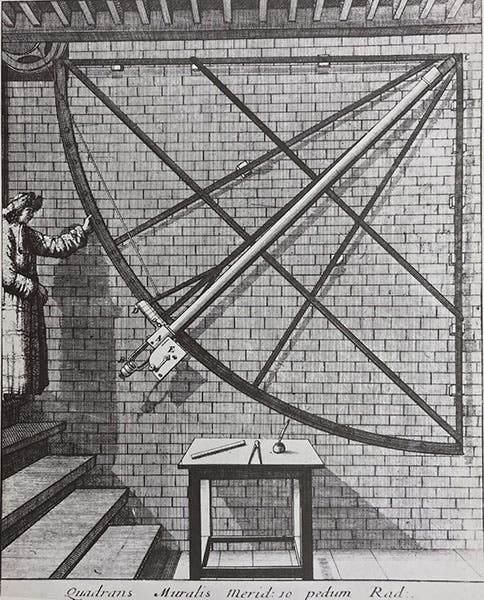
“Mural Quadrant,” plate X, facsimile etching, Francis Place and the Early History of the Greenwich Observatory, by Derek House, Science History Publications, 1975 (The Linda Hall)

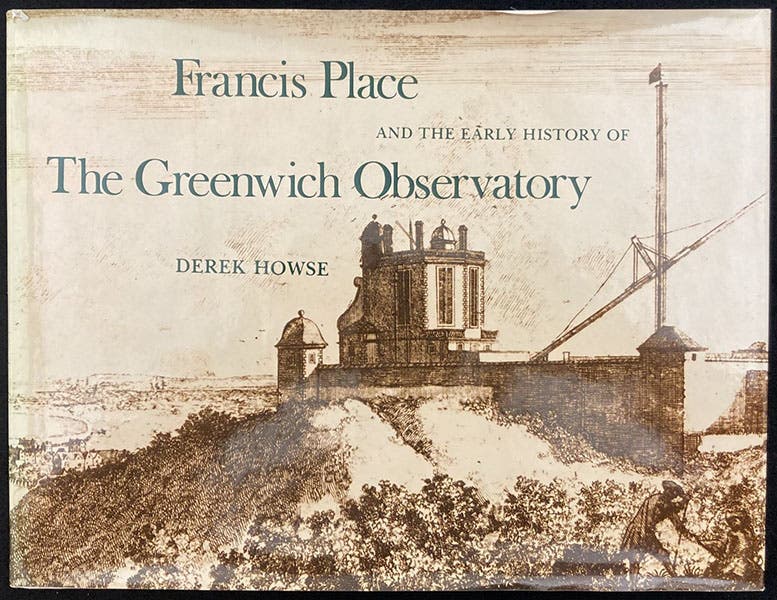
Dust jacket of Francis Place and the Early History of the Greenwich Observatory, by Derek House, Science History Publications, 1975, showing plate V, the North Prospect (author’s copy)
The facsimile etchings we show here are the "Prospectus toward London" (the right half only - it is a double page plate, with a gutter in the center); "The North Face", viewed from the bottom of the hill; "The Star Chamber Interior," or, as it would come to be called, the Octagon Room; and the "Mural Quadrant,” mounted outside. In the interior view of the Octagon Room (fifth image), the two Tompion clocks are behind the wall under the portrait of Charles II, with only the clock-faces visible. The “Prospect toward London” (first image) includes a small tower jutting out of the ground on the far right. This was the top of a hundred-foot well-telescope, built for Robert Hooke, who would try to detect stellar parallax there, lying on his back at the bottom. Place made a separate etching of a cross-section of the well telescope, but it does not fit in a space like ours, as you can imagine.

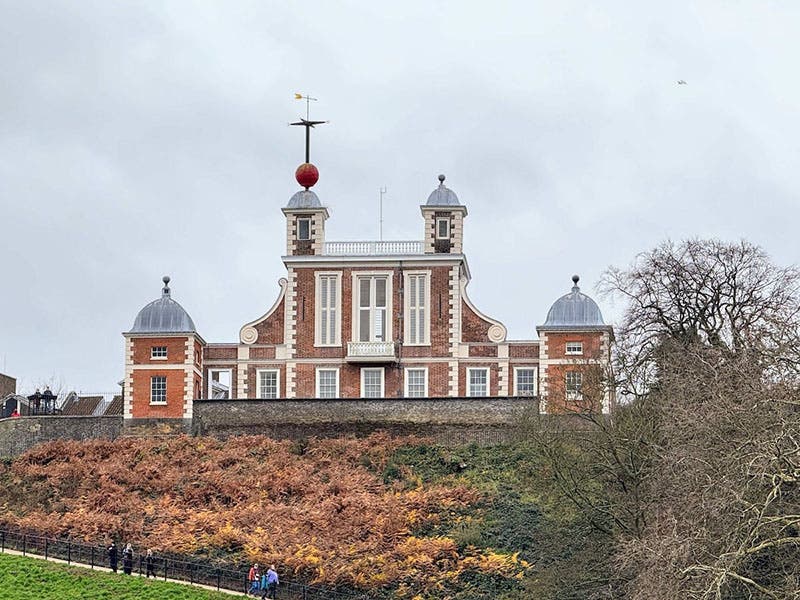
Old Greenwich Observatory today, north face, Living London History blog (livinglondonhistory.com)
The man who made the drawings for Place to engrave is known, because his name is on each plate: Robert Thacker, but his name is about all we know. Place, a much more prominent figure, seems to get most of the credit for the prints.
Moore died on Aug. 24, 1679, leaving behind a manuscript that was published in 1680 as A New Systeme of the Mathematicks, with a handsome engraved title page, but we do not have this work in our library. I hope we acquire it before long, so we can write another post about this remarkable patron of the sciences.
William B. Ashworth, Jr., Consultant for the History of Science, Linda Hall Library and Associate Professor emeritus, Department of History, University of Missouri-Kansas City. Comments or corrections are welcome; please direct to ashworthw@umkc.edu.