Scientist of the Day - Hipparchus

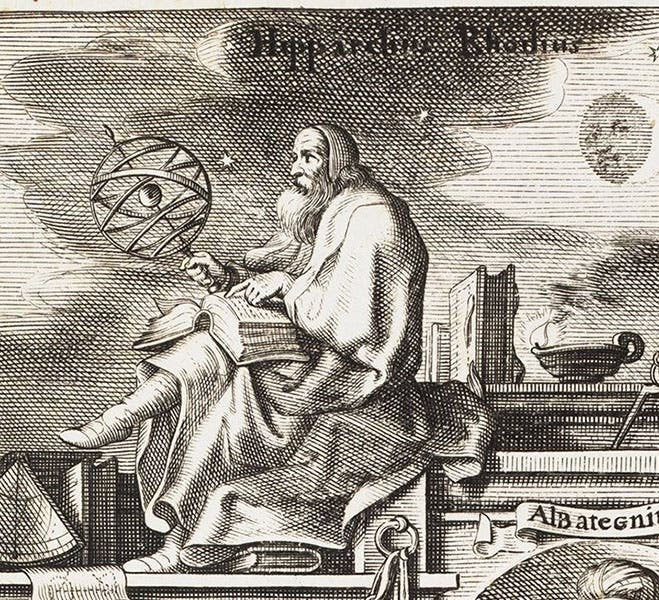
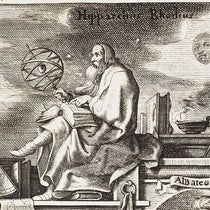
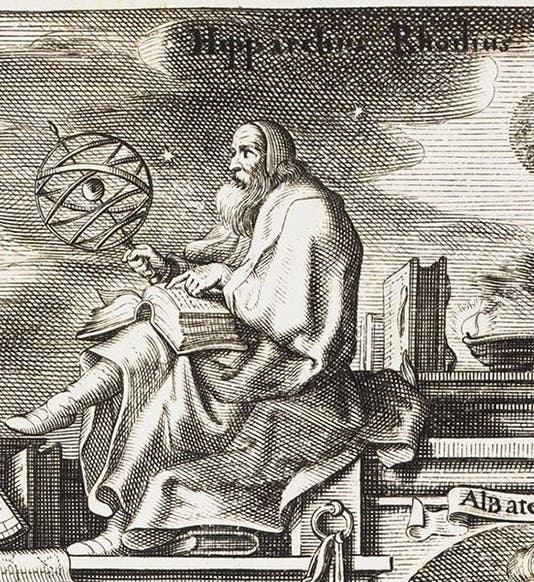
Imagined portrait of Hipparchus, detail of top right of Tabulae motuum coelestium, by Philippe van Lansbege, 1632 (The Linda Hall)
Hipparchus of Nicaea, an Ancient Greek astronomer, was born about 187 BCE and died sometime after 127 BCE. Because Nicaea was in Bythnia (up on the Black Sea), and because Hipparchus spent his later years in Rhodes, he is sometimes referred to as Hipparchus of Bythnia or Hipparchus of Rhodes.

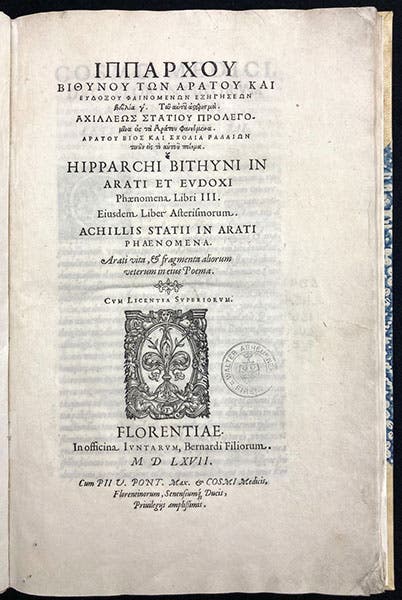
Title page, Hipparchi Bithyni in Arati et Eudoxi Phaenomena libri III, a commentary on the Phenomena of Aratus of Soli and Eudoxus of Cnidus, by Hipparchus of Rhodes, 1567 (The Linda Hall)
Whatever you call him, Hipparchus was probably the second most important astronomer of antiquity, after Ptolemy of Alexandria. He made regular observations of the planets and developed models to predict their motion. He made the first catalog of the stars, which Ptolemy simply adjusted and copied into his Almagest. Hipparchus was reputed to have invented the astrolabe and the armillary sphere. He practically invented trigonometry. His most significant achievement was no doubt the discovery of the precession of the equinoxes, a slight displacement of the stars with respect to the zero point of his star catalog, the spring equinox. This is a small, slow movement, about 1 degree every century, according to Hipparchus, and can only be detected by comparing stellar observations made hundreds of years apart. We now know that precession is caused by a slow wobble of the Earth on its axis, but in times when the Earth was thought to be central and unmoving, the motion of precession was assigned to the stars.

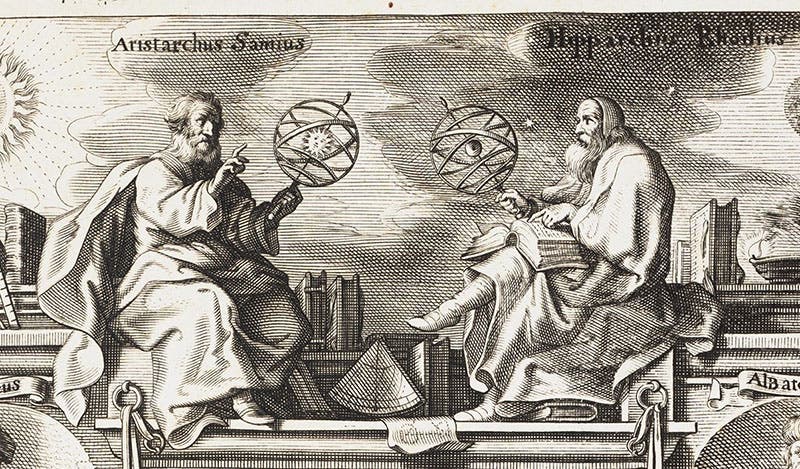
Imagined scene, with Aristarchus of Samos admonishing Hipparchus of Rhodes for his geocentric cosmological stance, detail of top of engraved title page, Tabulae motuum coelestium, by Philippe van Lansbege, 1632 (The Linda Hall)
Hipparchus wrote many books, but only one has come down to us, a commentary – a rather critical commentary – on the Phaenomena of Aratus, a book on the constellations, which partially reconstructed a now-lost book of the same title by Eudoxus of Cnidus We have many editions of the Aratus work, but just one edition of the commentary by Hipparchus, printed in 1567, of which we show the title page (second image).

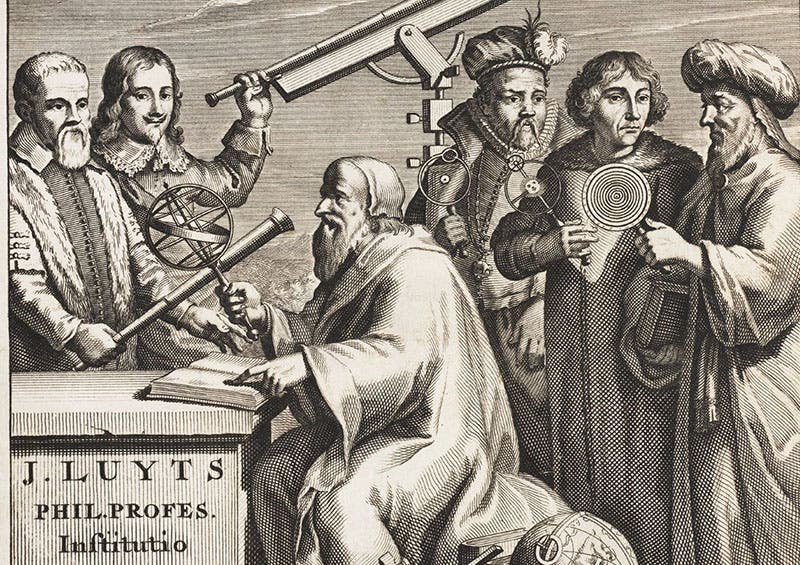
Imagined group portrait: Galileo, Johannes Hevelius, Hipparchus (seated), Tycho Brahe, Copernicus, and Ptolemy, detail of engraved title page, Astronomica institutio, by Jan Luyts, 1692 (The Linda Hall)
Because Hipparchus left such a sparse written legacy, it is not surprising that no portrait of him survives. But there is an imagined portrait that is more interesting than most, especially because it was used more than once (first image). For the title page of Phillipe van Lansberge's Tables of 1632, which is a work supporting the Copernican system, Lansberge's artist created a dramatic scene (third image) in which an ancient heliocentrist, Aristarchus of Samos, holding a sun-centered armillary, admonishes a geocentric astronomer, with an earth-centered armillary, as to the error of his ways, and that astronomer is identified as Hipparchus of Rhodes. Except for the startled expression at being singled out for abuse, it is actually a fine portrait (first image). So you may establish the context, we show the entire title page below (fifth image).

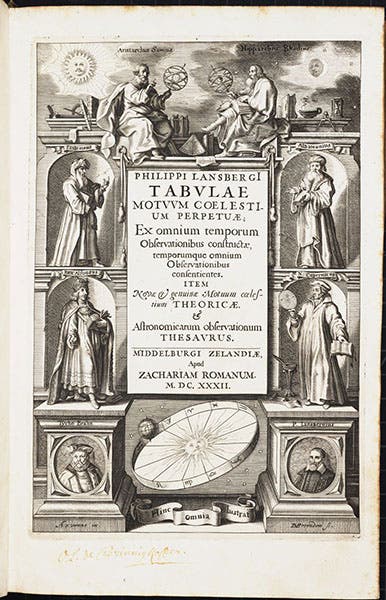
Engraved title page, Tabulae motuum coelestium, by Philippe van Lansbege, 1632 (The Linda Hall)
Exactly 60 years later, for the engraved title page of the 1692 edition of Jan Luyts' Astronomica institutio, another Netherlandish artist came up with a pleasing group portrait, depicting four modern astronomers – Galileo, Johannes Hevelius, Tycho Brahe, and Copernicus (left to right) – and two ancient ones, Ptolemy standing at far right, and Hipparchus seated at center (fourth image). It is easy to identify Hipparchus, since he was copied from the labeled figure on Lansberge's title page of 1632, although the look of terror has mellowed considerably. If Rhodes were ever to issue a commemorative stamp – and they should – this would be the portrait to use. Again, we show the entire 1692 title page below, so you may see how Hipparchus fits into the overall framework.

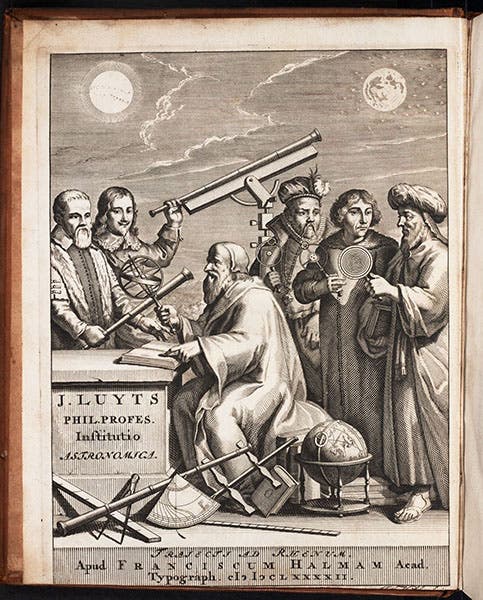
Engraved title page, Astronomica institutio, by Jan Luyts, 1692 (The Linda Hall)
We seldom mention when an astronomer has a lunar crater named after him or her, since every astronomer of note has a named crater on the Moon, but we make an exception here, because the crater Hipparchus is not only splendid to view, but it was the first crater to be drawn in detail, by Robert Hooke, who stuck it in at the end of his marvelous book on microscopic objects, Micrographia (1665; last image here). We included it in our exhibition, The Face of the Noon: Galileo to Apollo.

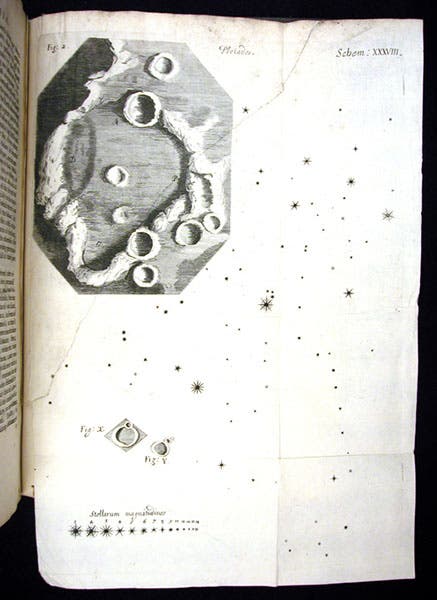
The lunar crater Hipparchus, drawn by Robert Hooke, engraving in his Micrographia, 1665, plate 38 (The Linda Hall)
William B. Ashworth, Jr., Consultant for the History of Science, Linda Hall Library and Associate Professor emeritus, Department of History, University of Missouri-Kansas City. Comments or corrections are welcome; please direct to ashworthw@umkc.edu.