Scientist of the Day - Josef Pallenberg

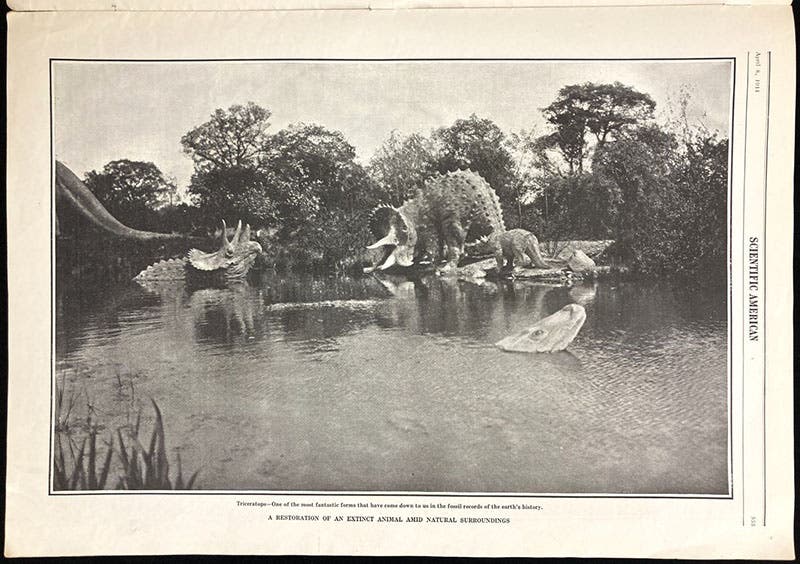
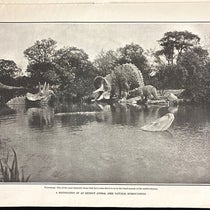
Triceratops family, sculptures by Josef Pallenberg at Tierpark Hagenbeck, Hamburg, Scientific American, vol. 104(14), p. 353, Apr. 8, 1911 (The Linda Hall)
Josef Pallenberg, a German sculptor, animalier, and proto-paleoartist, was born on Aug. 6, 1882, in Cologne. He started drawing animals at the zoo as a child, and at the age of 17, he enrolled in the Art Academy in Düsseldorf, still with an emphasis on drawing animals, but now also including sculpture. When he graduated, he was offered a job at the Berlin Zoo, which is where he ran into Carl Hagenbeck, getting ready to open up a new kind of zoo, an open-air, natural-habitat animal park at Stellingen in Hamburg. Hagenbeck recognized Pallenberg’s talent and commissioned him to design animal sculptures for the gates of the new museum, Tierpark Hagenbeck, which opened in 1907.

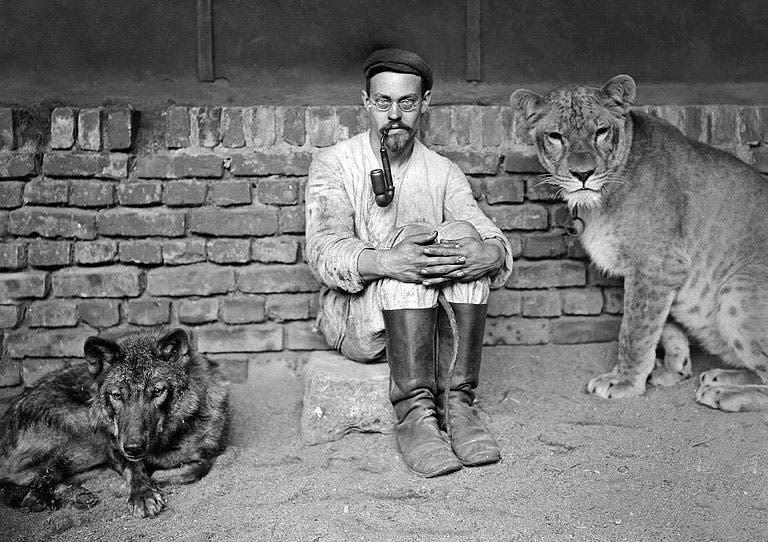
Portrait of Josef Pallenberg with two of the animals in his personal zoo, Schloss Benrath, Düsseldorf (schloss-benrath.de)
And then, somehow, Hagenbeck got the notion of adding life-size statues of dinosaurs to his Tierpark. I don't know if this was Hagenbeck's idea, or if it was inspired by Pallenberg, but Pallenberg was hired to construct some 30 concrete dinosaurs and prehistoric reptiles at Stellingen. Perhaps one or both of them had had a chance to see the Crystal Palace dinosaurs erected outdoors by Benjamin Waterhouse Hawkins in 1854, and thought that similar constructions would be a popular attraction at the Tierpark.

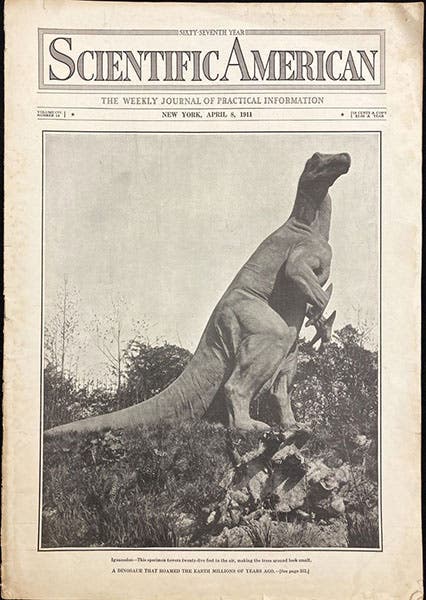
Iguanodon, sculpture by Josef Pallenberg at Tierpark Hagenbeck, Hamburg, cover of Scientific American, vol. 104(14), p. 351, Apr. 8, 1911 (The Linda Hall)
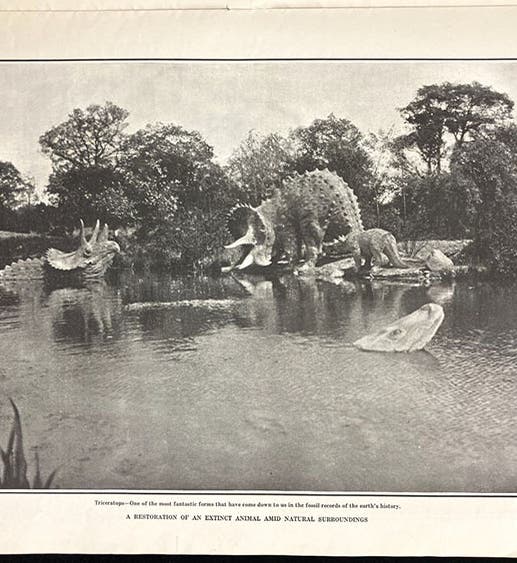
The dinosaur wing at Tierpark Hagenbeck must have opened by April of 1911, for on the 8th of that month, Scientific American magazine in the United States ran a cover story on the Pallenberg dinosaurs, and showed 4 of them – Triceratops (first image), Iguanodon (on the cover; third image here), Tyrannosaurus, and Diplodocus (fourth image), plus a pterodactyl and a plesiosaurus. The photographs are black and white, making the dinosaurs look a bit drab, but as sculptures, they are certainly impressive.

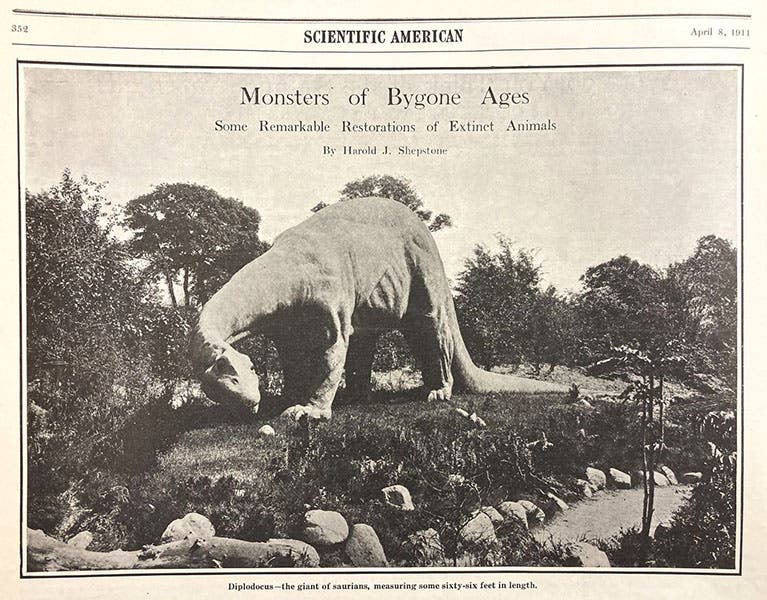
Diplodocus, sculpture by Josef Pallenberg at Tierpark Hagenbeck, Hamburg, Scientific American, vol. 104(14), p. 352, Apr. 8, 1911 (The Linda Hall)
Scientific American only showed a selection of Pallenberg's creations. Four years later, John W. Gregory published Geology of To-day (1915), which, despite its title, was mostly about prehistoric animals. The Stellingen creations were featured in abundance, in many cases with the exact same photos used by Scientific American, suggesting that the magazine did not take them, but rather Pallenberg did, or someone at the Tierpark. Gregory's book has several Pallenberg dinos we have not seen, including one of the best, a Ceratosaurus attacking a Stegosaurus (fifth image).

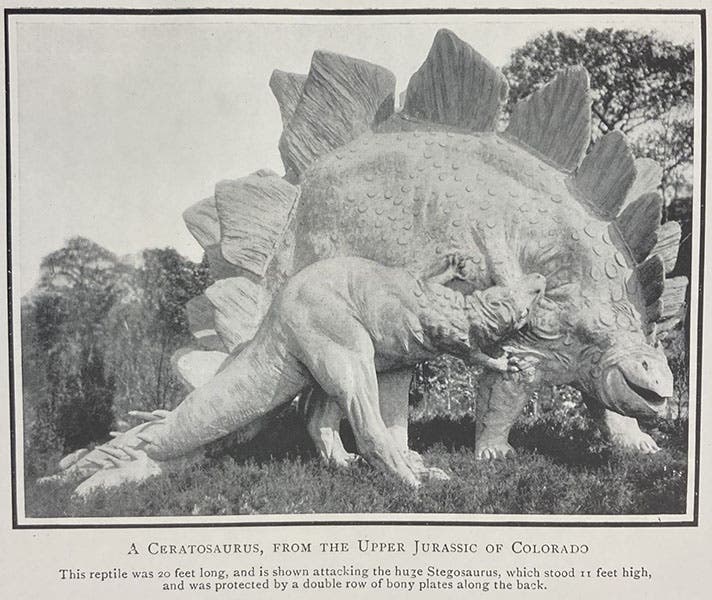
Stegosaurus attacked by Ceratosaurus, sculpture by Josef Pallenberg at Tierpark Hagenbeck, Hamburg, photograph in Geology of To-day, by John W. Gregory, p. 254, 1915 (The Linda Hall)
The Pallenberg sculptures, like those of Hawkins in London, proved to be a popular attraction and, being concrete, have withstood the onslaughts of time better than the flesh-and-blood versions, as we see in a recent photo of poor Stegosaurus under attack (sixth image).
.JPG#/media/File:Tierpark_HagenbeckJosef_Pallenberg1909Dinosaurs_(6).JPG)
Stegosaurus attacked by Ceratosaurus, sculpture by Josef Pallenberg at Tierpark Hagenbeck, Hamburg, recent photograph (Wikimedia commons)
There is an excellent blog series called Love in the Time of Chasmosaurus which, this past spring (2026), published a post on the Pallenberg dinosaurs, written by Gemma Hazeborg, with dozens of new color photographs of Pallenberg's sculptures in their natural settings, just as you would encounter them if you visit the zoo. If you do not have that opportunity, you should at least visit the blog.

Trumpeting stag, life-size bronze sculpture by Josef Pallenberg, recent photograph, Düsseldorfer Hofgarten (Wikimedia commons)
Pallenberg also sculpted many non-extinct animals in bronze, both miniature and life-size; you can regularly bid on the miniatures at auction. You can also see many of the small ones on display at a Pallenberg gallery recently opened at the Schloss Benrath Museum of Natural History in Düsseldorf. Some life-size ones ae scattered about various German parks, including one in Düsseldorf (last image).
William B. Ashworth, Jr., Consultant for the History of Science, Linda Hall Library and Associate Professor emeritus, Department of History, University of Missouri-Kansas City. Comments or corrections are welcome; please direct to ashworthw@umkc.edu.