Scientist of the Day - John Ericsson

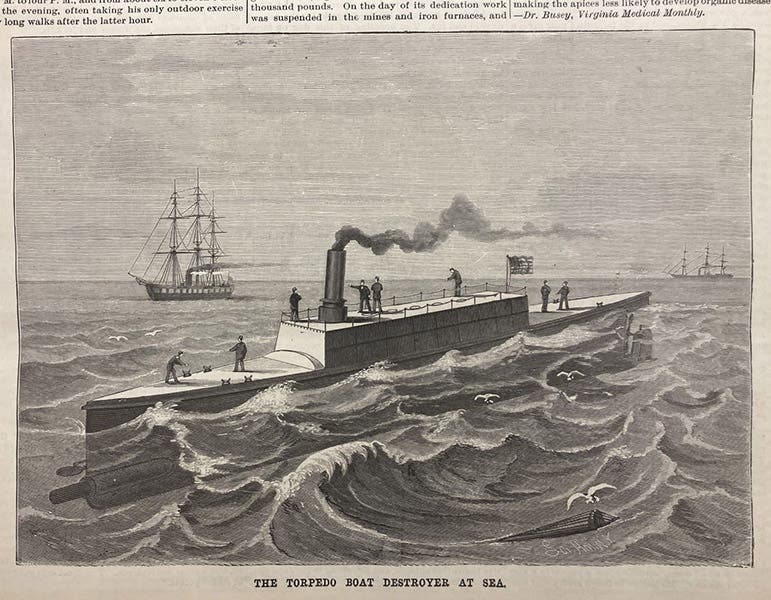
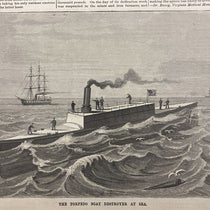
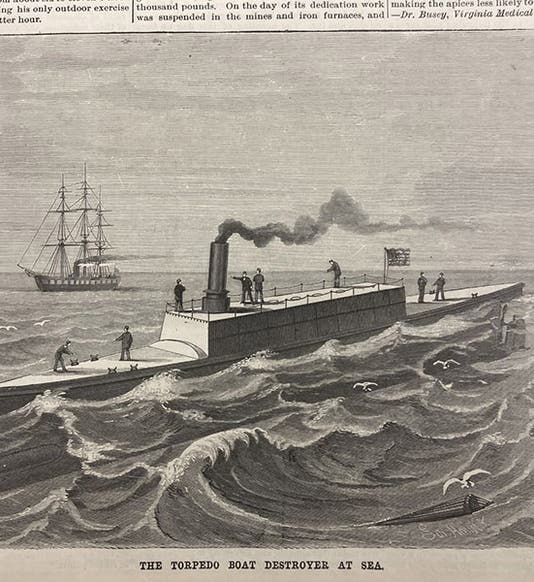
Torpedo boat Destroyer, designed and built by John Ericsson, steel-engraving, Scientific American, vol. 60(12), p. 183, Mar. 23, 1889 (The Linda Hall)
John Ericsson, a Swedish/American engineer, was born on July 31, 1803, in Långban, a tiny village in Värmland, Sweden. He was taught surveying by his father, and that was the extent of his formal education. He started working as a surveyor when he was fourteen, and soon moved on to inventing improvements to all manner of new technologies, especially steam engines. He thought that screw drives would be superior to paddle wheels on early steamships (of which there were not many in the 1820s), and he came to England to demonstrate his screw drives in some trials on the Thames. The Royal Navy was not sold on the idea. While in England, he and a fellow inventor, John Braithwaite, built a locomotive, Novelty, that they entered in the Rainhill Trials in October of 1829. Novelty had mechanical problems, and the trials were won by Rocket. Ericsson was only 26 years old.

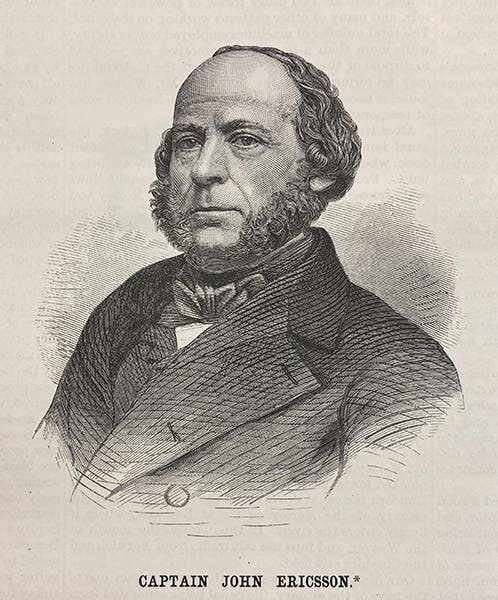
Portrait of John Ericsson, steel-engraving, Scientific American, vol. 60(11), p. 163, Mar. 16, 1889 (The Linda Hall)
The Royal Navy was, at the time, sending ship after ship into the icy Arctic in quest of a Northwest Passage. These all went under sail, as the Admiralty was not yet interested in steam power. When John Ross had to seek private sponsorship for his 1831 exploration up north (he was in the Admiralty's doghouse, for reasons described here), in the persona of Felix Booth, Ericsson saw opportunity, and he equipped the Victory, Ross's (Booth’s) vessel, with an auxiliary steam engine. Ross was not a fan, and when the Victory was frozen in off the Boothia Peninsula (for 5 years!), he ripped out the engine and left it on the shore.

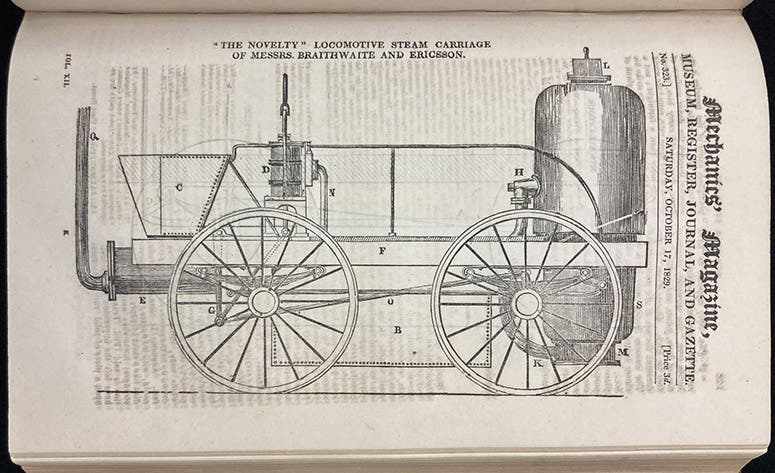
Novelty, locomotive built by John Braithwaite and John Ericsson for the Rainhill Trials in 1829, woodcut in Mechanics' Magazine, Register, Journal, and Gazette, vol. 12, p. 129, Oct. 17, 1829 (The Linda Hall)
So far, Ericsson had not had much of a success rate. He had designed a new war ship with twin steam engines and twin screw propellers, but could find no takers in England. An American naval officer, however, was interested, and he convinced Ericsson to come to the United States and build his ship, for which he would find the funds. The result was the USS Princeton, the most advanced warship in the world in 1843 (fifth image). Ericsson even designed and built a gun that could fire a shell at a target 5 miles away. The ship was a great success, especially among dignitaries, until February of 1844, when, on a pleasure cruise on the Potomac, during a combat demonstration, a second long gun, NOT designed by Ericsson, exploded, killing two members of President Tyler's cabinet and almost snaring the President, who had ducked below and thus escaped the shrapnel. Ericsson was unfairly blamed, and no more boats like the Princeton were ever built, which is a shame.

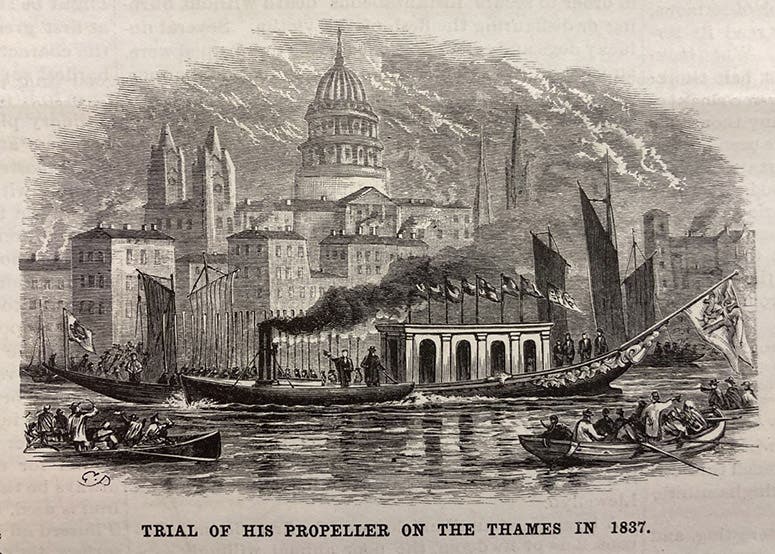
Demonstration of Ericsson’s screw propellers on the Thames, 1837, wood engraving, Scientific American, vol. 60(12), p. 182, Mar. 23, 1889 (The Linda Hall)
Fortunately for Ericsson's career and his reputation, his other ships were not involved in freak accidents, and one of them, the USS Monitor, an ironclad, secured its niche in naval history when it battled the confederate ironclad CSS Virginia to a draw in the Battle of Hampton Roads in 1862. We told that story in our first post on Ericsson, and in a post on the USS Monitor (without duplicating any images, I might add).

USS Princeton, a steam screw sloop, designed and built by John Ericsson in 1843, engraving, 1851 (Wikimedia commons)
Ericsson had a fertile imagination and continued to invent new kinds of propulsion systems for ships, including a hot-air engine and a solar-heat engine. He designed another warship, the Destroyer, which had a torpedo tube that could fire a projectile underwater, and this ship was built (first and seventh images). I do not know if it was ever used in combat.

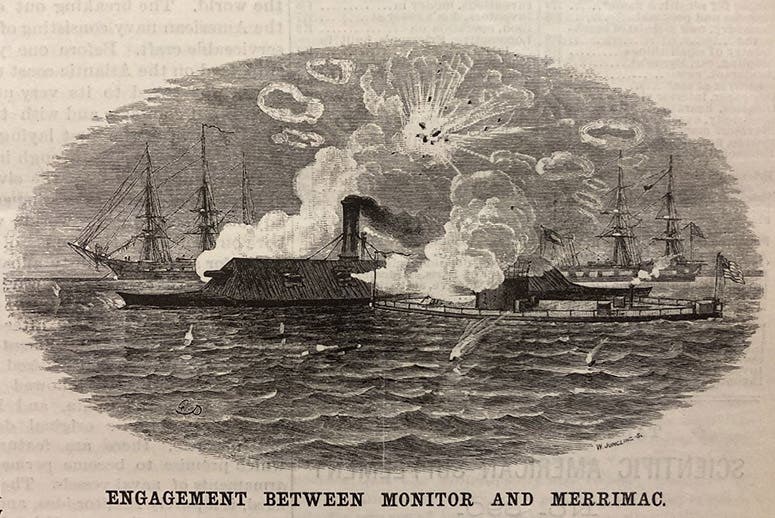
Battle of the USS Monitor and the CSS Merrimac (Virginia), 1862, wood engraving, Scientific American, vol. 60(12), p. 175, Mar. 23, 1889 (The Linda Hall)
By the 1870s, Ericsson was the most respected naval engineer in the world. He had quite a reputation in his native Sweden, even though he hadn't been home in decades, and in the 1870s, while Ericsson was still alive, a large granite monument was erected in the front yard of his birth house in Värmland, which still stands.

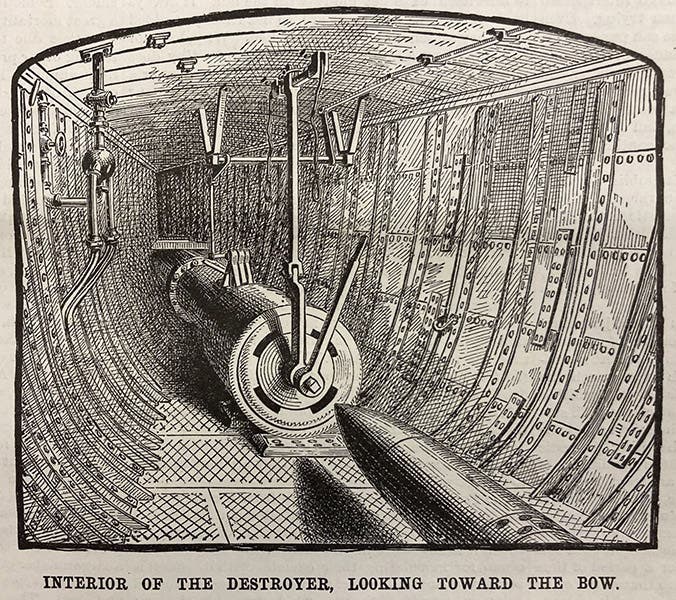
Interior below-decks of Destroyer, showing torpedo launch tube, wood engraving, Scientific American, vol. 60(12), p. 183, Mar. 23, 1889 (The Linda Hall)
When Ericsson died on Mar. 8, 1889, Scientific American magazine, which had covered his inventions for years, commemorated Ericsson with a cover story for their issue of Mar. 23, 1889, with a number of wood engravings, which we have drawn on to illustrate this post. You can see the entire first page below (eighth image).

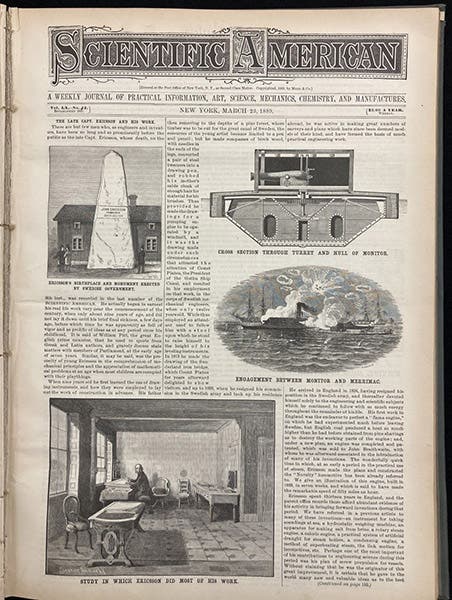
Front-page story on John Ericsson, a tribute after his death on Mar. 8, 1889, Scientific American, vol. 60(12), p. 175, Mar. 23, 1889 (The Linda Hall)
In 1926, an ornate monument honoring Ericsson was erected in Washington, D.C., right on the Mall, near the Lincoln Memorial. We showed that monument in our first post, so we don't have to do so again. It incorporates a fine statue of Ericsson in its otherwise Symbolist iconography. We will show here the U.S. postage stamp honoring Ericsson that was issued that same year, with a view of the new monument (last image).

U.S. postage stamp commemorating John Ericsson, with a view of his Washington monument, 1926 (Wikimedia commons)
Ericsson’s remains were conveyed back to Sweden for burial by a convoy of U.S. Navy ships in 1890. There are paintings that show the armada leaving New York Harbor, flying Swedish flags, if you wish to seek them out.
William B. Ashworth, Jr., Consultant for the History of Science, Linda Hall Library and Associate Professor emeritus, Department of History, University of Missouri-Kansas City. Comments or corrections are welcome; please direct to ashworthw@umkc.edu.