Scientist of the Day - Francis Crick

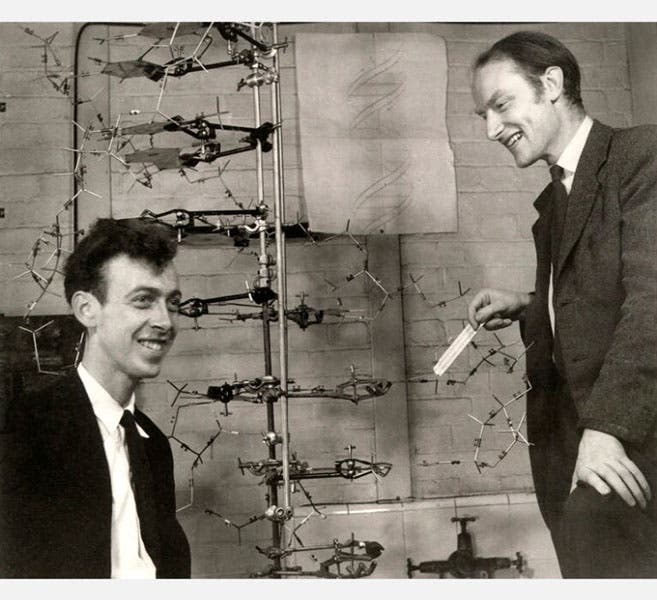
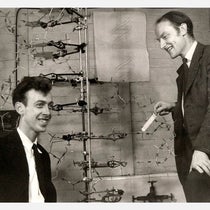
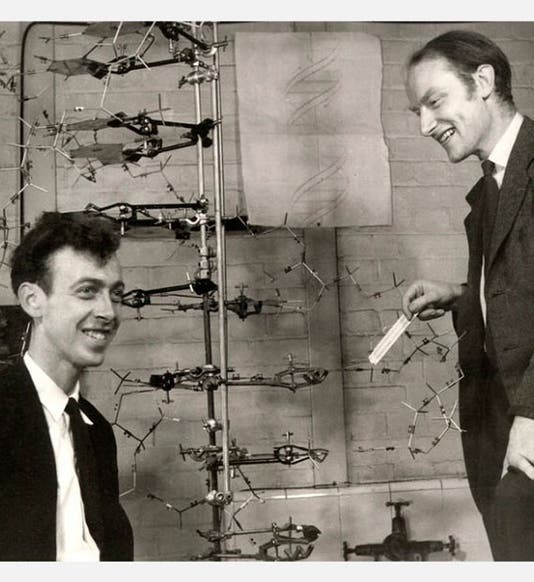
Francis Crick (right) and James Watson, with their model of DNA, photograph by Antony Barrington Brown, one of many taken in their lab on May 21, 1953, National Portrait Gallery, London (npg.org.uk)
Francis Crick, a molecular biologist and neuroscientist, died July 28, 1904, at age 88. He was born near Northampton on June 8, 1916. He attended school in Northampton until he was 14, and he must have shown some promise, since he won a scholarship to Mill Hill School in London, a notable prep school. He had early on developed an interest in science, primarily in physics, an interest he maintained through his undergraduate days at University College, London. His PhD studies in London were interrupted by the War, during which he worked on magnetic mines and, ironically, invented a mine that could target German minesweepers.
After the war, Crick, like many young English physicists in the late 1940s, switched to the life sciences, wanting to find the physical basis of life. He transferred to Cambridge, where he studied at what would become the Laboratory for Molecular Biology, run by the Medical Research Council (MRC), and then at their Strangeways Lab, before settling into a PhD program under Max Perutz and John Kendrew at the Cavendish Lab at Cambridge. The lab was headed up by Lawrence Bragg, who had won a Nobel prize some 30 years before, but would soon be out of his element trying to control Crick and the soon-to-arrive Yank, James Watson.

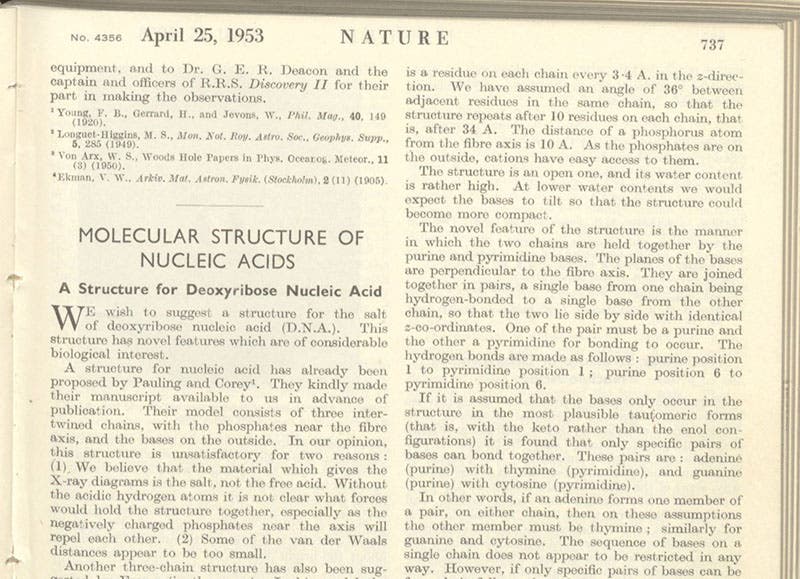
First paragraph of “Molecular structure of nucleic acids: A structure for deoxyribose nucleic acid," by James D. Watson and Francis Crick, Nature, vol. 171, p. 737, Apr. 25, 1953 (The Linda Hall)
Crick married Odile Speed in 1949, with whom he had a compatible if unconventional marriage, and then he met Watson in the fall of 1951. Both desperately wanted to work on the structure of DNA, and they found each other to be perfect sounding boards, one steeped in math and physics, the other in biology. Unfortunately, they were supposed to be working on other projects – Watson on hemoglobin, Crick on his PhD, which he had not yet finished. DNA research, using the techniques of X-Ray crystallography, was by agreement in the hands of King’s College, London, first with Maurice Wilkins, then Rosalind Franklin.
However, over the course of 18 months, Watson and Crick, getting grudging permission at every step, uncovered the double-helix structure of DNA, a story we have already told in our profiles of Watson, Franklin, and Wilkins. We have not discussed exactly what Watson contributed and what was provided by Crick, and for much of the work, it is impossible to separate the two. It was Watson who first realized that the DNA molecule must be a helix, and a double-helix at that, and Watson who thought model building would provide a solution. It was Crick who realized that the two sugar-phosphate backbones must run in opposite directions, and who recognized the significance of Edwin Chargaff's discovery that the amount of guanine in any specimen of DNA is always equal to that of cytosine, and adenine that of thymine. But mostly it was a joint achievement, and justly rewarded with a joint Nobel prize in 1962.
The reason the discovery of the double helix – surely the most significant biological achievement of the century – gets short shrift here, is because, important as the double-helix was, Francis Crick was just getting started. It was apparent in 1953 that DNA contains a code for life, but what was the code? How was it written? If the code of a gene is a recipe for a protein, what reads the recipe and how is it implemented? The unanswered questions were numerous and deep, but most were solved between 1953 and 1966, and Crick had a hand in the solution of every one.
it was primarily Crick who figured out that: a) the code must be written in triplets of bases; b) the work of building proteins is not done directly on the DNA helix, but elsewhere in the cell; c) the primary constructors of proteins are tiny bits of RNA, each bound to a particular amino acid, that do protein assembly on microsomes (now called ribosomes) in the cytoplasm; and d) the blueprint they work from is not the original DNA molecule, but an RNA copy of the gene, now called messenger RNA, that brings the code from the nucleus to the ribosomes. Crick even maintained, in the face of near-unanimous opposition from biochemists, that DNA contains only a recipe for the order of amino acids in a protein, with no plans for the three-dimensional folding of the protein – that is done automatically once the amino acids are in place. He turned out to be correct in all of this. Crick also framed the "Central Dogma"; the proposal that information flow in the cell goes only one way, from DNA to protein, and in no case do changes in proteins result in changes in DNA. He was later criticized for this, especially for using the word "dogma", which implied it was an unchallengeable truth. Crick (an agnostic) replied that he thought he had used dogma the way religions used it: to refer to something thought to be true, but for which there was no evidence at all.

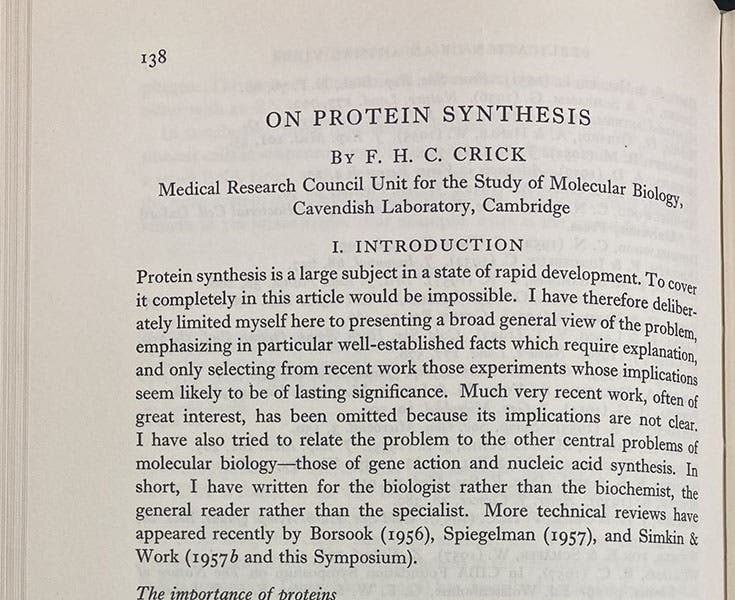
First paragraph of a paper by Francis Crick, “On protein synthesis,” in Symposia of the Society for Experimental Biology, vol. 12, p. 138, 1958 (The Linda Hall)
Most of Crick’s surmises and discoveries appeared in Nature and similar journals, but one famous one, “On protein synthesis” (1958), was included in a symposium volume that can be hard to find in a library catalog, so we scanned the beginning of the paper (third image) as well as the titIe page (fourth image), to make it easier to run down, and to show why libraries like ours, which collect scientific colloquia and symposia, are nice to have around. It was in this paper that Crick announced the Central Dogma and posited “adaptor molecules” that would bring messenger RNA and amino acids together in the cell cytoplasm.

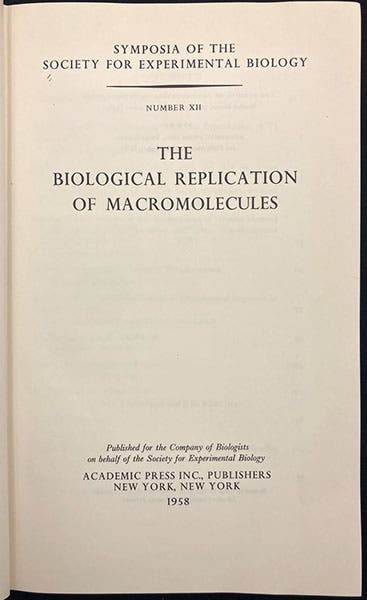
Title page of Symposium no. 12 of the Society for Experimental Biology, which has its own title, and contains the paper by Francis Crick, “On protein synthesis,” Symposia of the Society for Experimental Biology, vol. 12, 1958 (The Linda Hall)
Crick's professional life was not over when the last of the 64 base triplets was decoded in 1966. He was curious to know why there was only one genetic code for all living things, suggesting the possibility that life originated elsewhere. And he had always been interested in consciousness, convinced that, like life, it has a physical basis. He moved from Cambridge to the Salk Institute in San Diego In 1977 and devoted the rest of his life to trying to solve the problems of the origin of life and the origin of consciousness. It is a tale for another time.

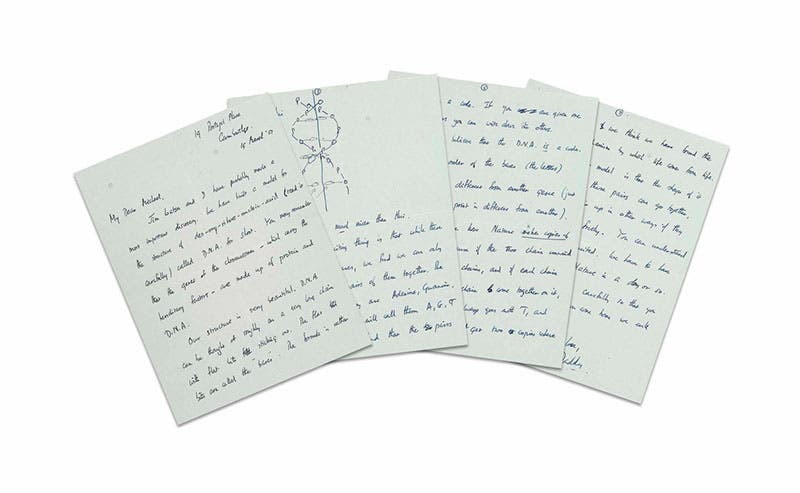
The four sheets of a 7-page letter from Francis Crick to his 12-year-old son Michael, Mar. 19, 1953, one month before the double-helix paper was published in Nature, offered at auction by Christie’s on Apr. 10, 2013 (christies.com)
On Mar 19, 1953, Francis penned a hand-written letter to his 12-year-old son Michael, describing what he and Watson had done and why it was important. This was before their paper was published in Nature in April. In the opinion of historians, the account in the letter is 100% accurate. The letter was saved, and sold at auction at Christie's in 2013, where it fetched over six million dollars, the proceeds going to support scientific research (fifth image). The same auction saw the sale of a portrait of Crick by his wife Odile that I had never seen before, showing Francis reading a journal in their apartment in Cambridge that they called the Green Door, and into which they moved when Max Perutz moved out (last image). It was Odile, by the way, who drew the sketch of the double helix that is pasted to the wall in the photo with the model (first image), and which was printed in the paper in Nature in 1953 (you can see the printed version in our post on Watson, fifth image).

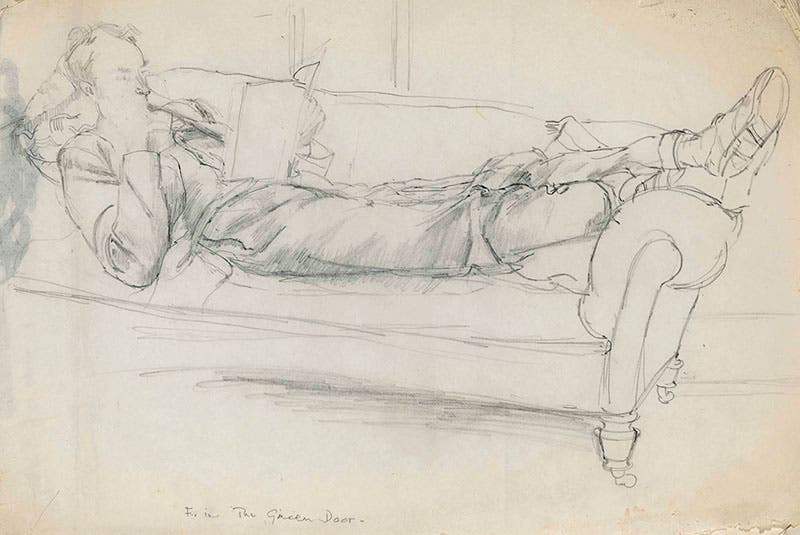
Portrait of Francis Crick, “F. in the Green Door,” by Odile Crick, pencil on paper, ca 1950, offered at auction by Christie’s on Apr. 10, 2013 (christies.com)
Should you be interested in learning more about Francis Crick, he has been well served by several excellent biographies and by his autobiography. For a general audience, I would recommend Francis Crick: Discoverer of the Genetic Code, by Matt Ridley (2006). I read it for the first time while writing this post, and found it accurate, literate, and yet readable.
William B. Ashworth, Jr., Consultant for the History of Science, Linda Hall Library and Associate Professor emeritus, Department of History, University of Missouri-Kansas City. Comments or corrections are welcome; please direct to ashworthw@umkc.edu.