Scientist of the Day - Frans Lindqvist

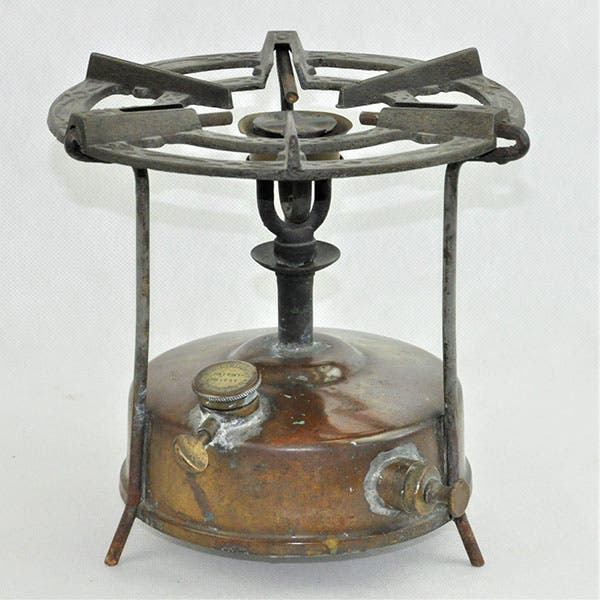
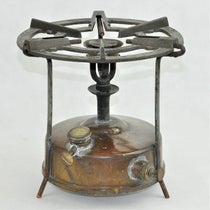
A very early Primus stove, ca 1892-1900 (classiccampstoves.com)
Frans Wilhelm Lindqvist, a Swedish inventor, was born in 1862; we do not know his birthday or date of death, so we chose today to celebrate. Lindqvist, in 1892, invented the Primus portable kerosene stove, one of the great inventions of the past 200 years, in my opinion.

Portrait of Frans Wilhelm Lindqvist, inventor of the Primus stove, undated and undocumented photograph (Wikimedia commons)
Kerosene (paraffin) lamps for heating had been around for some time, but they all used a wick, which produced a sooty, smoky flame. In 1882, another Swede, Carl Richard Nyberg, invented a handheld portable blowtorch, which pressured the kerosene and burned it directly, without a wick. The flame was horizontal, as we see in a photo (third image).

An early handheld blowtorch, ca 1880s (Wikimedia commons)
Lindqvist turned the flame upwards, which allowed him to place a small spirit cup around the vertical tube, and also put a pot-holder ring on top. The spirit cup held a little kerosene, which when lit, would preheat and vaporize the kerosene, which would rise because the small tank below was pressurized by a small thumb-pump. The vaporized kerosene gas coming out the nozzle could then be ignited, and it would burn without a wick, providing a hot, smokeless flame. Place a cup of water on the stovetop ring, and your tea would be ready in just a minute or two. Lindqvist began marketing these through a manufacturer as Primus stoves in 1892.

Early ad for the Primus stove by the manufacturer, B.A. Hjorth & Co., purportedly 1893; “Fotogenköket” means “kerosene stove” (Wikimedia commons)
The original stove was ingenious beyond measure. You could take off the ring and its support rods, and the whole stove would fit in the side pocket of a backpack, taking up no more room than a pair of rolled-up woolen socks. A flask of extra fuel could be stowed in another. The Primus stove had very few moving parts, just the thumb-plunger for pressurizing. You might have to clean the nozzle with a pin now and then. But that was it. It was a foolproof addition to any explorer's camping gear.

A labelled photo of a Primus stove, applicable to the first stoves of 1892, or one produced today (Wikimedia commons)
The Primus stove soon found many appreciative users, Fridtjof Nansen took several on the voyage of the Fram in 1893, and raved about them in his book, Farthest North, where he even provided a diagram of his Primus (fifth image; the odd containers on either side and the top are for melting ice). Other explorers took notice; Roald Amundsen took Primus stoves as he navigated the Northwest passage in 1993 and trekked to the South Pole in 1910. Nearly every other explorer followed suit, and soon millions of campers, when camping became a recreational sport. The National Air and Space Museum has a Primus stove owned by Charles Lindbergh, carried in his plane, just in case.

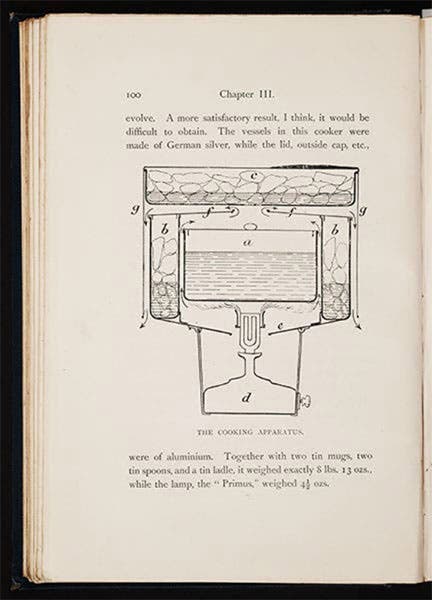
Diagram of a Primus stove in use, in Farthest North, by Fridtjof Nansen, p. 100, 1897 (The Linda Hall)
The reason I admire the original Primus stove so much is that it did its job so well that it hasn't changed in 144 years. I own several, made in the 1970s and 80s, and they look exactly like Lindqvist's first model. Same bottom tank, same thumb-pump, same spirit cup, same expansion chambers, same nozzle, same cooktop on its three rods. How many inventions can you think of that came forth, like Minerva, fully formed from the head of their progenitor? I expect that even something as simple and ingenious as a hammer or a screwdriver took some time to arrive at its optimal form. The Primus stove started out perfect, and it has stayed that way. You should all buy one, and use it, in tribute to the ultimate inventor, Frans Lindqvist. I wish we knew more about him.
William B. Ashworth, Jr., Consultant for the History of Science, Linda Hall Library and Associate Professor emeritus, Department of History, University of Missouri-Kansas City. Comments or corrections are welcome; please direct to ashworthw@umkc.edu.