Scientist of the Day - Glenn Curtiss

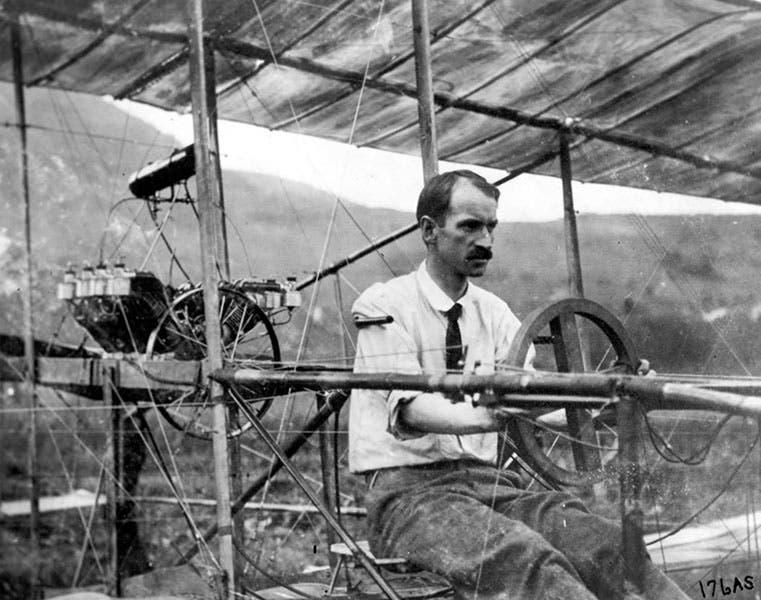
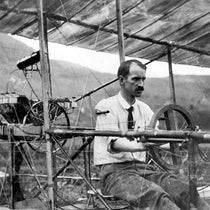
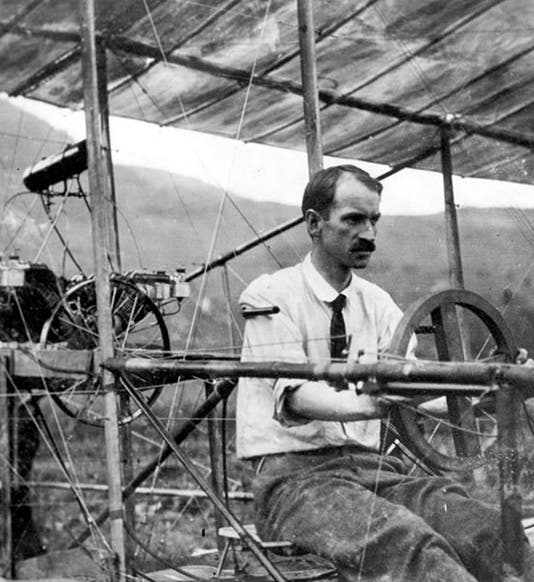
Glenn Curtiss at the controls of June Bug, which he designed and built, 1908 (wright-brothers.org)
Glenn Hammond Curtiss, an American engine-maker, aviator, and motorcyclist, died July 23, 1930, at the age of 52. He had been born on May 21, 1878, in Hammondsport, New York. Curtiss was mechanically minded as a boy, and while the Wright Brothers were taking wing at Kitty Hawk in 1903, Curtiss was busy building and selling bicycles and motorcycles, and racing the latter. He set a world land speed record of 64 mph on a one-cylinder motorcycle in 1993, and in 1907, he built a massive V-8 motorcycle, from which he wrung a top speed of 136 mph, a record that would stand for 23 years. That motorcycle, a most impressive object for 1907, is on display in the Smithsonian Institution (third image).

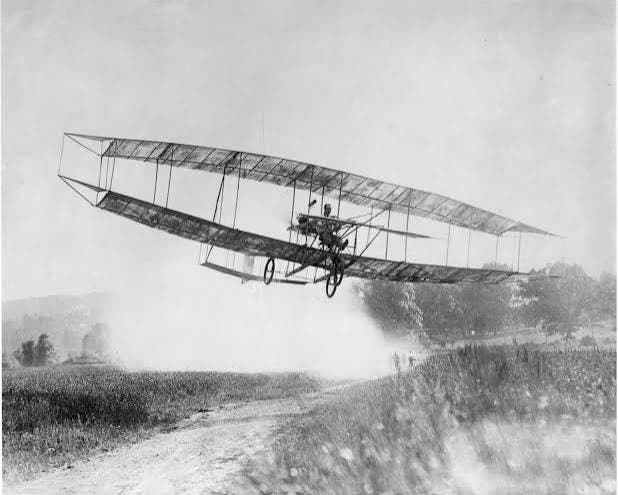
June Bug in the air, designed by Glenn Curtiss, with Curtiss at the controls, July 4, 1908 (the-leader.com)
Curtiss’s forte was building light and powerful engines, and in 1907, he joined the Aerial Experiment Association (AEA), founded by Alexander Graham Bell to build airplanes. Several of his constructions were top performers and won air meets, most significantly in France. All of them had Curtiss engines, but the first aircraft he designed was June Bug, which flew in 1908. Curtiss and the AEA discovered a way to control roll with ailerons, instead of the wing-warping used by the Wrights, and Curtiss refused to pay any licensing fees to the Wrights, who held all the patents on flight control. So the Wright Brothers sued Curtiss, arguing patent infringement. The case dragged on for 8 years, and the Wright Brothers won every court decision. I am not sure, however, that Curtiss ever paid any damages. We have written posts on both Wilbur and Orville Wright.

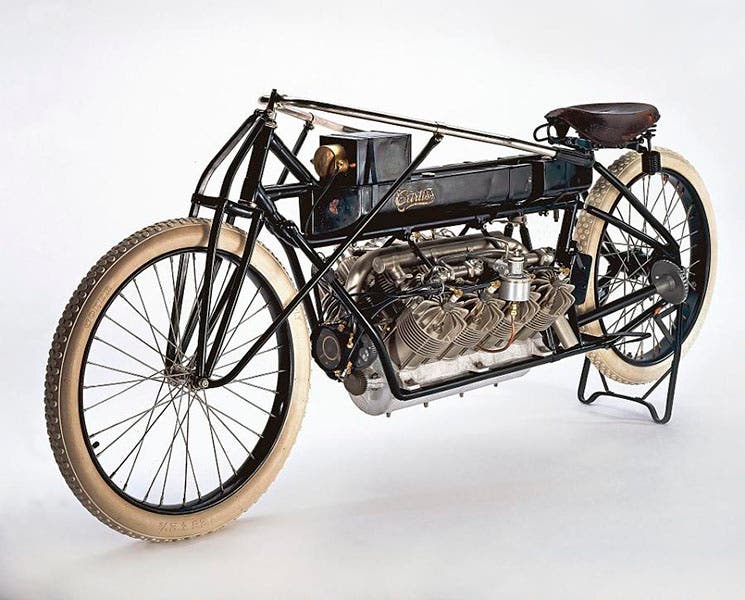
The V-8 motorcycle, built and ridden by Glenn Curtiss, 1907, with which he set a land-speed record of 136 mph, on display at National Air and Space Museum, Smithsonian Institution (airandspace.si.edu)
It was while these court cases played themselves out that Curtiss engineered a deception that has marred his reputation ever since. One way to defeat the Wrights in court was to invalidate the Wright Brothers patent of 1906, by showing they did not in fact invent powered human flight. Samuel P. Langley, the third Secretary of the Smithsonian, had built several aeroplanes around 1903, including Aerodrome A, which never got off the ground. Charles Walcott, the fourth Secretary of the Smithsonian and an ardent defender of Langley, asked Curtiss if he could get Aerodrome A to fly. Without telling anyone what he was doing, Curtiss made dozens of modifications to the original aircraft, and in 1914, he managed to get it off the ground for a few seconds. Walcott immediately proclaimed Langley to be the inventor of powered flight and hauled Aerodrome A off to the Museum. Before he gave it back, Curtiss restored the airplane to its original condition, so no one could see what he had done. It was of course in Curtiss’s interest to have Langley proclaimed the father of flight, because it would invalidate the Wrights’ patent claims and end the lawsuits. But the way he cheated when conducting his tests has always been hard to defend, even for ardent Curtiss supporters.

Working replica of the June Bug, original built in 1908, Glenn H. Curtiss Museum, Hammondsport, New York (Wikimedia commons)
Curtiss's company continued to develop new kinds of aircraft, especially amphibious models, including the Flying Boat, which the US navy bought in numbers (fifth image). Curtiss was still going strong in 1930, when he was suddenly struck down by an attack of appendicitis, which was often fatal in the years before penicillin, and was in this case.

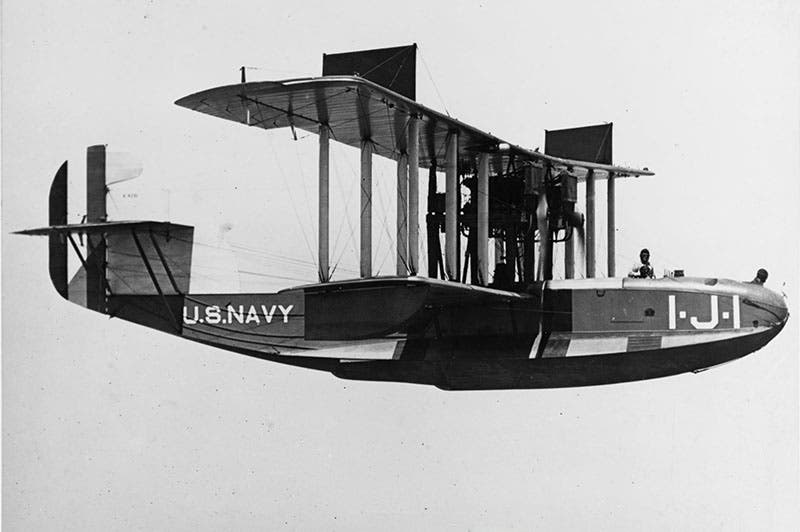
The Curtiss Flying Boat Model F, adopted by the U.S. Navy, photograph, ca 1917 (usni.org)
There are lots of Curtiss items in the National Air and Space Museum in Washington, and he even has his own museum, The Glenn H. Curtiss Museum, in Hammondsport. I was in the Finger Lakes Region of New York just last year, where I saw the Corning Museum, but I did not know about the Curtiss Museum, or else I would have gone there to check it out. Our fourth image shows a replica of June Bug on display at the Museum.


Outside of the Glenn H. Curtiss Museum, Hammondsport, New York (tripadvisor.com)
William B. Ashworth, Jr., Consultant for the History of Science, Linda Hall Library and Associate Professor emeritus, Department of History, University of Missouri-Kansas City. Comments or corrections are welcome; please direct to ashworthw@umkc.edu.