Scientist of the Day - Warren Weaver

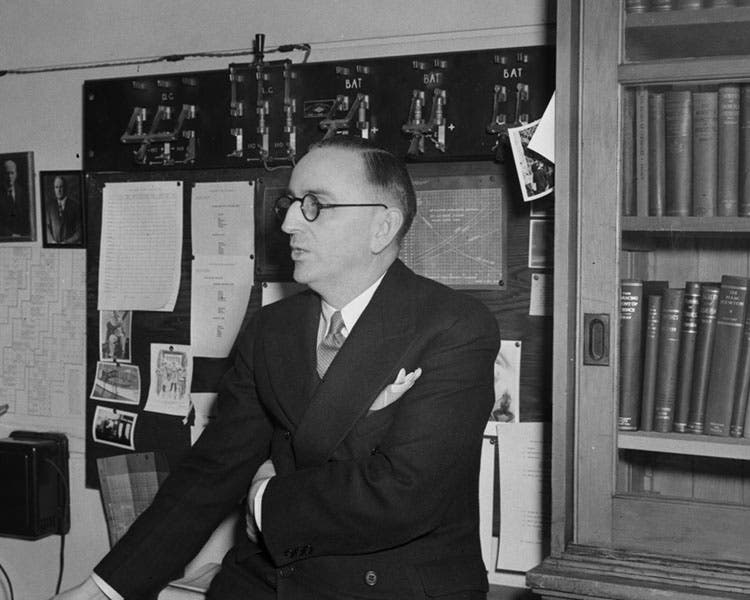
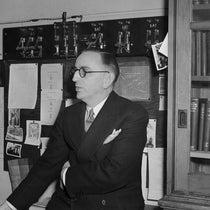
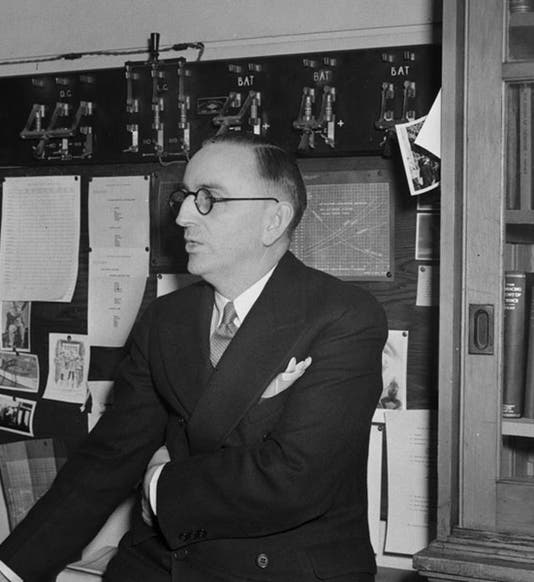
Portrait of Warren Weaver, photograph, 1940, NARA Archives (nara.getarchive.net)
Warren Weaver, an American mathematician and science administrator, was born in Reedsburg, Wisconsin, on July 17, 1894. He studied at the University of Wisconsin in Madison and received his PhD in mathematics there in 1921. He was immediately hired by soon-to-be Nobelist Robert Millikan to teach at Throop College in Pasadena, which Millikan was in the process of revamping into the California Institute of Technology (Caltech). Weaver is often described as a second-rate scientist, even by himself, but Millikan, surely a first-rate talent, was very pleased with Weaver’s work at Caltech, and saddened when Weaver left Caltech to return to UW-Madison. He even offered Weaver a lifetime pass to return to Caltech any time he wanted.

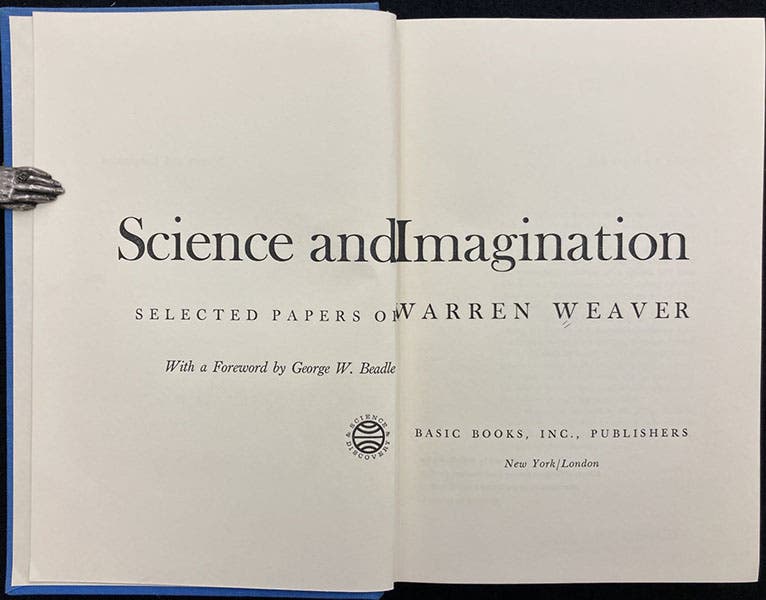
Title page, Science and Imagination: Selected Papers of Warren Weaver, 1967 (Linda Hall Library)
What Weaver was exceptionally good at was judging talent and research proposals, although he didn't know that until a fellow professor left UW-Madison to head up the Rockefeller Foundation and, in 1932, invited Weaver to take charge of the Natural Sciences Division. In essence, from 1921 to 1955, Weaver decided what projects would receive the millions of dollars that the Foundation had to dispense each year.
Weaver decided early on that the science most in need of support, and with the greatest potential and most exciting frontier, was biology – not the old biology that dealt with whole organisms, but the new biology that studied genes and proteins, the molecules of life. Weaver in 1936 even coined a name for this new branch of the life sciences: molecular biology. Weaver had an uncanny ability to assess proposals and project directors. The period from 1936 to 1968 was the golden age of molecular biology, when Oswald Avery discovered that DNA is the stuff of the gene (1944), James Watson and Francis Crick discovered the double helix (1953), and Max Perutz and John Kendrew worked out the structure of myoglobin and hemoglobin (1959-1968), and of the 18 Nobel-prize winners that emerged from this generation of molecular biologists, all but one were supported by Rockefeller Foundation money, all of it distributed by Weaver. In many ways, he was the orchestra leader of the entire revolution, and his baton arranged all the scenarios.

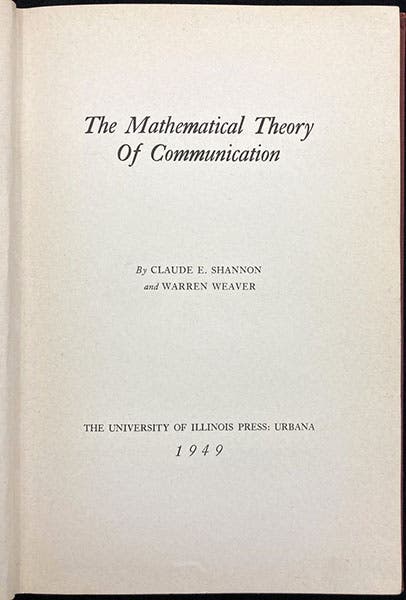
Title page, The Mathematical Theory of Communication, by Claude E. Shannon and Warren Weaver, 1949 (Linda Hall Library)
Weaver is also remembered for a memo he wrote in 1949 and circulated in mimeograph form. He had been impressed with the development of computer technology after the War, with ENIAC in 1946 and Project Whirlwind at MIT, and he wondered if computers might be useful at solving one of the principal problems faced by scientists everywhere: access to work published in languages foreign to them. Would it be possible, Weaver wondered in his memo, for computers to become translators? Did an era of machine translation lie ahead? Weaver was greatly surprised at the feedback he received, which was almost universally negative, even from people like Norbert Wiener, the founder of cybernetics. Everyone thought human languages were too nuanced, with convoluted syntax and vocabularies layered with multiple meanings, so much so that the idea of mechanical translation seemed absurd. When Weaver printed his memo as a book chapter 6 years later, reaction was more sympathetic, and of course machine translation has now been a welcome reality for decades. Weaver’s mimeo of 1949 would be exhibit item 1 in any exhibition on the prehistory of Google Translate. I wonder how many copies survive? We do not have one, nor have I ever seen a copy.

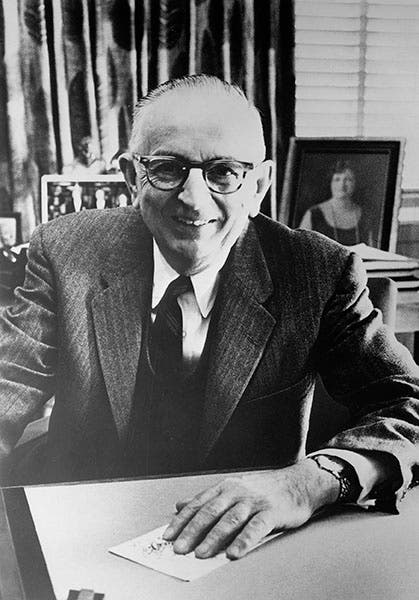
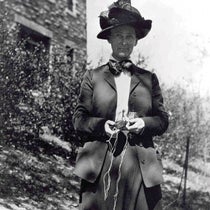
Portrait of Warren Weaver, photograph, 1961, Rockefeller Foundation (resource.rockarch.org)
Weaver was very good at explaining science to laypeople, and several of his books are collections of essays in that vein. We have several such Weaver books in our Library, including Science and Imagination (1967; second image). Weaver thought that all scientists have a responsibility to communicate their work to the public in non-technical language, and he was quite adept at it himself. When Claude Shannon published his ground-breaking “Mathematical Theory of Communication,” in a Bell System journal in 1948, the University of Illinois wanted to publish a version in book form. But Shannon's equation-laced text was utterly opaque to ordinary readers. So Weaver was asked to write a shorter version for laypeople. Both versions, Shannon's and Weaver’s, were published together in 1949 (third image). By providing such a welcome service, Weaver got equal billing on the title page of one of the milestone books of the 20th century.

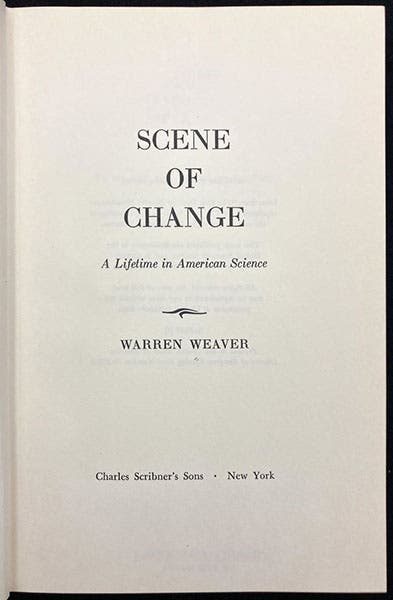
Title page, Scene of Change: A Lifetime in American Science, by Warren Weaver, 1970 (Linda Hall Library)
Weaver wrote an autobiography of sorts, Scene of Change: A Lifetime in American Science (1970; fifth image), which we have in our collections. Weaver retired to his home in New Milford, Conn., and died there on Nov. 24, 1978. I have been unable to discover the location of a burial plot or a memorial stone.
William B. Ashworth, Jr., Consultant for the History of Science, Linda Hall Library and Associate Professor emeritus, Department of History, University of Missouri-Kansas City. Comments or corrections are welcome; please direct to ashworthw@umkc.edu.