Scientist of the Day - Iwahashi Zenbei

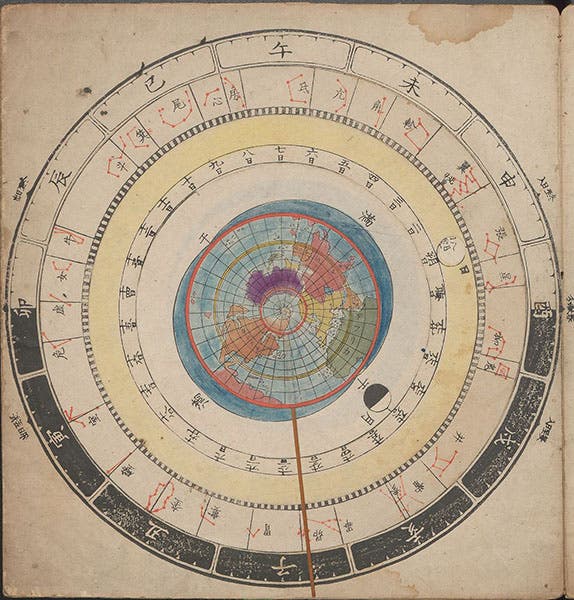
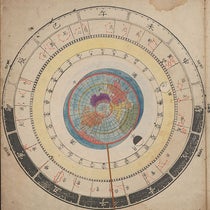
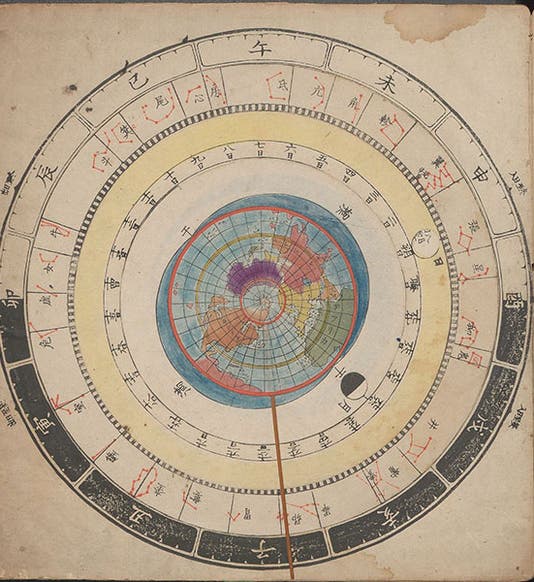
Earth-centered volvelle, hand-colored woodcut, Heitengi, by Iwahashi Yoshitaka, p. 2, 1801 (Linda Hall Library)
Iwashashi Zenbei, sometimes known as Iwahashi Yoshitaka, a Japanese astronomer, died July 15, 1811 (Iwahashi is the surname). He was born in Kaizuka, Osaka, in 1756. Iwashashi trained first as an optician, made his first telescope in 1793, and soon moved into astronomy. Eighteen of his telescopes survive in Japan.

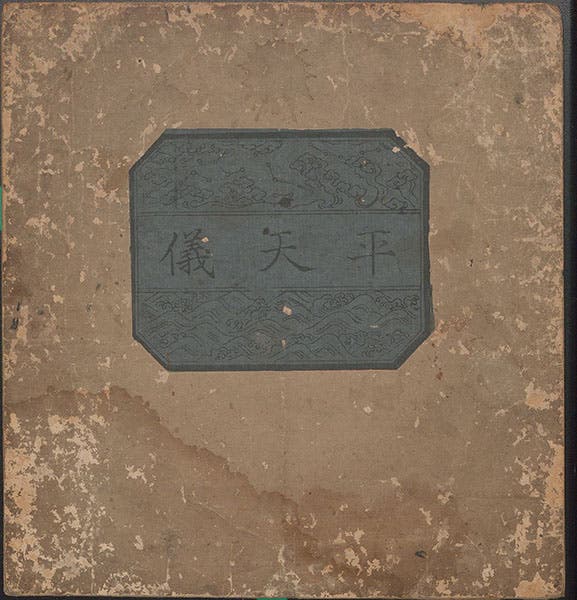
Front cover with paper title slip, Heitengi, by Iwahashi Yoshitaka, p. 1, 1801 (Linda Hall Library)
In 1801, Iwahashi published a short (but not little) four-page leaflet with a paper instrument of his own devising. It is titled Heitengi, which means, in this context, Planisphere. The instrument is what in the West would be called a volvelle, since the colored map of the Earth is connected to the paper below by only a central knotted string, so it may be rotated. It is mounted in a red bamboo ring which can be rotated via an attached bamboo stick-handle. There are three other paper discs mounted on the same string, all of which can be turned, but without a convenient bamboo handle. We show a detail of the hand-colored Earth in our third image.

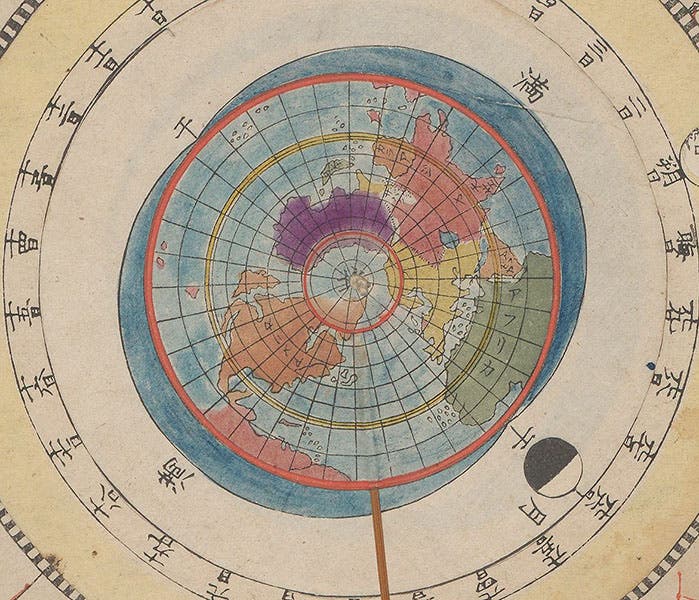
Detail of northern hemisphere of Earth-centered volvelle, hand-colored woodcut, Heitengi, by Iwahashi Yoshitaka, p. 2, 1801 (Linda Hall Library)
The second diagram (fourth image), also with a rotating Earth, is cosmological, showing a Tychonic world system, with Mercury and Venus orbiting the Sun at top, and Mars, Jupiter, and Saturn orbiting the Earth, along with the Moon (see this post on Tycho Brahe for more about the Tychonic system, which was introduced to China and Japan by Jesuit missionaries in the 17th century).

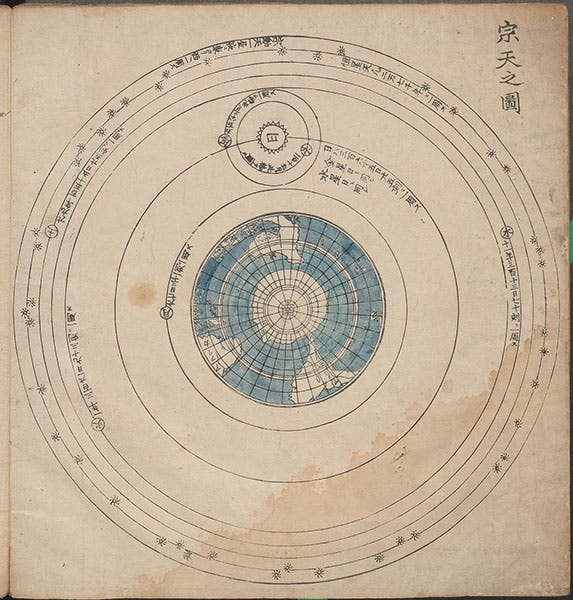
Tychonic cosmological system, woodcut, Heitengi, by Iwahashi Yoshitaka, p. 3, 1801 (Linda Hall Library)
In 1802, Iwahashi published a longer general treatise on astronomy, called Heitengi zukai (A guide to the heavens). It is said to contain directions for using his instrument of 1801, but since I do not read Japanese, I cannot confirm that. I can attest that it contains numerous attractive woodcuts that show one of Iwahashi’s telescopes (fifth image); craters on the moon (sixth image), the planets Saturn and Jupiter, the latter with 4 moons (seventh image), and a delightful round-earth volvelle with stick-figure humans standing all around (eighth image), which do not fall off when you rotate the volvelle. Other woodcuts show a Tychonic cosmological system, sunspots, and maps of the constellations.

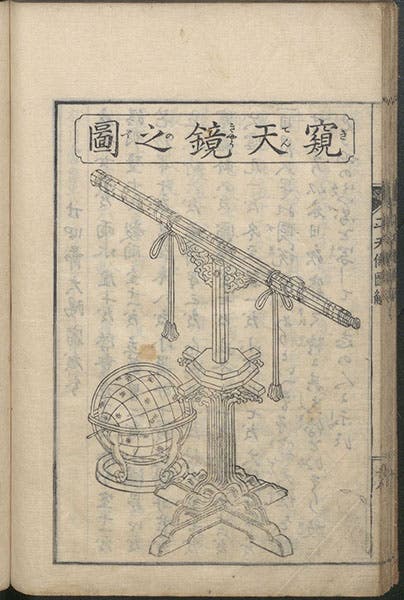
Telescope built by Iwahashi, woodcut, Heitengi zukai, by Iwahashi Yoshitaka, pdf p. 68, 1802 (Linda Hall Library)

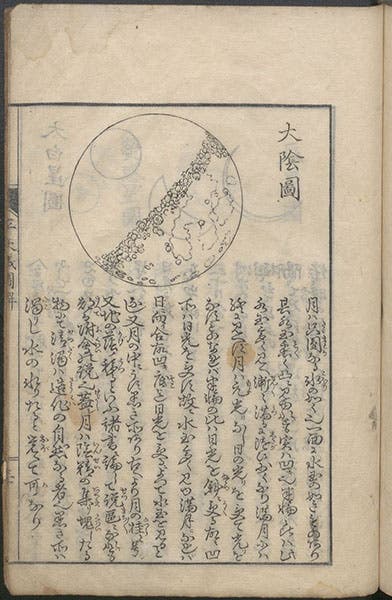
Moon with craters, woodcut, Heitengi zukai, by Iwahashi Yoshitaka, pdf p. 71, 1802 (Linda Hall Library)
Since not much is known in the West about Iwahashi, the main purpose of this post is to indicate that we recently (2025) acquired both books, and to invite scholars of Japanese astronomy to investigate further. Both books have been scanned and are available online; clicking on any of the images will take you to the scanned books. To appreciate the volvelles, you will have to visit us in person.

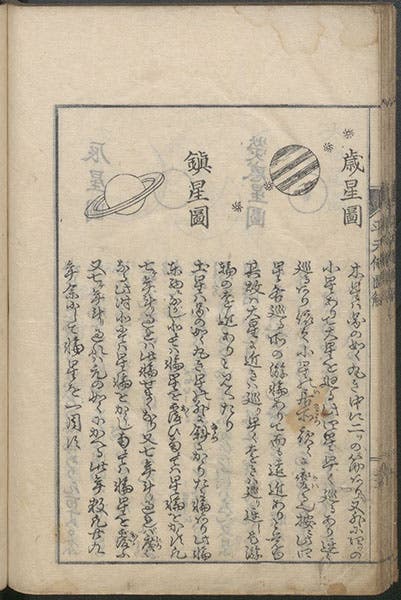
Faces of Saturn and Jupiter, the latter with 4 moons, woodcut, Heitengi zukai, by Iwahashi Yoshitaka, pdf p. 74, 1802 (Linda Hall Library)
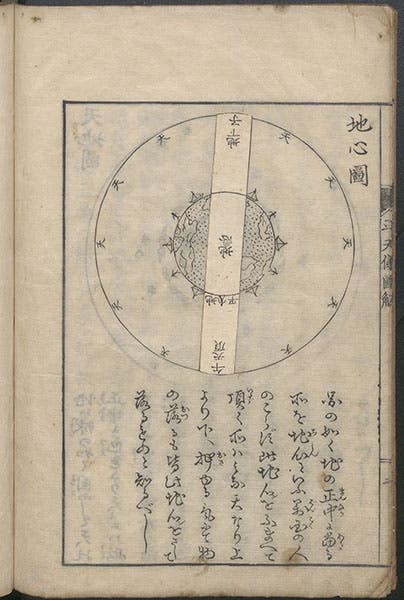
Earth volvelle, stick-figure humans and ships that do not fall off, woodcut, Heitengi zukai, by Iwahashi Yoshitaka, pdf p. 16, 1802 (Linda Hall Library)
To learn more about the many roles of volvelles in western astronomy, see our posts on Gemma Frisius and Erasmus Reinhold.
William B. Ashworth, Jr., Consultant for the History of Science, Linda Hall Library and Associate Professor emeritus, Department of History, University of Missouri-Kansas City. Comments or corrections are welcome; please direct to ashworthw@umkc.edu.