Scientist of the Day - James Lind

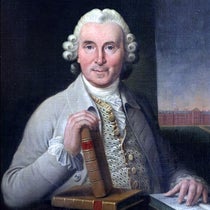
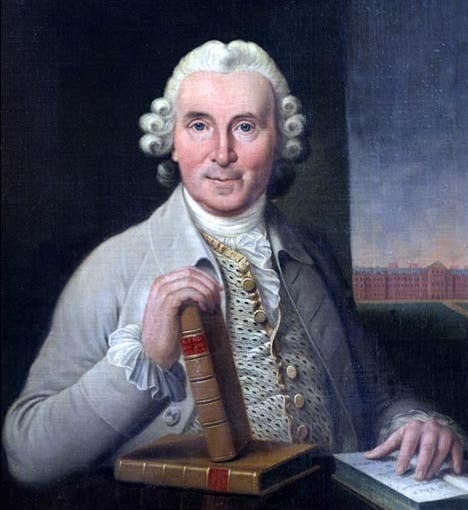
Portrait of James Lind, unknown artist, private collection, England (Wikimedia commons)
James Lind, a Scottish physician, died July 13, 1794, at the age of 77. Born into a well-to-do merchant family, he apprenticed to an Edinburgh surgeon for 8 years before joining the British Royal Navy, where he served as a ship's surgeon from 1739 to 1748. It was right in the middle of his tour of duty that George Anson returned from a four-year circumnavigation of the world, having lost some 1650 of his crew of 1850, mostly to scurvy.
Scurvy was the scourge of navies everywhere. It killed more seamen than all the battles in which they engaged in those war-torn times. Lind certainly took notice, for in 1747, right before he left the Royal Navy, he conducted a small experiment on board HMS Salisbury, in which he divided 12 patients with scurvy into 6 groups, and then treated them with different remedies - cider, vinegar in water, dilute sulfuric acid, sea water, barley water, and orange and lemon juice. Those dosed with citric fruit recovered in a matter of days.

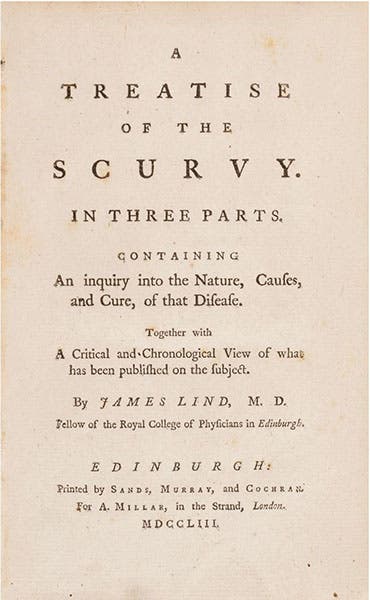
Title page, A Treatise of the Scurvy, by James Lind, 1753, copy at auction at Bonham’s, 2025 (bonhams.com)
Lind's experiment of 1747 is famous in medical lore because it seems like a modem clinical trial. It used controls, and it was blind, and neither of those features was common at the time. The claim that lime and lemon juice could cure scurvy was not new – that discovery had been made many times before, which was why Lind tried it in the first place. But no one before Lind had ever attempted to collect evidence that of all the anti-scorbutic (anti-scurvy) remedies recommended, citric juice worked best.

Plaque honoring James Lind at the Edinburgh Medical School, calling Lind the “Hippocrates of Naval Medicine” (Wikimedia commons)
After Lind left the Navy, he returned to Edinburgh to get his medical degree, and once he had returned to private practice, he published a book, A Treatise of the Scurvy (1753), in which he described his experience (and experiments) treating scurvy, and recommended supplementing sailor's diets with citrus fruit. He did not of course know about vitamin C, and he was far from advocating lime or lemon juice alone as a cure-all. Many factors were involved, he thought, including hygiene. His book went through several editions, so it must have been bought and read, but it had no effect on Royal Navy policy. It took another 50 years before lemons and limes were included in a seaman's fare, and 150 years before anyone understood the role of vitamins in the human diet. We are not a medical library, and we do not own Lind’s book. We show the title page from a copy sold at auction by Bonham’s in 2025 (second image).

The former Royal Naval Hospital Haslar, Gosport, modern photograph; the original building over which James Lind presided, 1758-1783, is the large U-shaped structure at center right (Wikimedia commons)
In 1758, Lind was appointed as chief physician to the recently built Royal Naval Hospital Haslar, at Gosport, near Portsmouth. This was a civilian position, offered to Lind via the recommendation of Anson, who was now First Lord of the Admiralty. Lind kept this position until he retired. His chief contribution to naval medicine was to insist that incoming patients be bathed and shaved and their clothing removed and boiled. Probably because of this, typhus, another scourge of the Navy, all but disappeared from the hospital. Had he required such sanitation measures from the staff, typhus might have disappeared entirely.

Churchyard of St. Mary’s Parish, Portchester, Hampshire, where James Lind is buried. A small memorial plaque is inside the church (Wikimedia commons)
Lind died in 1783 and was awarded a huge pension, for reasons no one knows – certainly not for finding the cure for scurvy. He died on his day in 1794 and was buried in St. Mary's Parish Churchyard, Portchester.
William B. Ashworth, Jr., Consultant for the History of Science, Linda Hall Library and Associate Professor emeritus, Department of History, University of Missouri-Kansas City. Comments or corrections are welcome; please direct to ashworthw@umkc.edu.