Scientist of the Day - Timothy Hackworth

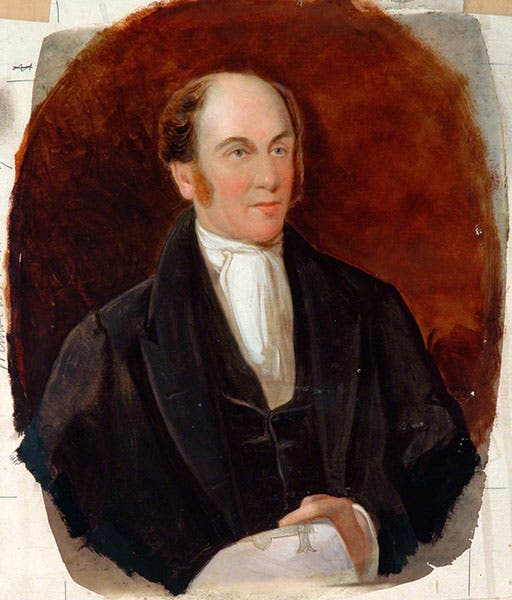
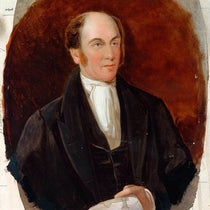
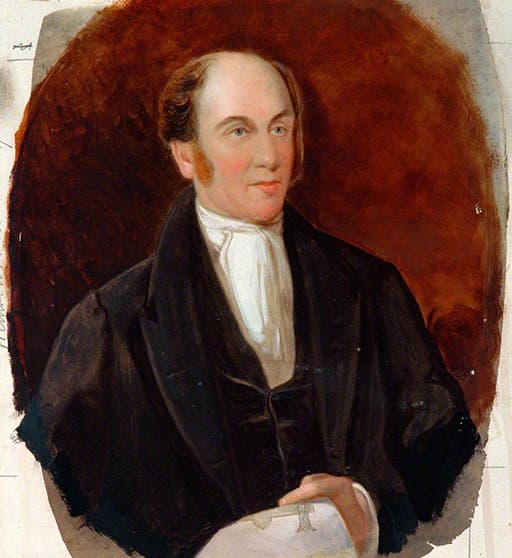
Portrait of Timothy Hackworth, oil on cardboard, unknown artist and date, National Railway Museum (artuk.org)
Timothy Hackworth, an English steam locomotive pioneer, died July 7, 1850, at the age of 63. He had been born on Dec. 22, 1786, in Wylam, Northumberland, just west of Newcastle upon Tyne, where George Stephenson, another early locomotive designer, had been born in 1781. Wylam was home to a colliery, or coal mine, and Timothy's father was head blacksmith for the mine. Timothy apprenticed as a blacksmith and succeeded to his father’s position in 1808.

Wylam Dilly, built by Timothy Hackworth and William Hedley, 1815, National Museum of Scotland (Wikimedia commons)
The owner of the Wylam Colliery was keen to mechanize the short railway used to carry coal from mine to river port, and he tasked William Hedley, his engineer/manager, and ironmaster Hackworth with the job of designing and building a locomotive that could economically pull ore cars down a five-mile track. The only precedents – two of them – had been built by Richard Trevithick before 1804, and one, the Pen-y-darren, had hauled a load of cars down a 10-mile track, but the engines were very slow and were never put to commercial use.

Replica of Locomotion no. 1 at Hopewell Darlington Railway Centre, built by Robert and George Stephenson in 1824-25, probably with input from Timothy Hackworth (Wikimedia commons)
Hedley and Hackworth produced two locomotives for the Wylam Colliery. The more famous one was called Puffing Billy, built in 1814, famous because it was the first, and it survives and is on display in the Science Museum London. You can see several photos in our post on Hedley. The second, built in 1815, was called Wylam Dilly, and is on display in the National Museums of Scotland (second image). Both locomotives were in service from 1830 to 1860, but until 1830, they were of little practical use, since the track in place was too flimsy to bear their 4-ton weight.

Royal George locomotive, used on the Stockton and Darlington Railway, drawing from The Engineer, Oct. 10, 1879 (Wikimedia commons)
Hackworth left Wylam eventually and went to another colliery, and then, in 1824, he went to work for George Stephenson in Newcastle, where it is believed he helped design the first locomotive, Locomotion no. 1, for the Stockton and Darlington Railway (S&DR) in County Durham, which carried coal from collieries in Shildon and was also the first locomotive to pull a passenger car. In 1825, Hackworth was appointed superintendent of locomotives for the S&DR, a position he would hold for the next 15 years, living and working in Shildon. The original Locomotion no 1 is at Locomotion, a railway museum in Shildon. A working replica is at Hopewell Darlington (third image). In September 2025, the replica re-enacted its first passenger trip on the S&DR in 1825.

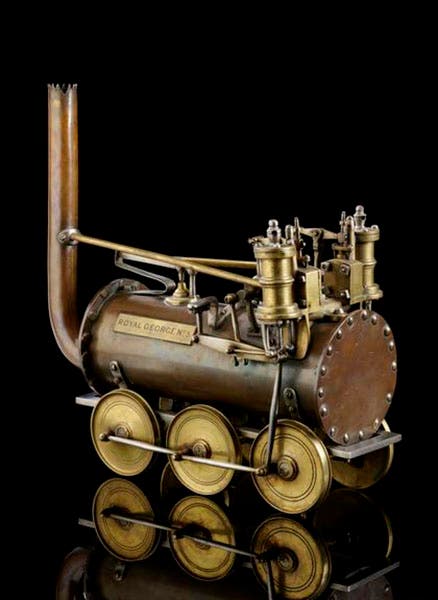
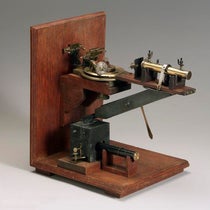
Model of Royal George, built by Timothy Hackworth in 1827, who also built the full-size locomotive for the Stockton and Darlington Railway, Science Museum, London (collection.sciencemuseumgroup.org.uk)
In 1827, Hackworth designed and built a locomotive called Royal George for the S&DR (fourth and fifth images). It is considered to be the first locomotive with a blastpipe, and Hackworth is deemed to be the inventor of the device. The blastpipe is a clever idea, sending the steam expelled from the cylinders through the chimney of the boiler, increasing the draft through the flue. Apparently a blastpipe needs to be “tuned” to work right, and it seems Hackworth figured out how to do this. All later locomotives had a blastpipe, thanks to Hackworth.

The original Sans Pareil locomotive, built by Timothy Hackworth for the Rainhill Trials, 1829, now in Locomotion, the railway museum in Shildon, County Durham (Wikimedia commons)
Hackworth's next famous steam engine was the Sans Pareil, which he built with Hedley and entered in the Rainhill Trials of 1829. This was the contest sponsored by the Liverpool and Manchester Railway to identify the best locomotive for their new line, and which was won by George and Robert Stephenson’s Rocket (see our post on the Rainhill Trials). The Sans Pareil ("without equal" in French) was over the weight limit, so it couldn’t win, and anyway, it cracked one of its cylinders during the proceedings and was put out of action. But it was later repaired and returned to service. It had twin vertical cylinders that drove one pair of wheels, the other pair being driven by connecting rods. It had a return-flue boiler, not as efficient as the multi-tube boiler of the Rocket, which probably gave the Rocket its winning advantage. Both had blastpipes, invented by Hackworth and Hedley. There are two contemporary drawings of the Sans Pareil, a woodcut and a lithograph, at our post on the Rainhill Trials. The original Sans Pareil (sixth image) is on display at Locomotion, the transportation museum at Shildon, which used to be called the Timothy Hackworth Museum. There is a statue of Hackworth on the grounds (last image).

Statue of Timothy Hackworth, Shildon, County Durham, England (shildon.gov.uk)
I am guessing there will be a lot of railway replica activity in the next few years, as the events of 1827-1830 are replayed for the public. A re-enactment of the Rainhill Trials in October of 2029 would be spectacular. Perhaps Hackworth will become better known, although he will probably always be in the shadow of the Stephensons.
William B. Ashworth, Jr., Consultant for the History of Science, Linda Hall Library and Associate Professor emeritus, Department of History, University of Missouri-Kansas City. Comments or corrections are welcome; please direct to ashworthw@umkc.edu.