Scientist of the Day - Aristarchus of Samos

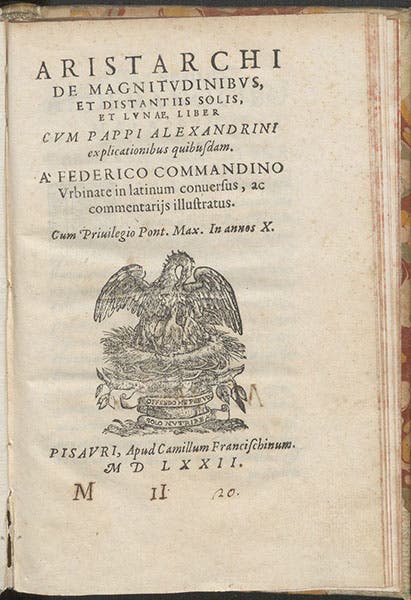
Title page, Aristarchi De magnitvdinibvs et distantiis solis et lvnae liber, ed. by Federico Commandino, 1572 (Linda Hall Library)
Aristarchus, a Greek mathematician and astronomer, was born around 310 BCE on Samos, the same Aegean island that had given us Pythagoras two centuries earlier. Both men left, never to return, as far as we know.
Aristarchus went to Alexandria, where the Library and Museum had been founded by the first Ptolemys. Aristarchus was a pupil of Strato of Lampsacus, and since Strato lived in both Alexandria, where he served Ptolemy II, and Athens, where he took over leadership of Aristotle's Lyceum after the death of Theophrastus, perhaps Aristarchus made it to Athens. We don’t know.

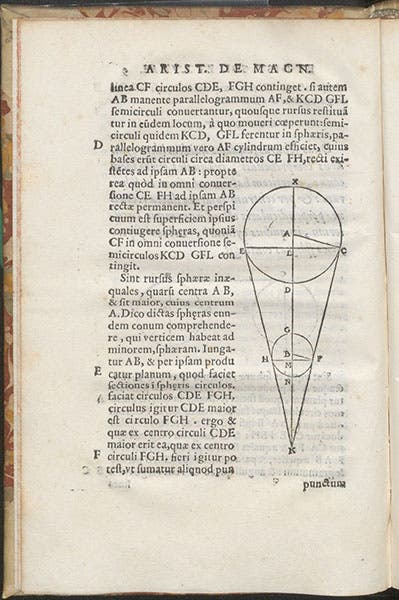
Solar eclipse diagram comparing relative sizes of Sun and Moon, Aristarchi De magnitvdinibvs et distantiis solis et lvnae liber, ed. by Federico Commandino, fol. 3v, 1572 (Linda Hall Library)
Aristarchus is known for his single surviving book, On the Sizes and Distances of the Sun and Moon, and for an idea, passed down to us by Archimedes. First we consider the book, of which we have a single early edition, compiled by the Italian scholar Federico Commandino and printed in 1572. It is the source of our first three images.
In his treatise, Aristarchus attempted to calculate, using geometry and a few observations, the relative diameters of the Sun and Moon. The first observation was that, when the Moon is exactly half-full, the angle between Earth, Moon, and Sun is 87º. A second was that the Sun and Moon have the same apparent diameter, since the Moon exactly covers the Sun during a total solar eclipse (second image). From these and a few other facts and estimates, Aristarchus calculated that the Sun is between 18 and 20 times bigger than the moon, and 18 to 20 times further away. He was off by a factor of about 20 – the Sun is about 400 times larger than the Moon, and 400 times further away. The error was the result of trying to measure the angle between Sun and Moon at half-moon, which is more like 89º 50’, about 18 times closer to a right angle than Aristarchus thought. In his defense, that is an impossible measurement to make back then, or even today. So we excuse him – he was, after all, the first to apply geometry to the problem.

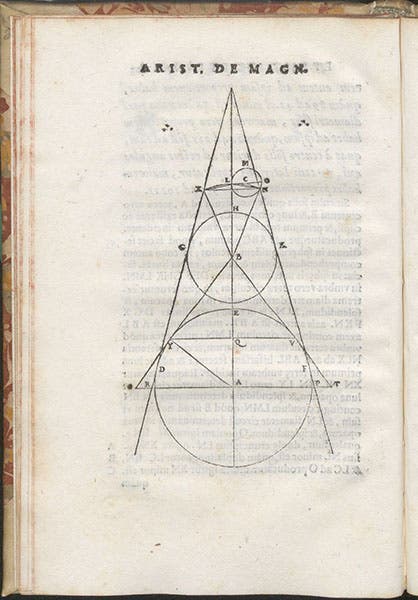
Lunar eclipse diagram, with Sun at boom, Earth at center, and Moon at top, just half the size of the Earth’s shadow, Aristarchi De magnitvdinibvs et distantiis solis et lvnae liber, ed. by Federico Commandino, fol. 23v, 1572 (Linda Hall Library)
Aristarchus is better known for a cosmological surmise, which is related by Archimedes in his Sand Reckoner (and later by Plutarch). Archimedes was trying to calculate the number of grains of sand it would take to fill the universe, and to make the problem as difficult as possible (and thus its solution more impressive), he says he chose the cosmos of Aristarchus, in which the Sun, and not the Earth, was the center, requiring that the sphere of stars be much further away, since we do not see them shift as the Earth orbits the Sun. Archimedes’ statement is our only historical indication that Aristarchus proposed a heliocentric cosmology, some 1800 years before Copernicus. Aristarchus and Philolaus, an earlier Pythagorean, are the only two ancient Greeks known to have put the Earth in motion, and only Aristarchus had the Sun at the center.
Scholars don't think Copernicus got the idea of a heliocentric astronomy from Aristarchus, but he did mention Aristarchus as a precursor in the manuscript of De revolutionibus, before crossing it out in a final revision before publication. However, the name of Aristarchus often came up in later discussions of Copernicanism, as did that of Philolaus and the Pythagoreans, to show classical precedence for the idea of a moving Earth.

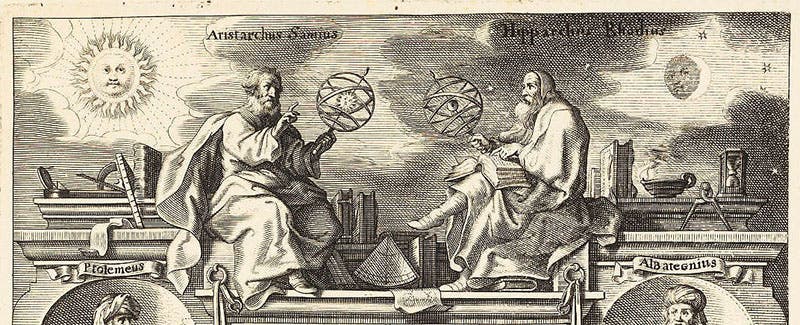
Aristarchus with sun-centered armillary sphere, admonishing the geocenic astronomer Hipparchus, detail of engraved title page, Tabulae motuum coelestium, by Philippe van Lansbege, 1632 (Linda Hall Library)
I know of only one early modern depiction of Aristarchus the man. It appears at the top of the engraved title page of Philippe van Lansberge's Tabulae motuum coelesti (1632), where Aristarchus, at the left, holding a sun-centered armillary sphere, admonishes a startled Hipparchus, for defending a geocentric cosmos (fourth image). You can see the entire title page at our post on Lansberge.
William B. Ashworth, Jr., Consultant for the History of Science, Linda Hall Library and Associate Professor emeritus, Department of History, University of Missouri-Kansas City. Comments or corrections are welcome; please direct to ashworthw@umkc.edu.