Scientist of the Day - George George

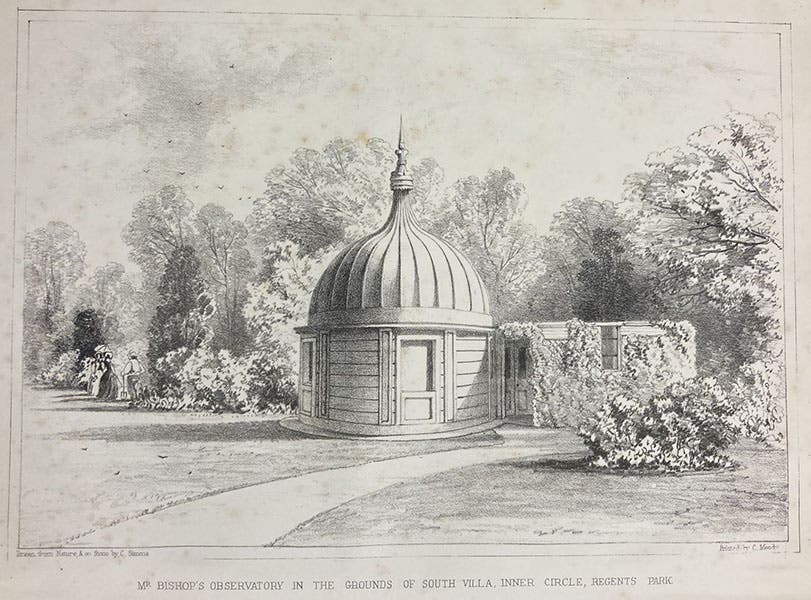
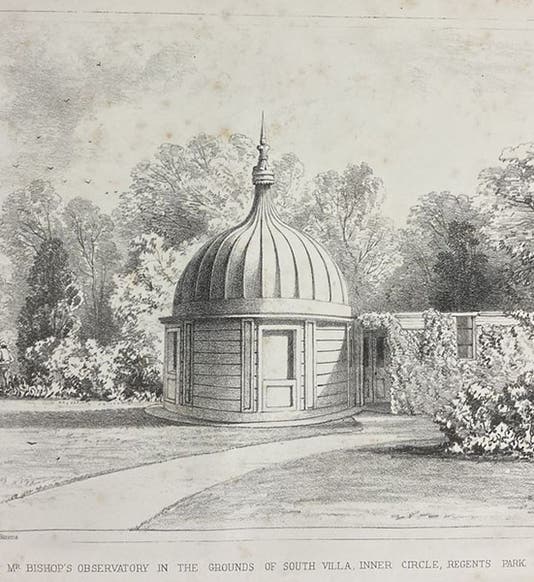
View of George Bishop’s Observatory, South Villa, Inner Circle, Regent's Park, London, frontispiece to Astronomical Observations … During the Years 1839-51, by George Bishop, 1852 (The Linda Hall)
George Bishop, an English astronomer, was born in Leicester on Aug. 21, 1785. Bishop made a lot of money selling wine, and in a mid-life change of career, he decided he wanted to be an astronomer. He was elected to the newly renamed Royal Astronomical Society in 1830, and since he had not yet done anything of note in the field, his election must have been the result of some kind of financial gift or promise. He was elected Secretary of the RAS in 1833, a further sign that something was going on in the back rooms.

Portrait bust of George Bishop, Royal Astronomical Society, Burlington House, London (Wikimedia commons)
This seemingly premature recognition must have been related to the fact that, in 1836, Bishop constructed a small private observatory near his home in South Villa, Regent's Park, London. Lots of wealthy men built private observatories in Victorian England, but most were competent astronomers – except for Bishop. He seems to have built an observatory because he wanted to contribute something to his new profession, and endowing an observatory for others to use was the only thing he could do, and do well. He must have had good advisors, for he equipped his small observatory (which was always called “Mr. Bishop's Observatory"), with a 7-inch Dolland achromatic refractor mounted in a 10-foot tube. And then he opened the doors and invited others to come sit in the observing chair. It was rather like carving a ballpark out of an Iowa cornfield, with the thought: "Build it, and they will come." And come they did.

The 7-inch Dolland refractor, George Bishop’s Observatory, Regent’s Park, London, contemporary engraving (Wikimedia commons)
Bishop’s first "astronomer in residence" was William Rutter Dawes, who started in Bishop’s employ in 1839. Dawes was at that time primarily interested in double stars, and Bishop’s achromat was perfect for measuring their separation. Dawes moved on and built his own observatory, and was replaced by John Russell Hind, who was only 22 when he started working for Bishop in 1844. Presumably he was hired to continue the double-star research, but no sooner had he begun his career than a German astronomer discovered a fifth minor planet (asteroid, if you prefer) in orbit between Mars and Jupiter. The first four had been found in quick succession at the beginning of the century, beginning with Ceres in 1801, but after 1807, no more were sighted, despite an intensive search. Then, in 1845, the floodgates reopened, and Hind was right there to take advantage. Hind discovered ten asteroids, an extraordinary number, all of them between 1847 and 1854, and all at George Bishop's observatory in Regent's Park.

![Circular announcing the discovery of a new planet [18 Melpomene] by John Russell Hind, “at Mr. Bishop’s Observatory,” on June 24, 1852 (The Linda Hall)](https://preview-assets-us-01.kc-usercontent.com:443/9dd25524-761a-000d-d79f-86a5086d4774/1f38e3bc-6d41-42f0-ba7c-a82d4e84d1c2/bishop4.jpg?w=773&h=600&auto=format&q=75&fit=crop)
Circular announcing the discovery of a new planet [18 Melpomene] by John Russell Hind, “at Mr. Bishop’s Observatory,” on June 24, 1852 (The Linda Hall)
In the United States, an American astronomer named Benjamin Gould invented a new way to announce the discovery of a new planet, called the astronomical circular, a one-page announcement that was mailed out to subscribers to the Astronomical Journal immediately after a new planet was discovered and confirmed. I show you what I think was the first such Circular (fourth image), announcing Hind's discovery of the 18th minor planet, Melpomene, in 1852. In our library, these circulars are simply bound into our volumes of the Astronomical Journal. Note that the Circular for 18 Melpomene mentions "Mr. Bishop's Observatory."

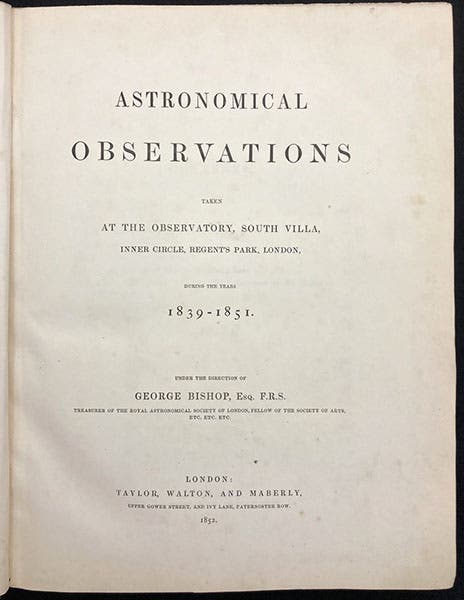
Title page, Astronomical Observations … During the Years 1839-51, by George Bishop, 1852 (The Linda Hall)
In 1852, Bishop published the result of 13 years of double-star measurement, as Astronomical Observations Taken at the Observatory, South Villa, Inner Circle, Regent's Park, London, During the Years 1839-1851. We have this quarto volume in our collections. The frontispiece (first image) is a drawing of the exterior of Bishop’s Regent’s Park observatory. There are no illustrations of the Dolland telescope in Bishop’s book, so we use an engraving that is in internet circulation (third image). I do not know where it first appeared, perhaps in the Illustrated London News. If anyone knows the original source, please let me know.

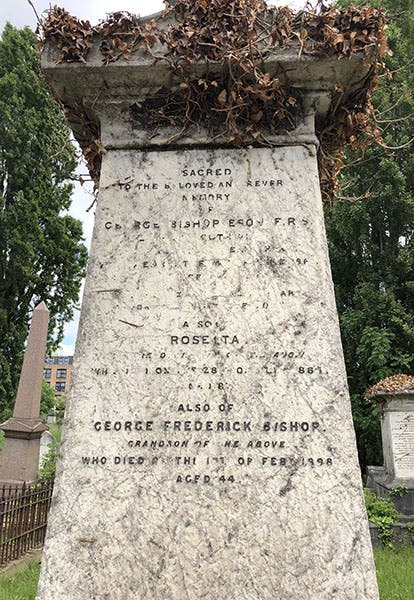
Tombstone of George Bishop, Kensal Green Cemetery, London (findagrave.com)
Bishop was in poor health the last few years of his life, and he died on June 14, 1861, at the age of 76, and was buried in Kensal Green Cemetery in London (last image).
William B. Ashworth, Jr., Consultant for the History of Science, Linda Hall Library and Associate Professor emeritus, Department of History, University of Missouri-Kansas City. Comments or corrections are welcome; please direct to ashworthw@umkc.edu.