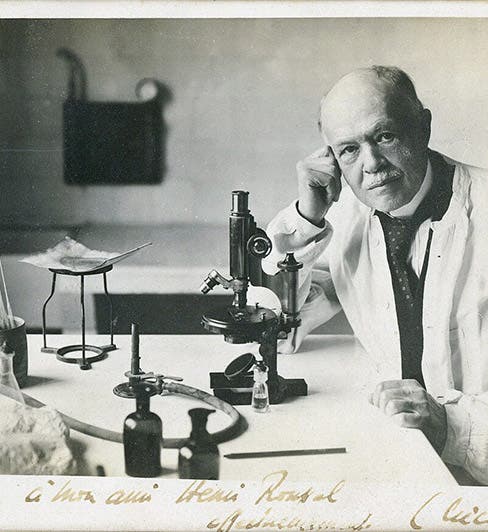
Scientist of the Day - Charles Nicolle

Charles Nicolle in his lab, Pasteur Institute of Tunis, photograph, undated (Wikimedia commons)
Charles Nicolle, a French physician and bacteriologist, was born September 21, 1866, in Rouen. He received his medical degree from the Pasteur Institute in Paris, taught medicine and bacteriology back in Rouen, and then, in 1903, Nicolle was appointed Director of the Pasteur Institute of Tunis, French Tunisia, a satellite lab that had been established about 10 years earlier. Nicolle would direct the Tunis Institute until his death in 1936.
One of the most insidious diseases threatening large urban populations in those days was epidemic typhus. No one knew the cause, but typhus was well known to be highly infectious in crowded and unclean conditions, especially in wartime, and lethal to large numbers of people, with a mortality rate, if untreated, of 40%. Nicolle set out to find the cause, and, hopefully, a vaccine.

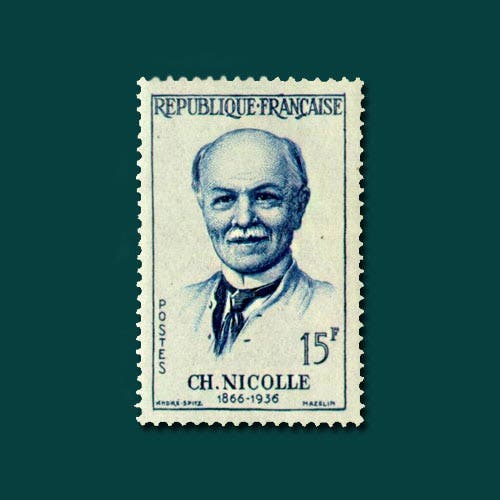
Postage stamp issued in France on the centennial of Nicolle’s birth, 1966 (mintagewold.com)
He and his staff found that typhus victims were infectious to a high degree, but if they were given a hot bath and clean clothes, they were infectious no more. He suspected an insect host; yellow fever and malaria had recently been linked to mosquitoes, and Nicolle suspected that some other insect that infested humans in crowded conditions, such as fleas, ticks, or lice, carried an agent causing typhus. He discovered, in 1909, by animal experimentation that a common body louse, taken from a human with typhus, would infect a chimpanzee, and that a louse from the infected animal could infect another.
Nicolle also discovered that lice do not need to bite a human to infect him or her. Lice leave behind in their excrement thousands of microbes which can linger on the skin and in clothes and easily infect others.

The original buildings of the Pasteur Institute of Tunis, where Nicolle worked, recent photograph (Wikimedia commons)
Nicolle tried to develop a vaccine but was unable to do so. Nor did he identify the microbe responsible, which was not discovered until 1916 and named Rickettsia. But Nicolle managed to rid Tunis of epidemic typhus, and showed other crowded metropolitan areas how to do likewise. Nicolle also succeeded in developing a vaccine for Malta fever, a tick-borne disease, and learned how to control a variety of other epidemic diseases that had previously wreaked havoc in Tunis. And he made the Tunis Institute one of the most important institutions in the world for epidemiology. For discovering that typhus is carried by lice, and for all his other work on infectious epidemics, Nicolle was awarded the Nobel Prize in Physiology/Medicine in 1928. And in 1966, he was awarded his own postage stamp by a grateful France.
William B. Ashworth, Jr., Consultant for the History of Science, Linda Hall Library and Associate Professor emeritus, Department of History, University of Missouri-Kansas City. Comments or corrections are welcome; please direct to ashworthw@umkc.edu.