Scientist of the Day - Agatha Christie

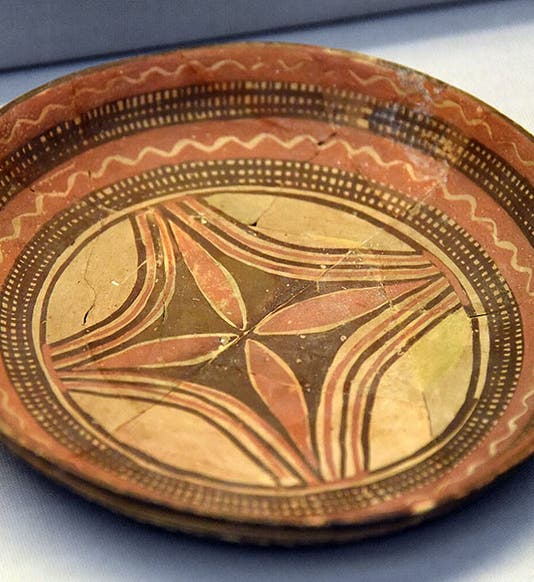
Decorated pottery plate from Tell Arpachiyah, Iraq, 5000-6000 BCE, found by Max Mallowan in 1933 and originally reassembled by Agatha Christie, British Museum (Wikimedia commons)
Agatha Christie, an English writer of mystery novels and stories, was born Sep. 15, 1890, in Torquay, Devonshire. She had a privileged upbringing, travelling extensively and writing fiction all the while, finally publishing her first mystery novel, The Mysterious Affair at Styles, in 1920, when she was 30 years old. It introduced a quirky detective, Hercule Poirot, and over a 55-year career, the two would make each other as famous as a writer and fictional character can be.

Agatha Christie in the garb of the British Red Cross, photograph, 1915; one year later, she would finish writing her first mystery novel featuring Hercule Poirot (Wikimedia commons)
Christie had married in 1914, had a daughter, and then, in 1926, she became quite ill, lost her mother, was asked for a divorce by her husband, and mysteriously disappeared for 11 days, but she emerged from that series of ordeals as a stronger and more determined woman. She decided she wanted to go by herself to Baghdad, and chose to do so on the Orient Express, with a stop in Istanbul and a long bus ride across the Syrian desert. Once in Baghdad, she set her sights on a visit to the excavations at Ur, up the Euphrates, about whose director, Leonard Wooley, she had read in the Times of London. What she did not know was that Katherine, Leonard’s wife, was a new fan, having just read The Murder of Roger Ackroyd (1926), and she ensured that Leonard give Agatha the VIP treatment. Christe saw a dig the way few visitors do, and she was hooked on archaeology for life.

Agatha Christie and Max Mallowan, photograph, 1950, National Portrait Gallery, London (Wikimedia commons)
Christie was invited back to Ur by the Wooleys in 1930, where she met their new assistant, Max Mallowan. They fell in love rather quickly and were married later that same year. Soon Christie was a regular member of the annual digs, beginning in Nineveh, where Henry Layard, a hero of Mallowan, had first excavated a century earlier.

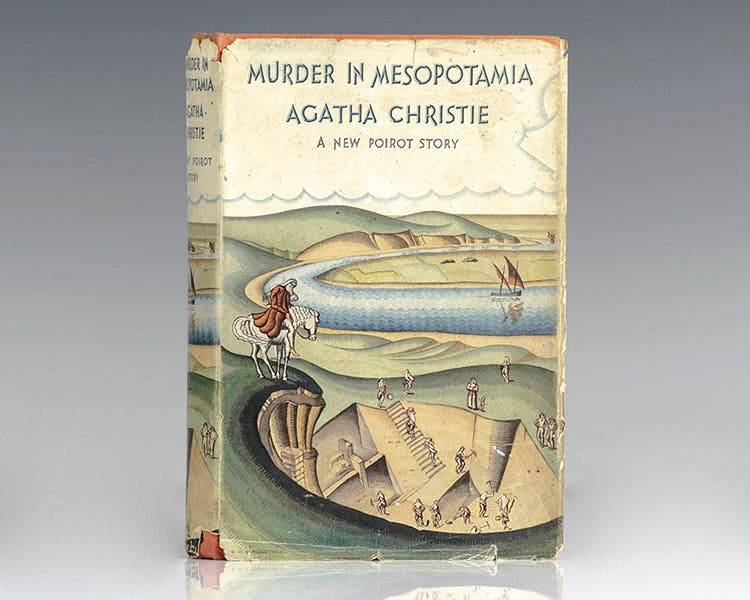
Dust jacket, Murder in Mesopotamia, by Agatha Christie, first edition, 1936, offered for sale by Raptis Rare Books (raptisrarebooks.com)
Mallowan’s (and Christie’s) first big discovery came at Tel Arpachiyah, a tiny mound (a “pimple,” Christie called it in her Autobiography), which proved to be over 6000 years old, and which contained the most exquisite pottery, predating that of Nineveh by several thousand years. Mallowan found what he thought was a potter’s shop, which had burned and collapsed, breaking but preserving the pottery within, which Christie then reassembled. One of the pieces from Arpachiyah that she described, with its floral center, looks very much like our first image, now in the British Museum.

Lioness killing a man, Nimrud ivory found by Max Mallowan at Mosul, 1954, and described by Agatha Christie in her Autobiography, British Museum (Wikimedia commons)
Christie’s Autobiography is exciting to read, if you are looking for archaeological stories, but it is almost totally devoid of dates, and is out of order chronologically, in a way no biography, auto- or not, should be. After recounting her enthusiasm for the pots at Arpachiyah, Christie talks about ivories from Nimrud, and how she cleaned them as fast as Max could dig them up, using her cold cream as a cleanser and orange sticks and dental picks as implements. Little does one realize, unless you already knew, that Max’s excavation at Nimrud came 20 years later, well after World War II. But she does recount cleaning a pair of carved and gilded ivories, depicting a lion about to eat a man. These happen to be, now, the most famous of the “Nimrud ivories;” one is in the museum in Baghdad, the other, the one we show here (fifth image), is in the British Museum.
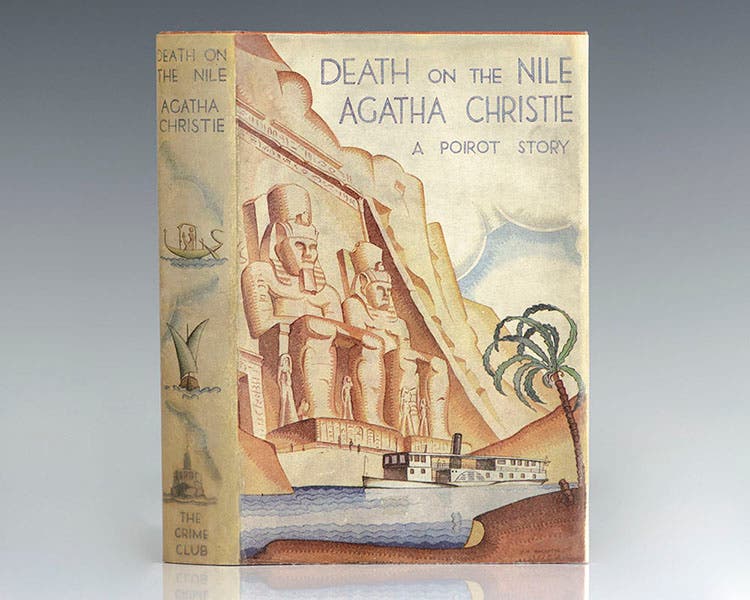
Dust jacket, Death on the Nile, by Agatha Christie, first edition, 1937, offered for sale by Raptis Rare Books (raptisrarebooks.com)
Christie’s lifelong exposure to travel and archaeology doesn’t show up in her fiction as much as one might want, although her travels certainly shaped Murder on the Orient Express (1934) and Death on the Nile (1937; last image). It is said that archaeology plays a more important role in Murder in Mesopotamia (fourth image), however, I have not yet found a copy and have not read it. But I did enjoy Christie’s Autobiography, despite her disdain for dates and chronology, because her insights on people are just delightful. Her description of the imperious ways of Katherine Wooley are often quoted in discussions of the Wooleys, and you should look them up. Better yet, find a copy of her Autobiography and dive in. The copy I have has a full index, so you can find her thoughts on anything you can spell, which might not include Arpachiyah.

Gravestone of Agatha Christie and Max Mallowan, Church of St. Mary, Cholsey, Oxfordshire (Wikimedia commons)
Agatha Christie died in 1976, at the age of 85, and her husband Max two years later. They share a grave at the Church of St. Mary, Cholsey, Oxfordshire (last image).
William B. Ashworth, Jr., Consultant for the History of Science, Linda Hall Library and Associate Professor emeritus, Department of History, University of Missouri-Kansas City. Comments or corrections are welcome; please direct to ashworthw@umkc.edu.