Scientist of the Day - Eudoxus of Cnidus

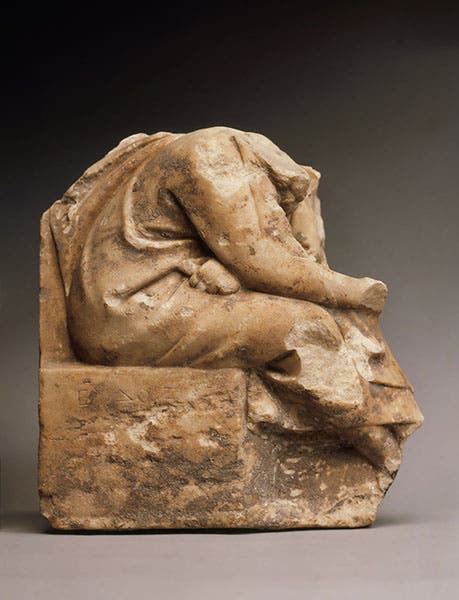
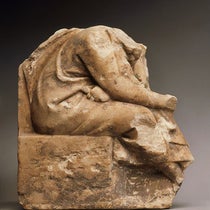
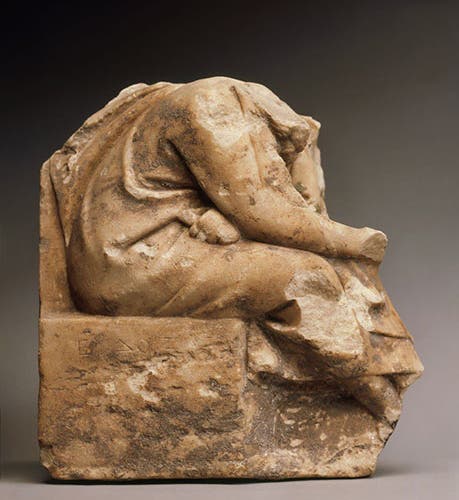
Headless statue of Eudoxus of Cnidus, Roman, Museum of Fine Arts, Budapest (mfab.hu)
Eudoxus of Cnidus, a Greek astronomer and mathematical modeler, was born about 390 BCE in the port city of Cnidus on the southwest corner of Anatolia, modern day Turkey. Eudoxus was about 30 years younger than Plato and about 10 years older than Aristotle.
Eudoxus got his education on the hoof, studying with Archytas of Tarentum in southern Italy, down in Pythagorean country. He studied astronomy in Egypt, and then travelled north to Cyzicus, in northwestern Anatolia, on the Sea of Marmara, where he set up his own school while still a young man.
The key move came when he travelled to Athens to attend the Academy of Plato. Plato had adopted a cosmology that had the planets arranged on spheres which rotated uniformly around the Earth. It was a harmonious system, but it did not conform to experience. The motion of the planets as seen from earth is irregular; they speed up, slow down, and five of them (excepting Sun and Moon) occasionally seem to move backward in their annual motion. Supposedly, Plato called for someone to "save the appearances" – account for the irregularities with a system of uniform circular motion. Eudoxus would do just that.
Eudoxus proposed a model of three or four nested concentric spheres, one nest for each of the seven planetary bodies. Each sphere rotated about a different axis. The motion of the Moon, for example, could be accounted for with three nested spheres; the outermost, on an axis pointed north, rotated once a day and accounted for the daily motion. The sphere inside it, no. 2, rotated once a month on an axis inclined 23º to the first, and accounted for the Moon’s monthly passage through the zodiac belt. But since the moon moves north and south of the ecliptic by about 5º each month, a third sphere is needed inside the second, rotating on an axis inclined 5º to the second. The Moon itself is then attached to the equator of the third sphere. Rotate all three spheres at the proper rates, and the model moon will reproduce, more or less, the motion of the Moon in the heavens.

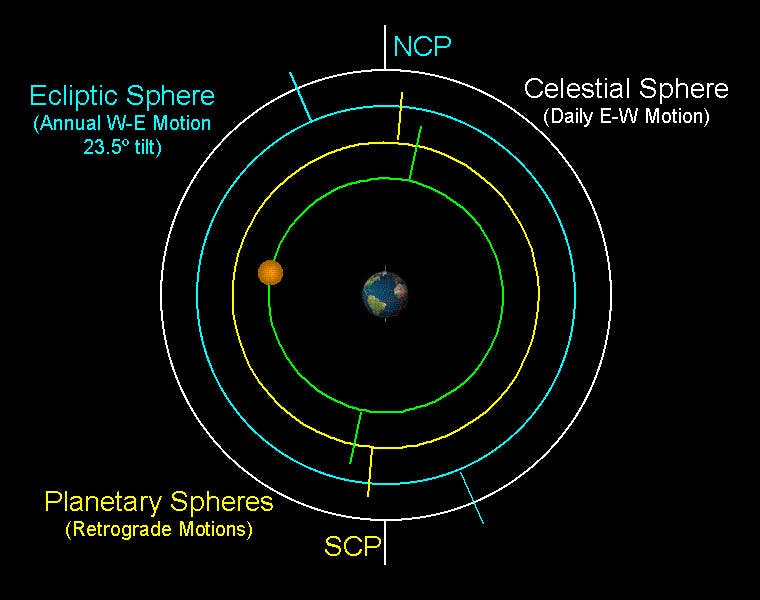
Diagram demonstrating the concentric-sphere model of Eudoxus for the planet Mars, copyright Richard W. Pogge (astronomy.ohio-state.edu)
The motion of the planets was a little tougher to model, because of the occasional periods of "retrograde motion," where they appear to go backwards against the stars, before resuming their normal forward motion. This Eudoxus was able to reproduce with 2 interior spheres, rotating on axes inclined 90º to the second sphere, but with opposite rotations (second image). Amazingly, in a very general way, it works.
Eudoxus’s seven models required 26 spheres in total, plus one for the stars, or 27 spheres in all. It was a remarkable moment in the history of cosmology, the first time ever, anywhere, that someone had tried to account for planetary motion with a mathematical model. Aristotle, who studied with Plato at the same time as Eudoxus, used the Eudoxean spheres as the basis for his own cosmology, although unlike Eudoxus, he tried to nest them, which meant he had to add many extra spheres to "unwind " the motion of the outer spheres, making a rather messy, and indeed impossible, mechanical planetary machinery. But that was not the fault of Eudoxus.
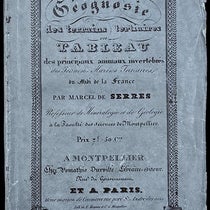
Eudoxus wrote several books, one on his spheres, but the books do not survive. However, his treatise on the stars, Phenomena, inspired Aratus of Soli to write a similar treatise, with the same title, and the 2nd-century BCE astronomer Hipparchus wrote a commentary on Aratus, in which he quoted a little from Eudoxus, so there is something. Our library has a 1567 Florentine edition of The Commentary of Hipparchus, which mentions Eudoxus on the title page (third image).

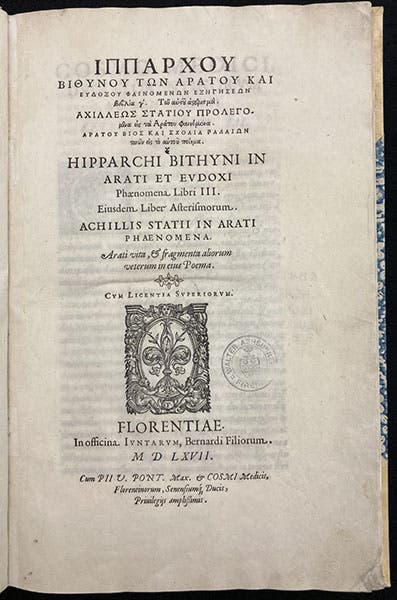
Title page, Hipparchi Bithyni in Arati et Eudoxi Phaenomena libri III, 1567 (The Linda Hall)
Eudoxus, later on, left his school in Cyzicus and returned to his hometown of Cnidus, where he lived out his life and died about 340 BCE. Only one statue, headless, but purporting to depict Eudoxus, is known, in the Museum of Fine Arts in Budapest. Their documentation does not indicate why it is thought to show Eudoxus. But since we have such a paucity of images for Eudoxus, we include it here (first image).
Eudoxus is discussed in most texts on ancient Greek astronomy and cosmology, but I would recommend The Mechanical Hypothesis in Ancient Greek Natural Philosophy, by Sylvia Berryman (2009), which discusses Archytas in some detail and places Eudoxus into the Greek tradition in mechanics.
William B. Ashworth, Jr., Consultant for the History of Science, Linda Hall Library and Associate Professor emeritus, Department of History, University of Missouri-Kansas City. Comments or corrections are welcome; please direct to ashworthw@umkc.edu.