Scientist of the Day - André Thevet

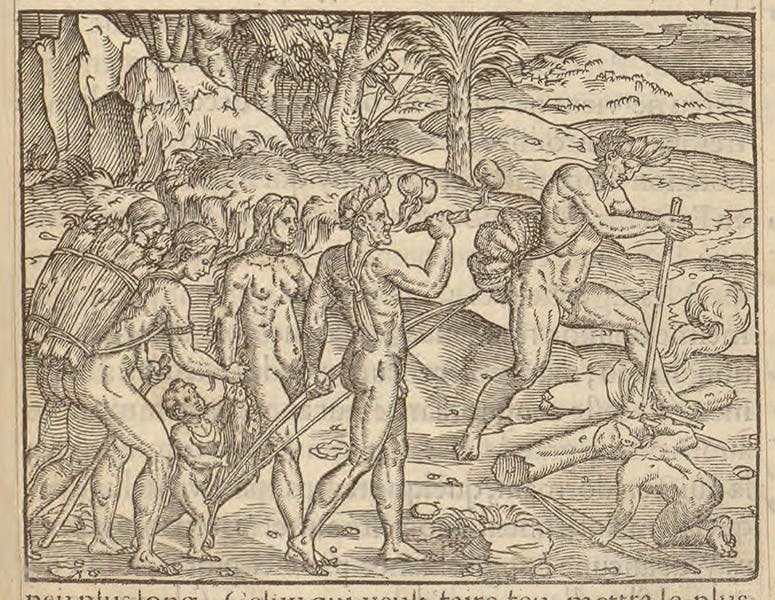
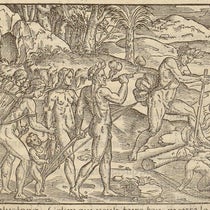
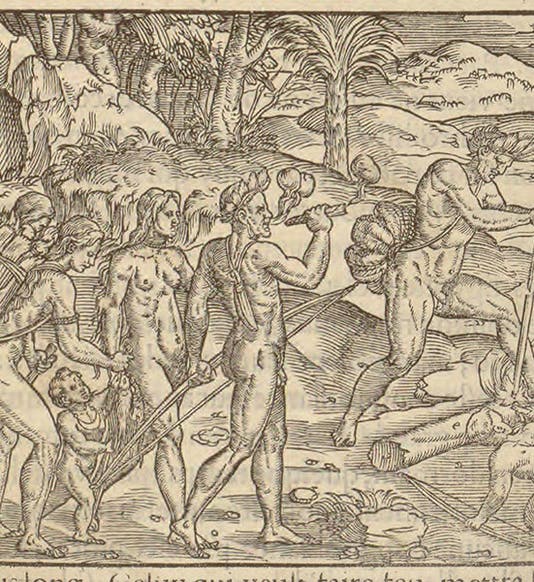
Natives smoking tobacco, woodcut, Les singularitez de la France antarctique, by André Thevet, p. 101, 1557 (loc.gov)
André Thevet, a French Franciscan traveler and cosmographer, died on Nov. 23, 1590, in Paris. The notion of being a priest was not his idea, and he spent little time saving souls. He somehow attracted patrons, who paid for his education and an extended trip through the Middle East, which resulted in his first book, a cosmography of the Levant. In 1555, he traveled to Brazil with a French colonizing expedition. He stayed less than three months, but on his return, he wrote and published Les singularitez de la France antarctique (1557), which was an extremely influential book about Brazil and its native inhabitants and fauna. It was abundantly illustrated with woodcuts depicting animals like the sloth; new plants like the pineapple; and rich scenes of the Tupinamba natives smoking tobacco, and capturing, cooking, and devouring their foes. The book was so popular that Christoph Plantin published an edition in Antwerp in 1558, with a completely new set of woodcuts (if a Thevet sloth is facing left, it is from the Plantin edition).

Portrait, of André Thevet, engraving ca 1550, original source unknown (Wikimedia commons)

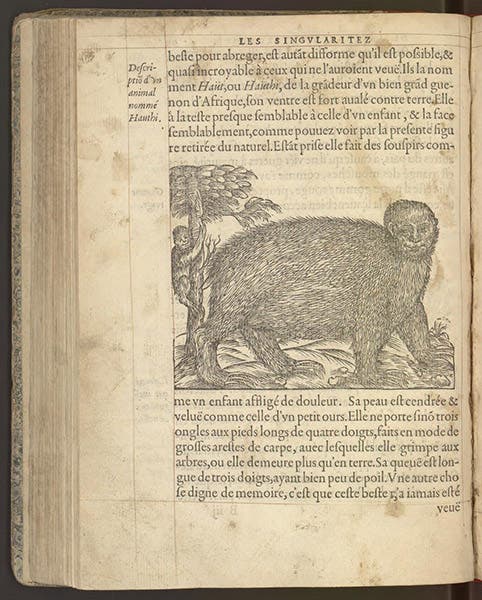
Sloth, woodcut, Les singularitez de la France antarctique, by André Thevet, p. 99v, 1557 (loc.gov)
Much of the information in Thevet's Singularitez was pirated from other accounts, published and unpublished, but that did not take away from its impact. Conrad Gessner had already published the quadruped volume of his History of Animals (1551), but when he came to issuing a German version, Thierbuch (1563), he included the sloth, and he put Thevet's su, an imaginary animal inspired perhaps by a great anteater, right on the title page as a decorative vignette.

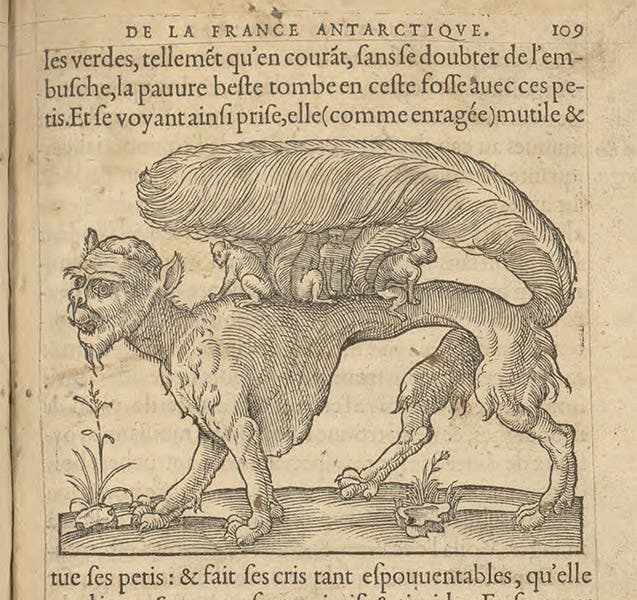
Su, woodcut, Les singularitez de la France antarctique, by André Thevet, p. 109r, 1557 (loc.gov)

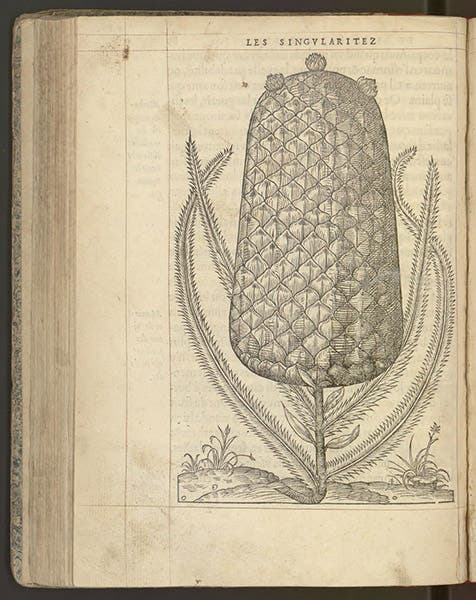
Pineapple, woodcut, Les singularitez de la France antarctique, by André Thevet, p. 89v, 1557 (loc.gov)
We do not have a copy of Thevet's Singularitez, and probably never will, since it is considered an early piece of "Americana" and fetches high prices when it sells. It would be very nice to have. The copy shown here is in the Library of Congress; it has been beautifully ruled in red.
Thevet published a universal cosmography in 1575, which we do not own either. I have seen a copy, and it is a lovely book, a thick folio, which shows the New World animals in scenes, like the tobacco smokers of 1557, rather than in isolation. It too would be nice to own.

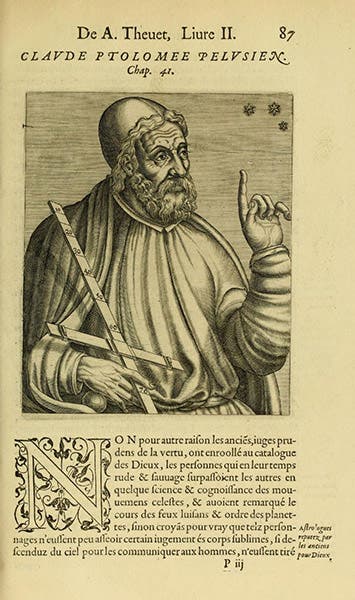
Portrait of Ptolemy of Alexandria, engraving, Les vrais pourtraits et vies des hommes illustres, by André Thevet, vol. 1, p. 87r, 1584 (archive.org)
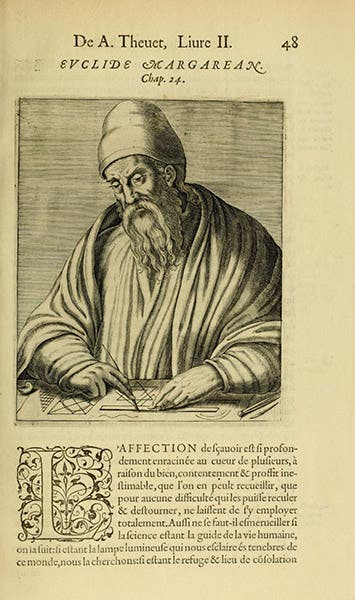
Portrait of Euclid of Alexandria, engraving, Les vrais pourtraits et vies des hommes illustres, by André Thevet, vol. 1, p. 48r, 1584 (archive.org)
A third book that Thevet compiled, an illustrated biographical encyclopedia, is also missing from our collections. His Vrais pourtraits (True Portraits, 1584) is one of three important portrait books, published in the last two decades of the 16th century, that include scientists. The others are Jean-Jacques Boissard’s Icones (1597-99) with engraved portraits by Johann Theodor de Bry, and Nikolaus Reusner's Icones (1590), with woodcuts by an unknown artisan. We have both in our collections and use them often to illustrate these essays. See, for example, our post on Albertus Magnus, which uses both.

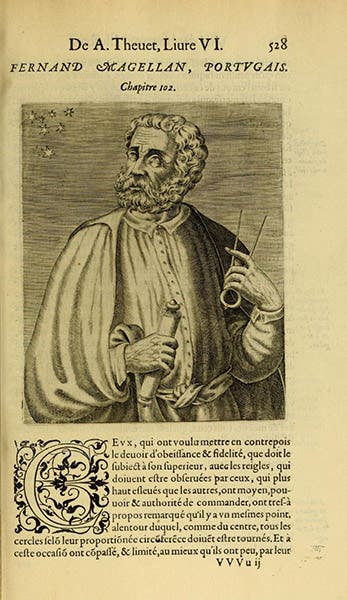
Portrait of Ferdinand Magellan, engraving, Les vrais pourtraits et vies des hommes illustres, by André Thevet, vol. 3, p. 528r, 1584 (archive.org)
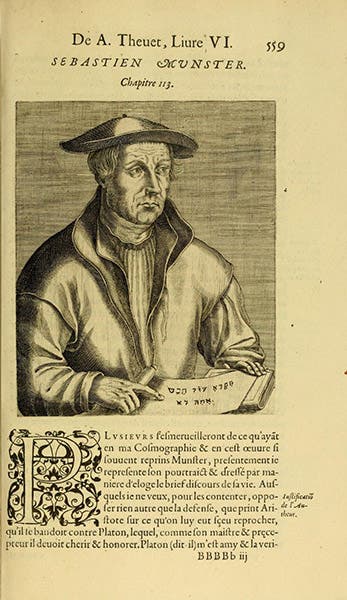
Portrait of Sebastian Munster, engraving, Les vrais pourtraits et vies des hommes illustres, by André Thevet, vol. 3, p. 559r, 1584 (archive.org)
Thevet's True Portraits is the most comprehensive of the three, with over 230 engraved portraits, and it is unfortunate that we do not have a copy. I feel the lack keenly at times, for there are individuals illustrated in Thevet, such as Sacrobosco, and Euclid of Alexandria, who are not depicted in our other collections. Thevet's True Portraits has engravings of Pliny the Elder, Archimedes, Ptolemy of Alexandia, Dioscorides, Vespucci, Magellan, even the Venerable Bede, which I could have used when I did a post on Bede (as I could have used the Sacrobosco in our post on him). The examples here are from a copy at Boston Public Library, available online at archive.org, although the pages have unfortunately been cropped and color-corrected, unlike the Library of Congress scans, which are full-page and perfect. Interestingly, Thevet has no portraits of contemporary scientists, such as Copernicus and Vesalius, the one exception being Sebastian Munster, but he is probably included because he was a cosmographer. Otherwise, only navigators, like Magellan, made the cut.
Our want list at the Library is a long one, but the two books by Thevet discussed here are near the top.
William B. Ashworth, Jr., Consultant for the History of Science, Linda Hall Library and Associate Professor emeritus, Department of History, University of Missouri-Kansas City. Comments or corrections are welcome; please direct to ashworthw@umkc.edu