Scientist of the Day - William Jessop

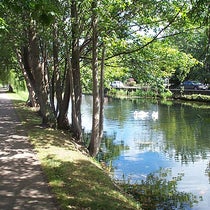
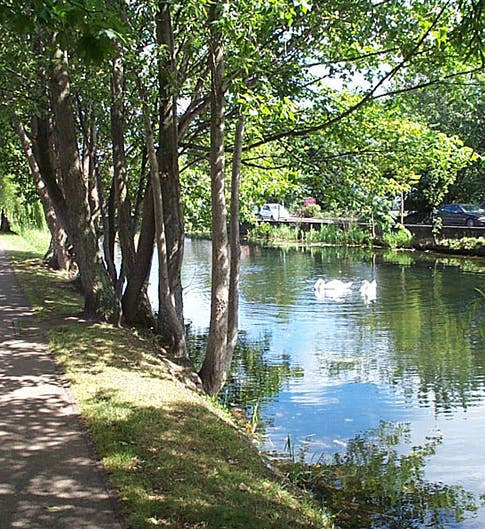
Section of the Grand Canal in Dublin, engineered by William Jessop, completed by others in 1804 (Wikimedia commons)
William Jessop, an English civil engineer, died on Nov. 18, 1814, at his home, Butterley Hall, in Derbyshire, at the age of 69. He was born on Jan. 23, 1745, in Devonport, near Plymouth. His father, Josias, was the keeper of the second Eddystone lighthouse, a wooden structure, off the coast of Plymouth. When it burned down in 1755, John Smeaton was asked to design a stone replacement, the construction of which was overseen by Josias, and it was in operation by 1759. Young William was 14 years old at the time. When Josias died two years later, Smeaton took on William as an apprentice (and ward), and Jessop learned at the side of the man who is usually called England’s first civil engineer. Smeaton soon turned to building canals, and Jessop went with him to Yorkshire and Scotland to lay out and dig two early canal systems. Jessop was a natural at canal design and construction and made it his lifelong vocation

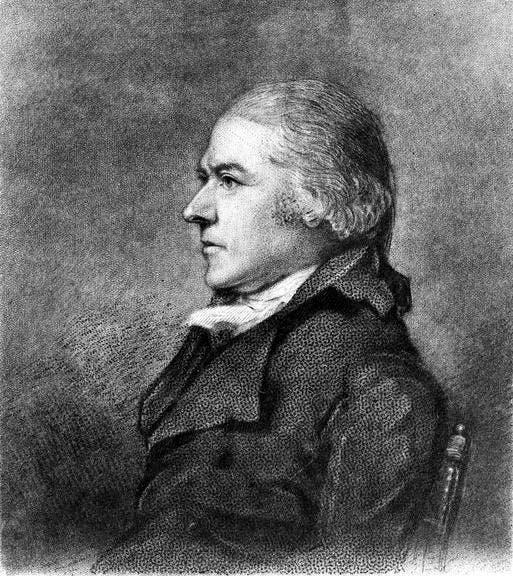
Portrait of William Jessop, engraving, undated, Science Museum, London (sciencemuseumgroup.org.uk)
The era from roughly 1780 to 1800 is referred to as a time of “canal mania,” as canals were dug everywhere and share offerings were subscribed immediately. They were usually organized and financed by private companies and individuals, authorized by an Act of Parliament. The builders of the first canals in the 1760s were not engineers and seldom measured things like flow rates or clay content of the soil. That all changed with Smeaton and then with Jessop. Smeaton was called to Ireland in the 1770s by authorities who wanted to dig a canal (or two canals, as it turned out) from Dublin on the east coast, to the River Shannon, which connected to Limerick on the west coast. Smeaton took Jessop with him, and then, since he was getting too old for field work, he turned the entire project over to Jessop. The main obstacle was an immense pest bog, the bog of Allen, that stood in the way. Jessop figured out a way to run a canal across it, by cutting drainage ditches on either side, and slowly making them deeper, to dry the soil enough to allow a shallow cut and support a build-on-top canal. The Grand Canal, and its mate to the north, the Royal Canal, were a great success, and Jessop was soon in demand everywhere.

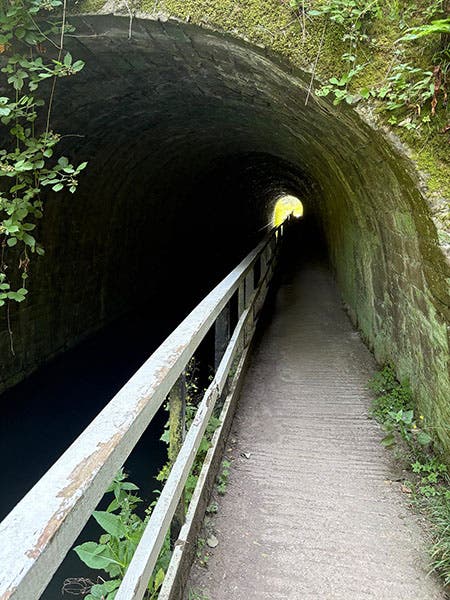
One of the tunnels on the Cromford Canal in Derbyshire, completed by Jessop in 1794, modern photograph, Tripadvisor (tripadvisor.com)
In England, Jessop was engineer in charge of the Grand Junction Canal project, which would connect the Thames west of London with the Midlands, where much of England's manufacturing took place. This was difficult, because of the low mountains in between, which required either extensive lock systems to raise and lower the canal, or long tunnels. Tunnels were the easier solution on paper, and there were two of them on the route of the Grand Junction, but they proved to be a problem, and Jessop grew to hate tunnels. The problem with locks is that they slow traffic down, and they require lots of water, which meant building reservoirs, and calculating water needs very accurately. A canal that lacks water in the dry season is no good to anyone. Jessop was very good at this part of the business, and good at persuading directors that he was right, which he usually was.

West India Docks, painting, 1802, designed and built by William Jessop, 1800-02 (Wikimedia commons)
Jessop's canals were different from the early canals in that they accommodated boats 14 feet wide, twice the width of the narrow-boat canals with which the canal boom started. Jessop's canals were more expensive to build and maintain, but they did not go obsolete for shipping like the narrowboat canals quickly did.

Map of the West India Docks and the Isle of Dogs, 1899; London is just to the right; the Thames flows right to left; the third dock at the bottom was originally a canal in Jessop’s plan (Wikimedia commons)
One of Jessop's most impressive projects was the design and building of the West India Docks on the Isle of Dogs at a U-bend in the Thames east of London. This involved dredging estuaries for both incoming and outgoing ships, and building massive warehouses for unloaded goods, all the while allowing controlled traffic in and out of the Thames. It is said to have been the most massive construction project anywhere in Europe in early modern times, and it came in nearly on schedule in 1804, with Jessop in charge.

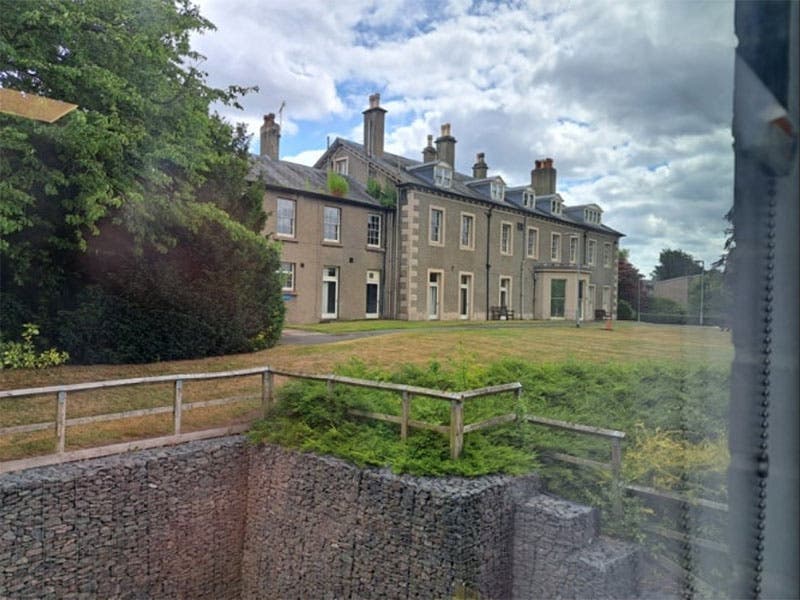
Butterley Hall, Jessop‘s home in Ripley, Derbyshire, where he died in 1814, recent photograph (historicengland.org.uk)
Jessop, like Smeaton, also trained the next generation of civil engineers, men like Thomas Telford and John Rennie, who are much better known today, because they built bridges that still stand, and because canals were soon eclipsed by railways. Jessop's reputation was not bolstered by his modesty, or by the fact that his heirs refused to allow historians and interested engineers access to his papers, to see how Jessop did things. In fact, we don't know to this day what happened to all his diaries and workbooks. As a result, it has been hard to write a proper biography. We have only one, William Jessop, Engineer (1979), by Charles Hadfield and A.W. Skempton, which was professionally compiled, but cannot provide much insight into Jessop's character and personality, except as observed by others. He was by those accounts respected and trusted by all his colleagues and employers, and his honesty and modesty was mentioned by all commentators. He deserves a bust or a statue somewhere, preferably along a canal that is now a route for pleasure boats, where he would be seen. We have 4 surviving portraits, some of them just sketches, but surely enough for a likeness in three dimensions.
William B. Ashworth, Jr., Consultant for the History of Science, Linda Hall Library and Associate Professor emeritus, Department of History, University of Missouri-Kansas City. Comments or corrections are welcome; please direct to ashworthw@umkc.edu.