Scientist of the Day - 26-Inch USNO Refractor

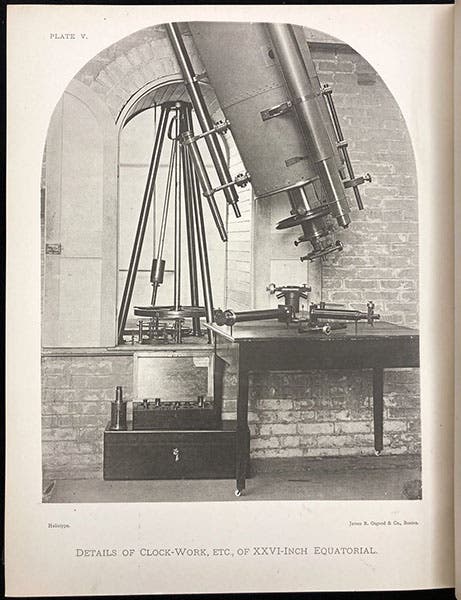
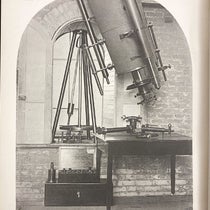
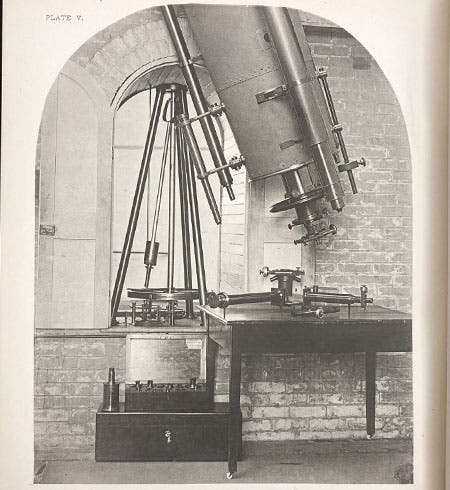
The clockwork dive for the 26-inch refractor at the U.S. Naval Observatory, built by Alvan Clark & Sons, 1873, heliotype in Washington Astronomical Observations, plate 5 at end, 1874 (publ. 1877) (The Linda Hall)
The 26-inch refractor at the United States Naval Observatory (USNO), the largest telescope in the world at the time, saw its "first light," as astronomers like to put it, on Nov. 12, 1873. The USNO had been built in 1842, designed by James Gillis, who also outfitted the observatory with instruments from Europe. The largest instrument for several decades was a 9-inch refractor. The Old Observatory, as it is now called, was located in an area just north of the Lincoln Memorial, called Foggy Bottom. If this sounds like an odd site for an observatory, you are right, and they would move it in 1893, but first, today's story.

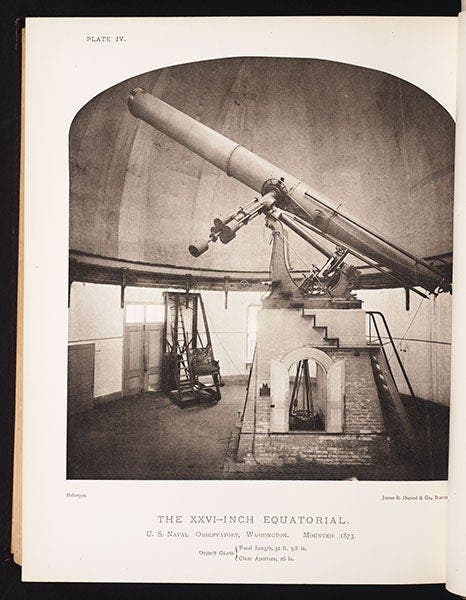
The 26-inch refractor at the U.S. Naval Observatory, built by Alvan Clark & Sons, 1873, heliotype in Washington Astronomical Observations, plate 4 at end, 1874 (publ. 1877) (The Linda Hall)
In 1870, Congress appropriated $55,000 for a new telescope, mounting, and dome. The Superintendent, Benjamin Sands, turned to Alvan Clark in Cambridge, Mass., who, with his two sons, had built an 18.5-inch refractor for the University of Mississippi that ended up at Dearborn Observatory in Chicago (a refractor is a telescope that uses lenses, unlike a reflector, which has a mirror as its light-gathering element). The Clarks were geared up to build the Next Big Thing, a 26-inch monster, 40 feet long, with two giant lenses, coupled to produce images without color distortion (chromatic aberration).

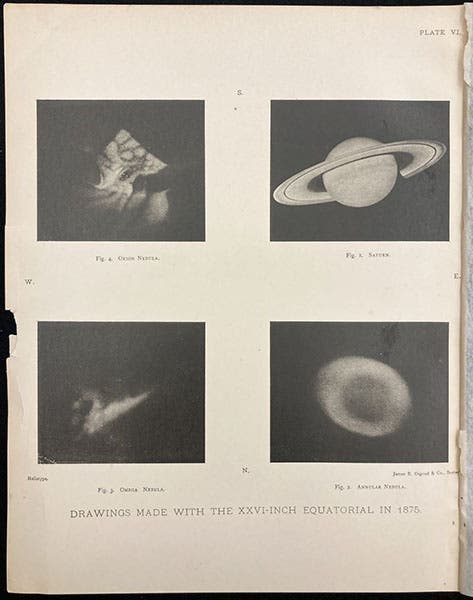
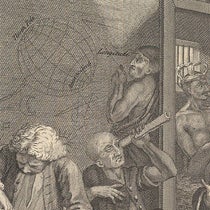
Drawings of Saturn and the Orion and Lyra nebulas, by Etienne Trouvelot, 1875, using the 26-inch USNO refractor, heliotype in Washington Astronomical Observations, plate 6 at end, 1874 publ. 1877) (The Linda Hall)
The new telescope was a big hit with USNO astronomers, who included Simon Newcomb and Edward Holden at the time, but it made world headlines just four years later, when junior astronomer Asaph Hall used the new refractor to discover two new moons of Mars, on Aug. 11 and Aug. 17, 1877. Everyone had been confident for centuries that Mars must have moons, probably two, since Earth had one and Jupiter had four, and surely the mean planet had a mean number of moons. But no one had been able to see moons around Mars with the telescopes available.

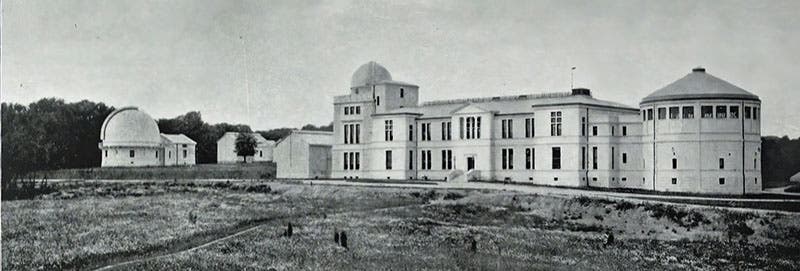
The Old Naval Observatory in Foggy Bottom, in Washington, D.C., not far from the Lincoln Memorial; the large dome at left was built to house the 26-inch Clark refractor (cnmoc.usff.navy.mil)
Hall was as sure as anyone that Mars had moons, and it is said that he waited until Newcomb and Holden were out of town to go looking for them, so he would not have to share the discovery. He spotted the first moon right away, but bad seeing in Foggy Bottom kept him from confirming the discovery until Aug. 17, at which time Hall also spotted a second moon. Both were very small and very close to Mars. They were soon named Phobos and Deimos, Fear and Terror. We told the story of their discovery more fully in a post on Hall. And we discussed the predecessor to the 26-inch USNO refractor, the 18.5-inch Clark Dearborn refractor, in our post on Alvan Graham Clark. In our recent post on Holden, we noted that Holden later claimed to have found a third moon of Mars, but his observations were spurious, and he was ridiculed for many years for his faux pas.
The first several times I mentioned the USNO refractor in these posts, I used a photo of the grand old instrument provided by the USNO on their website. It wasn't until later that I discovered that we have the original print, a heliotype, in our Government Documents Collection, and several others which we show here for the first time (first and third images). They first appeared in Astronomical and Meteorological Observations made during the Year 1874 at the United States Naval Observatory (1877); the series is often called Washington Astronomical Observations for short.

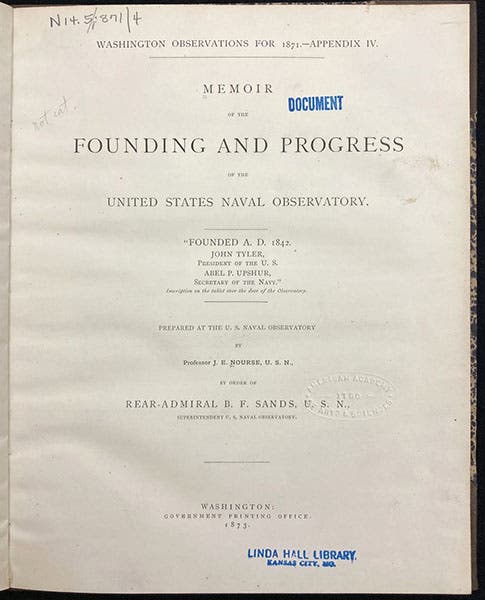
Title page, Memoir of the Founding and Progress of the United States Naval Observatory, by J. E. Nourse, 1873 (The Linda Hall)
There are many informational treasures in the Documents Collection that often get overlooked, since they are not as well indexed as the serials. I show the title page of one which has much useful information on the first 30 years of the USNO, Memoir of the Founding and Progress of the United States Naval Observatory, by J. E. Nourse (1873; last image).
The 26-inch refractor was moved in 1893 to a better site in Georgetown, where it is still in use. It was joined by a late-arriving big brother in 1934, a 40-inch reflector, but that was later moved to Tucson.
William B. Ashworth, Jr., Consultant for the History of Science, Linda Hall Library and Associate Professor emeritus, Department of History, University of Missouri-Kansas City. Comments or corrections are welcome; please direct to ashworthw@umkc.edu.